One life, filed into five areas, kept on paper, published here.
Zach Phillips
Ten Things the PEN Has Done
I believe this is officially the 26th week in a row that I’ve sent out a Personal Email Newsletter (PEN) to a little over 100 people. Here’s this week’s: https://pen.zachphillips.blog/p/2021-week-4-six-months-straight
And here are 10 things this insignificant little weekly ritual has done for me. 👇
-
The PEN has kept me connected to people I care about in a way that I can control.
-
The PEN has reconnected me with many people I haven’t spoken with in years.
-
The PEN has gotten me into a regular publishing habit that feels more and more effortless. I’m now publishing an average of 500+ words a day and even adding some videos/more to come.
-
The PEN has given me a low-pressure way to reconnect with the simple creative act of making something and sharing it. I cannot express just how valuable this is, not just for my personal artistic aspirations, but for my professional aspirations too.
-
The PEN has allowed me to live more in line with my values. I tell people (customers and others) all the time about the importance of putting their thoughts, ideas, and expertise out there. Now I can begin to actually stand behind those recommendations with personal experience.
-
The PEN has seeded the beginning of a library of my thoughts, ideas, and expertise that every third day I am now pulling from to add to conversations, help someone out, or start something new.
-
The PEN has made me trust myself, that I can actually do the things I’ve committed TO MYSELF to do, not just those things I’ve committed to others to do.
-
The PEN has made pretty much everything else in my life easier. I’m no longer feeling frustrated or mentally absent from this magical period of my life with little kids and everything nascent/growing. I’m even working out every day and doing my jobby-jobs better.
-
The PEN has turned the Dread knob at least 5 clicks to the left and the Hope knob at least 5 clicks to the right.
-
The PEN has made me regularly happier than I have felt in some time.
Thanks to @fortelabs, @david_perell, and all the Second-Brainers and WOPpers who gave me the kick to get started.
If you want to come along for the journey and sometimes see cute pictures of my kids, you can sign up at pen.zachphillips.blog.
Summary
I believe this is officially the 26th week in a row that I’ve sent out a Personal Email Newsletter (PEN) to a little over 100 people. Here’s this week’s: https://pen.zachphillips.blog/p/2021-week-4-six-months-straight
And here are 10 things this insignificant little weekly ritual has done for me. 👇
-
The PEN has kept me connected to people I care about in a way that I can control.
-
The PEN has reconnected me with many people I haven’t spoken with in years.
-
The PEN has gotten me into a regular publishing habit that feels more and more effortless. I’m now publishing an average of 500+ words a day and even adding some videos/more to come.
-
The PEN has given me a low-pressure way to reconnect with the simple creative act of making something and sharing it. I cannot express just how valuable this is, not just for my personal artistic aspirations, but for my professional aspirations too.
-
The PEN has allowed me to live more in line with my values. I tell people (customers and others) all the time about the importance of putting their thoughts, ideas, and expertise out there. Now I can begin to actually stand behind those recommendations with personal experience.
-
The PEN has seeded the beginning of a library of my thoughts, ideas, and expertise that every third day I am now pulling from to add to conversations, help someone out, or start something new.
-
The PEN has made me trust myself, that I can actually do the things I’ve committed TO MYSELF to do, not just those things I’ve committed to others to do.
-
The PEN has made pretty much everything else in my life easier. I’m no longer feeling frustrated or mentally absent from this magical period of my life with little kids and everything nascent/growing. I’m even working out every day and doing my jobby-jobs better.
-
The PEN has turned the Dread knob at least 5 clicks to the left and the Hope knob at least 5 clicks to the right.
-
The PEN has made me regularly happier than I have felt in some time.
Thanks to @fortelabs, @david_perell, and all the Second-Brainers and WOPpers who gave me the kick to get started.
If you want to come along for the journey and sometimes see cute pictures of my kids, you can sign up at pen.zachphillips.blog.
Why I’m Not A Programmer
This morning I was reminded why I quit software development 5 years ago. My experience, always:
“Let’s do this!”
(5 mins) “I’m actually making this thing!”
(6 mins) smash into pain wall
(28 hrs no sleep, eating, lose touch with everyone/everything I love) “It works!”
Repeat. 👇
The Eureka at the end was always the greatest feeling, but I never found a way past that middle part, even after years of experience.
I consider that experience to be the Flow State’s evil twin. It’s SORT OF like Flow (lose all sense of self, dive deep) but just very, very bad.
Another thing I always hated about programming: There’s ALWAYS another deeper layer of abstraction to remove, and that moving-between-layers-of-abstraction is the ONE thing that programmers, for whatever reason, never communicate to each other, even when trying to be helpful.
A thing that hangs up a programming task is far more likely to be a simple misunderstanding about how a shell interprets a certain command in this mode a missing curly brace, not the figuring out of the real problem.
Constantly getting hung up on dumb shit made it excruciating.
Now, I may simply have learned to program wrong. I may not have a mind for it. I may have just never crossed the rubicon where things start to trend easier (I tried hard…).
Or I may just be so obsessive that I don’t switch enough to pursue a different way to the same place.
Anyway, as I was writing this thread, with the help of my friend and colleague Carlos, I figured out how to get this node task working to control an external video switcher via the serial port.
The feeling is really good. But I burned up my whole morning worried about this shit.
I will continue to stick to designing things, writing stories, and coming up with ideas, but build them in software, I will not. At least not in current programming environments.
Thank God for Carlos and all you superstars like him.
Summary
This morning I was reminded why I quit software development 5 years ago. My experience, always:
“Let’s do this!”
(5 mins) “I’m actually making this thing!”
(6 mins) smash into pain wall
(28 hrs no sleep, eating, lose touch with everyone/everything I love) “It works!”
Repeat. 👇
The Eureka at the end was always the greatest feeling, but I never found a way past that middle part, even after years of experience.
I consider that experience to be the Flow State’s evil twin. It’s SORT OF like Flow (lose all sense of self, dive deep) but just very, very bad.
Another thing I always hated about programming: There’s ALWAYS another deeper layer of abstraction to remove, and that moving-between-layers-of-abstraction is the ONE thing that programmers, for whatever reason, never communicate to each other, even when trying to be helpful.
A thing that hangs up a programming task is far more likely to be a simple misunderstanding about how a shell interprets a certain command in this mode a missing curly brace, not the figuring out of the real problem.
Constantly getting hung up on dumb shit made it excruciating.
Now, I may simply have learned to program wrong. I may not have a mind for it. I may have just never crossed the rubicon where things start to trend easier (I tried hard…).
Or I may just be so obsessive that I don’t switch enough to pursue a different way to the same place.
Anyway, as I was writing this thread, with the help of my friend and colleague Carlos, I figured out how to get this node task working to control an external video switcher via the serial port.
The feeling is really good. But I burned up my whole morning worried about this shit.
I will continue to stick to designing things, writing stories, and coming up with ideas, but build them in software, I will not. At least not in current programming environments.
Thank God for Carlos and all you superstars like him.
Ashcroft Coaching Praise
Just want to take a moment to say how great it has been to meet weekly with @m_ashcroft over the past many months.
In my life, I’ve had a dozens of coaches, therapists, and mentors, each of whom has been helpful in some way.
But Michael is on to something goofy… 👇
I refuse to draw conclusions from such a small data set, but I anticipate that soon I will report some of the most dramatic, sustainable creative progress I’ve ever had in my life.
Granted, much of it has little to do with Michael’s Alexander Technique mumbo-jumbo, and yet…
I’m a guy who has basically been yelling at himself for his entire adult life, attempting to generate output: MAKE THINGS, ZACHARY, YOU KNOW HOW AND LIKE TO DO IT SO WHAT ARE YOU DOING WITH YOURSELF?!
I’m the opposite of Johnny Five from Short Circuit: I need Output.
I’ve learned dozens of skills/trades, read all the productivity books, developed nuanced opinions about the efficacy of different systems, methods, and lifehacks. I’m a very lucky guy with a great life… but I’ve been creatively unfulfilled. I wrote a bit about that here: https://zachphillips.blog/2020/08/how-i-lost-the-joy-in-creative-work
I stayed up deep into the night reading, watching, listening to the secrets of the Masters and how they were able to get their creative spark to generate real fire.
The harder I pressed, the less I actually created and the worse I felt.
This is similar to my experience with addiction (18 years sober). The harder I tried to NOT do drugs (which I wanted more than anything), the more drugs I did, until it almost killed me.
The only way to stop drugs was to stop trying to not do them. Which took a LOT.
“Surrendering” to the fact that I would not be able to will myself to stop drugs took a total rearrangement of my life, psychology, spiritual shit… but more than a decade later, I guess I never considered that the same approach could be taken to my “VERY IMPORTANT WORK.”
Then I met Michael Ashcroft, and he was talking about some shit that seemed to relate to the Buddhist meditation practice I’d been doing for some years, but he was talking about applying Non-Doing to WORK.
Huh? How can you Non-Do the Work You Must DO?
Anyway, I’m not going to make any grand declarations before all the facts are in, but it’s beginning to appear that, indeed, you not only can, but MUST (if you’re like me) Non-Do your work. And perhaps suddenly you will find yourself producing a lot. And feeling happy.
If you are sick like me in this very specific way that I appear to be sick, I can’t recommend enough that you read @m_ashcroft’s writings and take his course (even though I haven’t taken the course yet… that’s how well this shit is working for me… I don’t even need the course).
Summary
Just want to take a moment to say how great it has been to meet weekly with @m_ashcroft over the past many months.
In my life, I’ve had a dozens of coaches, therapists, and mentors, each of whom has been helpful in some way.
But Michael is on to something goofy… 👇
I refuse to draw conclusions from such a small data set, but I anticipate that soon I will report some of the most dramatic, sustainable creative progress I’ve ever had in my life.
Granted, much of it has little to do with Michael’s Alexander Technique mumbo-jumbo, and yet…
I’m a guy who has basically been yelling at himself for his entire adult life, attempting to generate output: MAKE THINGS, ZACHARY, YOU KNOW HOW AND LIKE TO DO IT SO WHAT ARE YOU DOING WITH YOURSELF?!
I’m the opposite of Johnny Five from Short Circuit: I need Output.
I’ve learned dozens of skills/trades, read all the productivity books, developed nuanced opinions about the efficacy of different systems, methods, and lifehacks. I’m a very lucky guy with a great life… but I’ve been creatively unfulfilled. I wrote a bit about that here: https://zachphillips.blog/2020/08/how-i-lost-the-joy-in-creative-work
I stayed up deep into the night reading, watching, listening to the secrets of the Masters and how they were able to get their creative spark to generate real fire.
The harder I pressed, the less I actually created and the worse I felt.
This is similar to my experience with addiction (18 years sober). The harder I tried to NOT do drugs (which I wanted more than anything), the more drugs I did, until it almost killed me.
The only way to stop drugs was to stop trying to not do them. Which took a LOT.
“Surrendering” to the fact that I would not be able to will myself to stop drugs took a total rearrangement of my life, psychology, spiritual shit… but more than a decade later, I guess I never considered that the same approach could be taken to my “VERY IMPORTANT WORK.”
Then I met Michael Ashcroft, and he was talking about some shit that seemed to relate to the Buddhist meditation practice I’d been doing for some years, but he was talking about applying Non-Doing to WORK.
Huh? How can you Non-Do the Work You Must DO?
Anyway, I’m not going to make any grand declarations before all the facts are in, but it’s beginning to appear that, indeed, you not only can, but MUST (if you’re like me) Non-Do your work. And perhaps suddenly you will find yourself producing a lot. And feeling happy.
If you are sick like me in this very specific way that I appear to be sick, I can’t recommend enough that you read @m_ashcroft’s writings and take his course (even though I haven’t taken the course yet… that’s how well this shit is working for me… I don’t even need the course).
Healthcare and Entrepreneurship
If US leaders were actually interested in talented people starting businesses, they would implement these two policies IMMEDIATELY:
-
Universal healthcare not tied to employment
-
Universal childcare
Right now, we needlessly eliminate most businesses through dumb policies. 👇
The idiotic lack of these wildly popular, zero-downside policies destroys potential jobs, INNOVAY-SHUN, and particularly scalable businesses.
Even those with the moxie and hubris and acumen to succeed in business have to hedge their bets and start non-scalable services companies.
Now, there’s nothing wrong with non-scalable services companies and many business starters (and potential ones) love the work, but in my anecdotal experience a solid percentage of them would (and have tried to) pursue more scalable concepts but couldn’t risk healthcare/family.
“But that’s what venture capital is for. Raise the money.”
91% of VC money goes to men, and 94% of VC money goes to white or Asian (17%) people. And the biggest checks always go to the same guys from the same colleges cycling through the same circuit.
“But immigrants with nothing start businesses all the time. We’re just lazy.”
Immigrants with nothing have two choices: Work the jobs Americans aren’t interested in for low wages or start businesses chosen from a proven list of formulas a la franchising.
“But real entrepreNEURRRS will take the risks necessary to succeed.”
Dude, I’m probably the riskyest risktaking riskyboy I know, but I’m not risking my children’s lives. No one should.
Hundreds of thousands of potential JAHHHB creators are stuck in a job for the healthcare.
“They shouldn’t have kids if they want to start a business!”
Go think about that and wait for the heat death of the universe.
Also, having been both a parent and a non-parent business owner, I can assure you that parents are better at business (sorry non-parents, you’re great).
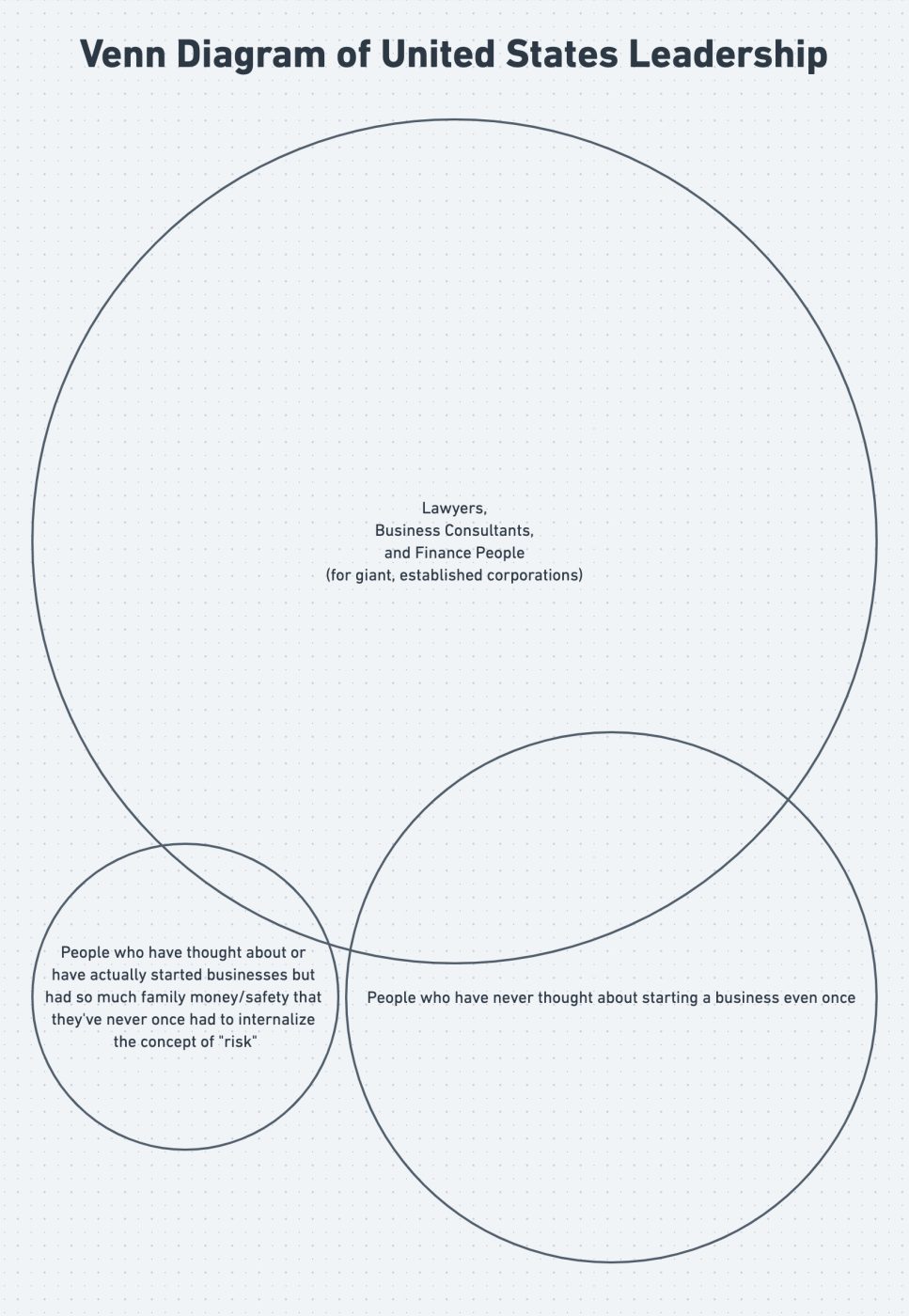
There are many reasons why US leaders will never do these obvious things, but it’s actually worse than that (and I’m giving them the benefit of the doubt): They will actually never even UNDERSTAND why they might do these things.
The Venn Diagram of US leaders looks like this.
I’m done with leaders saying that small business is important while standing in the way of everything that actually leads to more and better businesses.
Both parties are complicit. One is just shameless while the other lies through its teeth and wonders why people don’t trust it.
Summary
If US leaders were actually interested in talented people starting businesses, they would implement these two policies IMMEDIATELY:
-
Universal healthcare not tied to employment
-
Universal childcare
Right now, we needlessly eliminate most businesses through dumb policies. 👇
The idiotic lack of these wildly popular, zero-downside policies destroys potential jobs, INNOVAY-SHUN, and particularly scalable businesses.
Even those with the moxie and hubris and acumen to succeed in business have to hedge their bets and start non-scalable services companies.
Now, there’s nothing wrong with non-scalable services companies and many business starters (and potential ones) love the work, but in my anecdotal experience a solid percentage of them would (and have tried to) pursue more scalable concepts but couldn’t risk healthcare/family.
“But that’s what venture capital is for. Raise the money.”
91% of VC money goes to men, and 94% of VC money goes to white or Asian (17%) people. And the biggest checks always go to the same guys from the same colleges cycling through the same circuit.
“But immigrants with nothing start businesses all the time. We’re just lazy.”
Immigrants with nothing have two choices: Work the jobs Americans aren’t interested in for low wages or start businesses chosen from a proven list of formulas a la franchising.
“But real entrepreNEURRRS will take the risks necessary to succeed.”
Dude, I’m probably the riskyest risktaking riskyboy I know, but I’m not risking my children’s lives. No one should.
Hundreds of thousands of potential JAHHHB creators are stuck in a job for the healthcare.
“They shouldn’t have kids if they want to start a business!”
Go think about that and wait for the heat death of the universe.
Also, having been both a parent and a non-parent business owner, I can assure you that parents are better at business (sorry non-parents, you’re great).
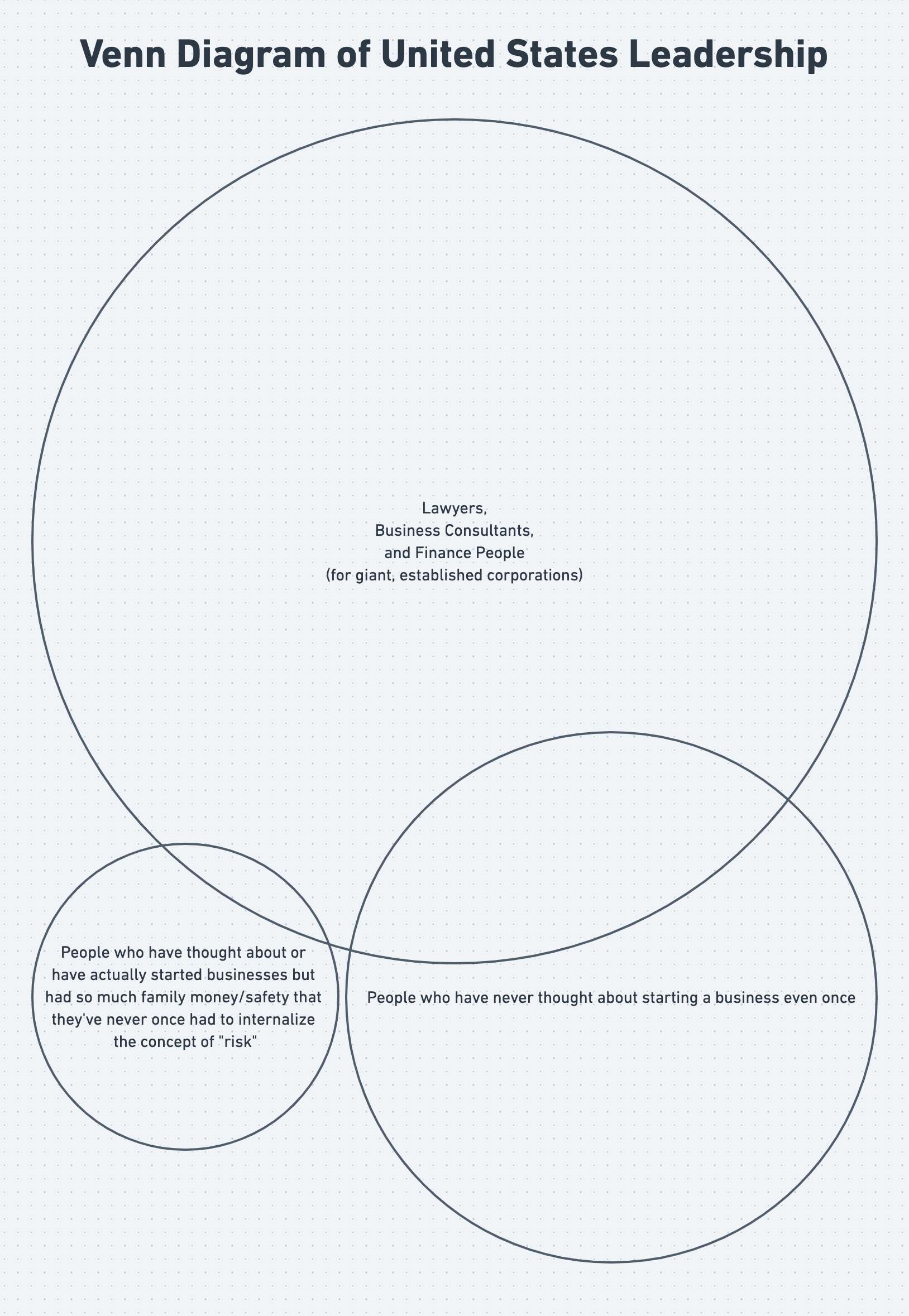
There are many reasons why US leaders will never do these obvious things, but it’s actually worse than that (and I’m giving them the benefit of the doubt): They will actually never even UNDERSTAND why they might do these things.
The Venn Diagram of US leaders looks like this.
I’m done with leaders saying that small business is important while standing in the way of everything that actually leads to more and better businesses.
Both parties are complicit. One is just shameless while the other lies through its teeth and wonders why people don’t trust it.
Failure Mode
As someone who has frequently felt like a failure, I’d like to talk about the importance of Failure Mode: No system can truly be trusted if it has not yet failed. And the more times it has failed without dissolving, the more it can be trusted.
Common example: For better mental health, you decide to go to the gym for one hour, five days a week, every week. Six weeks in, you are perfect…
6 weeks is a long time. There is cause for optimism. But this is an unstable system. You have no idea what failure mode looks like.
Something goes wrong. You get sick, lose momentum. A week passes. Next week comes and your engine is stalling out. You wake up late. There’s a big project at work…
Six weeks later: “I feel terrible. Remember when I was taking care of my mental health by going to the gym?”
You can extrapolate this out for any length of time and it’s still true. You’ve exercised five days a week for 146 weeks, no exceptions. Your system is probably pretty good, BUT YOU CAN’T BE SURE, because you haven’t seen what happens yet when it fails.
You’d much rather be in a position where you’ve exercised 5 days a week for 118 of the previous 146 weeks and had two missed months and a whole bunch of weeks that got blown up by a variety of excellent failure modes.
THAT is a stable system that you can trust.
In some systems, failure means death or worse, so it isn’t an option.
My friend Dustin runs a nuclear reactor and he follows what we all hope is a good system when running that reactor. He has never had the reactor melt down on him (which is good).
When she crosses the street, I make sure my three-year-old daughter always holds my hand and we both look to see if any cars or trucks or buses are coming before we step out.
We haven’t yet been crushed by a motor vehicle. 🤜🪵
These systems that MUST NOT FAIL can never fully be trusted which is good because fear and caution are desirable features in matters of life and death.
But in most cases, not only is failure NOT a matter of life and death, it is the most important component of the system.
To be clear, I’m not talking about “learning from failure” or “there there little one, we all fail and that’s okay” (true as that is). I’m talking about failure mode as THE MOST IMPORTANT TEST of any system, because it is inevitable.
The post-failure message of “Go easy on yourself” misses the mark. Failure is in fact the only reassurance we can have that our system works.
“Two steps forward, one step back” isn’t a compromised reality we all just have to live with… It is, in fact, the only path to success.
How many systems do we set up for ourselves that don’t account for (or softly welcome) their failure modes? For me, it’s too many. I need to stop that shit.
Summary
I wrote about how all the Hustle Porn in this culture is complete bullshit because not only is it a sick way to think, but it actually produces the opposite effect. It causes you to do less.
“No pain, no gain” is a lie. At least in the way it’s conventionally presented.
The truth is more like “You will probably experience lots of self-inflicted pain unless and until you realize that you can stop punching yourself in the face.” 👇
The Puritan fetishization around pain as part of your penance for being a no-good slobbery sinner must have served some purpose at some time, but it certainly wasn’t the purpose of happiness or even getting more work done. Pain leads to less work getting done.
Adding pain to any endeavor is the surest way to cause the part of you that actually cares for yourself to avoid that endeavor. This avoidance comes in many forms. People who believe in “no pain, no gain” usually call it “procrastination” or “laziness.”
This doesn’t mean that it’s not usefull to do things hard (vigorously), but the way to “go hard” is by first going softly, easily, and the easily naturally warms up to vigorously, all by itself, faster and more fruitfully than you can get there by “going hard.”
And because your body and mind got to this state naturally, easily, without any pain from “pushing yourself,” you didn’t encode any painful cues that could tend to make you want to avoid this activity in the future.
And to be clear, you went just as hard.
Most self-inflicted pain isn’t muscular or cardiovascular (though its manifestation is whole-body). For me, it’s a voice that says COME ON, WHAT’S THE MATTER WITH YOU? YOU’RE NEVER GOING TO ACTUALLY DO ANYTHING ARE YOU? THERE YOU ARE WASTING TIME AGAIN.
To date, this voice has never once helped me get a single thing done, but for most of my life I didn’t know there was an alternative way to “get myself to work.” It always seemed the only option was to press harder, the exact opposite of what would help.
I never NOTICED that the part of me that would occasionally get into a flow state and make cool things would do that all on its own as long as the scary voice wasn’t around. When I let that part of me run free, without pain, I’m both happier and more prolific.
“No pain, no gain” is bullshit.
“Hustle” is bullshit.
“Work ethic” is bullshit.
Not because gaining or getting things done or being prolific is wrong, but because all of these slogans/attitudes produce the OPPOSITE of what they claim.
And more importantly: They make you sad.
No Pain, No Gain
“No pain, no gain” is a lie. At least in the way it’s conventionally presented.
The truth is more like “You will probably experience lots of self-inflicted pain unless and until you realize that you can stop punching yourself in the face.” 👇
The Puritan fetishization around pain as part of your penance for being a no-good slobbery sinner must have served some purpose at some time, but it certainly wasn’t the purpose of happiness or even getting more work done. Pain leads to less work getting done.
Adding pain to any endeavor is the surest way to cause the part of you that actually cares for yourself to avoid that endeavor. This avoidance comes in many forms. People who believe in “no pain, no gain” usually call it “procrastination” or “laziness.”
This doesn’t mean that it’s not usefull to do things hard (vigorously), but the way to “go hard” is by first going softly, easily, and the easily naturally warms up to vigorously, all by itself, faster and more fruitfully than you can get there by “going hard.”
And because your body and mind got to this state naturally, easily, without any pain from “pushing yourself,” you didn’t encode any painful cues that could tend to make you want to avoid this activity in the future.
And to be clear, you went just as hard.
Most self-inflicted pain isn’t muscular or cardiovascular (though its manifestation is whole-body). For me, it’s a voice that says COME ON, WHAT’S THE MATTER WITH YOU? YOU’RE NEVER GOING TO ACTUALLY DO ANYTHING ARE YOU? THERE YOU ARE WASTING TIME AGAIN.
To date, this voice has never once helped me get a single thing done, but for most of my life I didn’t know there was an alternative way to “get myself to work.” It always seemed the only option was to press harder, the exact opposite of what would help.
I never NOTICED that the part of me that would occasionally get into a flow state and make cool things would do that all on its own as long as the scary voice wasn’t around. When I let that part of me run free, without pain, I’m both happier and more prolific.
“No pain, no gain” is bullshit.
“Hustle” is bullshit.
“Work ethic” is bullshit.
Not because gaining or getting things done or being prolific is wrong, but because all of these slogans/attitudes produce the OPPOSITE of what they claim.
And more importantly: They make you sad.
Summary
I didn’t (really) learn to type until I was almost thirty.
I was always a fast typist but I had bad habits. There was no chance that I would ever touchtype on QWERTY. I tried hard.
So I learned Dvorak. Here’s why it was a great decision and what it taught me about learning. 👇
It’s much harder to learn to do something BETTER than it is to learn to do something NEW. It’s helpful to be bad at something for a while.
“Picking things up quickly” is a specious talent. It means you can gouge bad habits into your brain and become an Arrogant Novice fast.
I pick things up quickly. This means that I usually skip fundamental steps like:
-
Stopping my palm from touching the basketball during a jumpshot (or a dribble)
-
Positioning my wrist properly when touching the fretboard of the guitar
-
Always using my pinky to type a P or a Q
Once you’ve gone a certain distance with bad habits, it’s very unintuitive to improve because a big step backward is required before you can go forward.
This is why when it came time to touchtype (I’m a writer and a developer, my job is the keyboard), I had to switch to Dvorak.
The first few weeks of typing Dvorak could be excruciating at times. I was SO slow and made tons of errors. I had no crutch to lean on. The keyboard had no labels on it to guide me.
But when I relaxed into it, the process of learning/carving new pathways felt awesome.
It’s conventional wisdom that learning new things gets harder as you get older. I no longer believe this is necessarily true.
The reason it FEELS true is because when we’re older we get the idea that we already know things. It’s disorienting to access Beginner’s Mind.
The good news is that Beginner’s Mind can be accessed at any age. There are many techniques to get there, but a really simple one is to just slow way, WAY down, to the point where what you’re doing becomes foreign and doesn’t even make sense to your brain anymore.
This is a great way to practice almost anything. Slow it down until it requires all of your attention to make a single move, ring a single string, touch a single key. Relax into that kind of focused attention and get comfortable not focusing on ANY resulting song, move, or skill.
A lot of meditation practice can be seen as simply accessing Beginner’s Mind, not becoming attached to all the things you think you already know. Letting them become new to you, objects of curiosity. With this kind of attention, you can learn, or relearn, anything.
Aside from touchtyping, here are a few other Dvorak benefits:
-
It’s an objectively better layout, with all the vowels on the lefthand home row and the common consonants on the righthand home row
-
If someone asks to touch your computer you can say “but you don’t know the layout”
Learning Dvorak and Learning in General
I didn’t (really) learn to type until I was almost thirty.
I was always a fast typist but I had bad habits. There was no chance that I would ever touchtype on QWERTY. I tried hard.
So I learned Dvorak. Here’s why it was a great decision and what it taught me about learning. 👇
It’s much harder to learn to do something BETTER than it is to learn to do something NEW. It’s helpful to be bad at something for a while.
“Picking things up quickly” is a specious talent. It means you can gouge bad habits into your brain and become an Arrogant Novice fast.
I pick things up quickly. This means that I usually skip fundamental steps like:
-
Stopping my palm from touching the basketball during a jumpshot (or a dribble)
-
Positioning my wrist properly when touching the fretboard of the guitar
-
Always using my pinky to type a P or a Q
Once you’ve gone a certain distance with bad habits, it’s very unintuitive to improve because a big step backward is required before you can go forward.
This is why when it came time to touchtype (I’m a writer and a developer, my job is the keyboard), I had to switch to Dvorak.
The first few weeks of typing Dvorak could be excruciating at times. I was SO slow and made tons of errors. I had no crutch to lean on. The keyboard had no labels on it to guide me.
But when I relaxed into it, the process of learning/carving new pathways felt awesome.
It’s conventional wisdom that learning new things gets harder as you get older. I no longer believe this is necessarily true.
The reason it FEELS true is because when we’re older we get the idea that we already know things. It’s disorienting to access Beginner’s Mind.
The good news is that Beginner’s Mind can be accessed at any age. There are many techniques to get there, but a really simple one is to just slow way, WAY down, to the point where what you’re doing becomes foreign and doesn’t even make sense to your brain anymore.
This is a great way to practice almost anything. Slow it down until it requires all of your attention to make a single move, ring a single string, touch a single key. Relax into that kind of focused attention and get comfortable not focusing on ANY resulting song, move, or skill.
A lot of meditation practice can be seen as simply accessing Beginner’s Mind, not becoming attached to all the things you think you already know. Letting them become new to you, objects of curiosity. With this kind of attention, you can learn, or relearn, anything.
Aside from touchtyping, here are a few other Dvorak benefits:
-
It’s an objectively better layout, with all the vowels on the lefthand home row and the common consonants on the righthand home row
-
If someone asks to touch your computer you can say “but you don’t know the layout”
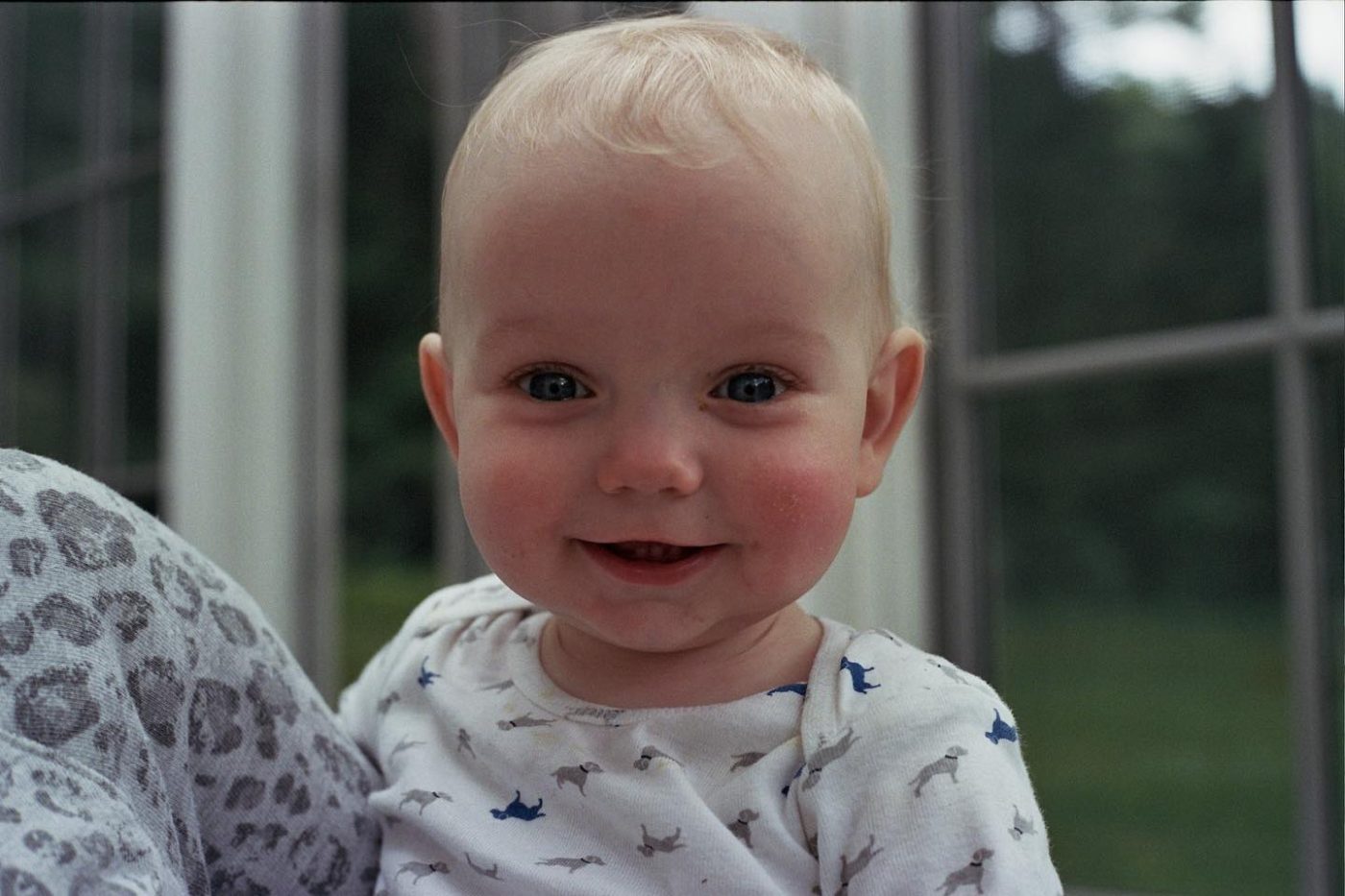
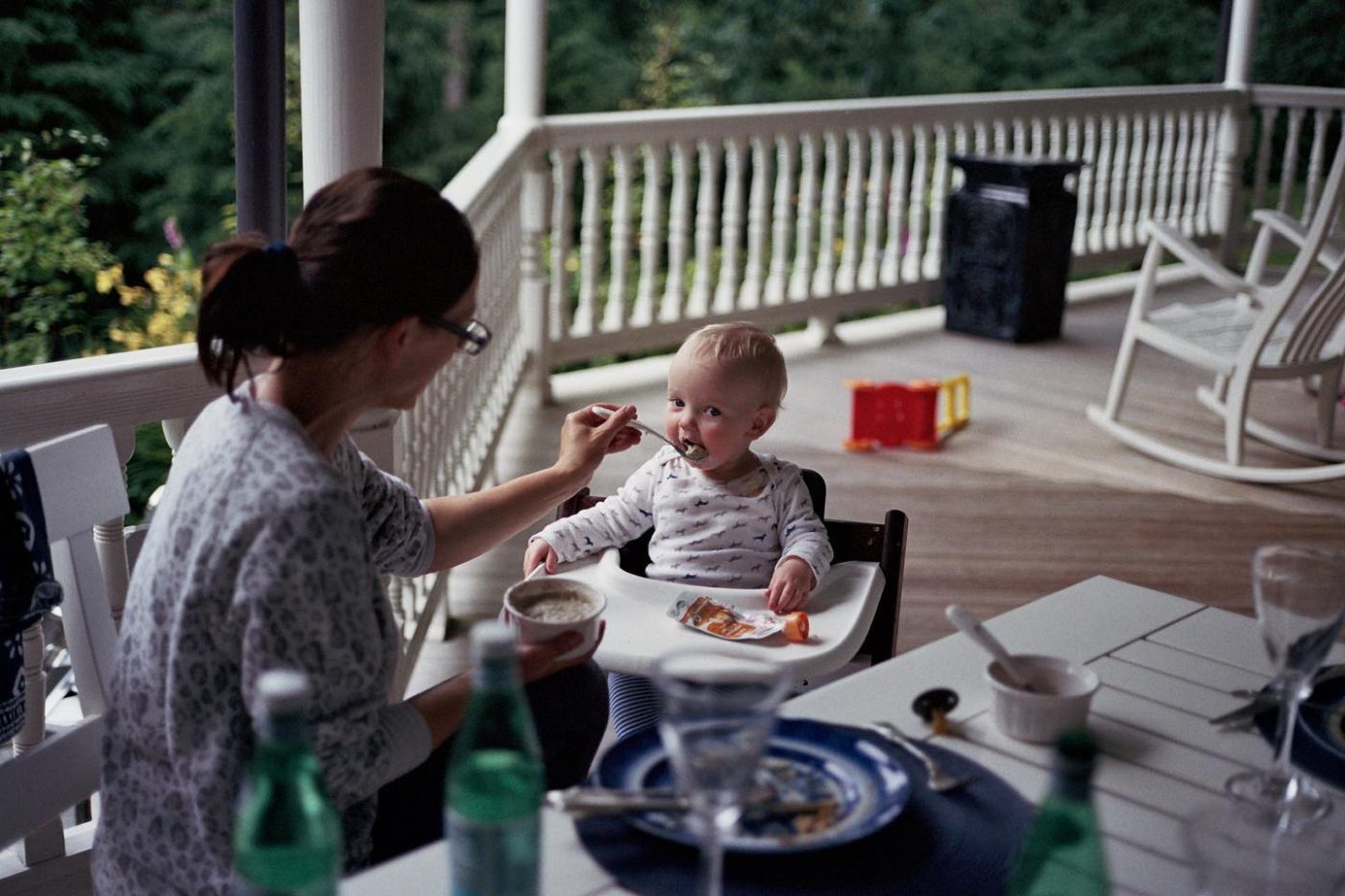
Ready to get back in the swing of developing film regularly. This was from a mystery roll. Wendell getting taken care of by @a.rzasa77 this summer. He misses you, Agnes!

eBay Selling Principles
Since the beginning of eBay (mid-90s), I’ve consistently gotten MUCH higher prices for items I sell online than I expect, sometimes as high as 50% above the market rate.
I list things differently than most. I follow two principles that I think can apply to selling anything. 👇
Principle 1 that seems to work for selling on eBay (or anywhere else): Let Them Know You’re A Human
When I’m buying anything, the most important thing to me is trust. Reviews do little more than check a box for me (⭑⭑⭑⭑⭑ A+++++ SELLER). I’d much rather hear an authentic voice.
Letting Them Know You’re A Human means that you convey who you really are, even exposing faults e.g. “I have two kids under the age of 3 so I might take a couple days to ship. Apologies in advance.” I instantly trust this seller 10x more than a listing that says “FAST SHIPPING!”
Principle 2 that seems to work for selling on eBay (or anywhere else): Convey That You Care About What You’re Selling More Than They Do
This is also about trust. As someone selling a thing, you know much more about it than the buyer does. Convey your true feelings about it!
Restaurant servers take note (I can speak on this because I’ve waited on 1000s of tables): If a customer asks if they should order this or that, THEY WANT YOUR EXPERT OPINION. “Well, it depends what you’re in the mood for” is not an answer.
I’m in the mood for your expert opinion.
Often, a buyer is excited to buy but they have doubts and fears and they just need to ask “Should I really buy this? I REALLY THINK I WANT IT, SHOULD I?” You know the answer. Be honest with them. Address caveats and drawbacks as enthusiastically as features and benefits.
This runs counter to the way most sellers talk. They focus on representing only the rosy stuff and say things like YOU CAN TRUST ME BECAUSE which is inherently untrustworthy.
Know the questions people have and be generous with your knowledge.
Another benefit of selling things this way is that you might make a friend. That someone is buying your thing is a good indicator that you share interests. I’m still in touch with people I’ve bought things from or sold things to years later.
You could sum up these principles for selling things online as “sell it like you would to a friend.”
I think these principles carry over to sharing ideas and even online behavior generally. “How would you say this to a friend?” This has me thinking about @visakanv’s work.
I’m going to experiment with getting even MORE human with how I list stuff to sell: I’ll record little videos about each item. Listing things can feel like such a chore so maybe this will make it fun?
I’ll call them Farewell Reviews and post them unceremoniously.
Summary
Since the beginning of eBay (mid-90s), I’ve consistently gotten MUCH higher prices for items I sell online than I expect, sometimes as high as 50% above the market rate.
I list things differently than most. I follow two principles that I think can apply to selling anything. 👇
Principle 1 that seems to work for selling on eBay (or anywhere else): Let Them Know You’re A Human
When I’m buying anything, the most important thing to me is trust. Reviews do little more than check a box for me (⭑⭑⭑⭑⭑ A+++++ SELLER). I’d much rather hear an authentic voice.
Letting Them Know You’re A Human means that you convey who you really are, even exposing faults e.g. “I have two kids under the age of 3 so I might take a couple days to ship. Apologies in advance.” I instantly trust this seller 10x more than a listing that says “FAST SHIPPING!”
Principle 2 that seems to work for selling on eBay (or anywhere else): Convey That You Care About What You’re Selling More Than They Do
This is also about trust. As someone selling a thing, you know much more about it than the buyer does. Convey your true feelings about it!
Restaurant servers take note (I can speak on this because I’ve waited on 1000s of tables): If a customer asks if they should order this or that, THEY WANT YOUR EXPERT OPINION. “Well, it depends what you’re in the mood for” is not an answer.
I’m in the mood for your expert opinion.
Often, a buyer is excited to buy but they have doubts and fears and they just need to ask “Should I really buy this? I REALLY THINK I WANT IT, SHOULD I?” You know the answer. Be honest with them. Address caveats and drawbacks as enthusiastically as features and benefits.
This runs counter to the way most sellers talk. They focus on representing only the rosy stuff and say things like YOU CAN TRUST ME BECAUSE which is inherently untrustworthy.
Know the questions people have and be generous with your knowledge.
Another benefit of selling things this way is that you might make a friend. That someone is buying your thing is a good indicator that you share interests. I’m still in touch with people I’ve bought things from or sold things to years later.
You could sum up these principles for selling things online as “sell it like you would to a friend.”
I think these principles carry over to sharing ideas and even online behavior generally. “How would you say this to a friend?” This has me thinking about @visakanv’s work.
I’m going to experiment with getting even MORE human with how I list stuff to sell: I’ll record little videos about each item. Listing things can feel like such a chore so maybe this will make it fun?
I’ll call them Farewell Reviews and post them unceremoniously.
Google: Driving vs. Biking vs. Walking
I’m going to attempt to explain one of many reasons I have a dead-inside feeling when I use Google. I’ll use the analogy of Driving vs. Biking (vs. Walking). 👇
I had a nice phone call today with a film professor from my time at Syracuse, Richard Breyer. I haven’t seen him in 15 years. An intern I had is a student of his. We reconnected on Facebook.
Professor Breyer had a reputation for always bicycling. In Syracuse, that’s not normal.
Syracuse is both the snow capital of the USA (125 inches/yr) and a town with LOTS of hills (called “drumlins”). It’s a tough city to bike.
It wasn’t until halfway through my 20s that I discovered just how superior a mode of transportation the bicycle really is. Even in Syracuse.
The problem with driving is that there’s very little experience of the journey. There isn’t time to take in the senses of neighborhoods you pass through, whether familiar or new.
All drivers have had the experience, a little scary, of arriving not even remembering the drive.
Walking, on the other hand, is wonderful, the most natural human movement and best exercise currently known, and you really get to experience that journey, but we’re all kind of busy, and it can take FOREVER. Once you get beyond a couple of miles you get to impractical territory.
Then there’s the bicycle, or as Goldilocks would call it, the mode of transportation that is “just right.” You get there fast (in a city like Philadelphia, often faster than driving). You get some gentle exercise. You use no power.
But most importantly, you are IN that journey.
Professor Breyer and I talked about Google and how little true exploration it facilitates. It’s like only driving and only ever using a GPS. Its algorithm is designed for everyone to get to the same, clean, “good enough” answer. It’s just… autopilot.
Just before COVID hit (my timing is awesome) I rediscovered the Library, which is goddamn MAGIC.
Walk up to a librarian and ask them about a thing and they will show you WAY cooler stuff than Google ever could.
And here’s the thing: There are other books around!
Along the library aisles leading to your book are OTHER books. Sometimes just arbitrarily related, alphabetically, by subject, and sometimes, as happened to Professor Breyer, a book will literally drop off a shelf into your hands on a page relevant to a film you’re making.
Google is driving blind, with only a GPS guide that you’re watching the whole time. It’s just not a satisfying thing, and as the algorithm gets “better,” there’s less and less serendipity, less journey, less human experience.
I can’t wait to ride my bike to the library again.
Summary
Post Draft
Tweets {{word-count}}
I’m going to attempt to explain one of many reasons I have a dead-inside feeling when I use Google. I’ll use the analogy of Driving vs. Biking (vs. Walking). 👇
I had a nice phone call today with a film professor from my time at Syracuse, Richard Breyer. I haven’t seen him in 15 years. An intern I had is a student of his. We reconnected on Facebook.
Professor Breyer had a reputation for always bicycling. In Syracuse, that’s not normal.
Syracuse is both the snow capital of the USA (125 inches/yr) and a town with LOTS of hills (called “drumlins”). It’s a tough city to bike.
It wasn’t until halfway through my 20s that I discovered just how superior a mode of transportation the bicycle really is. Even in Syracuse.
The problem with driving is that there’s very little experience of the journey. There isn’t time to take in the senses of neighborhoods you pass through, whether familiar or new.
All drivers have had the experience, a little scary, of arriving not even remembering the drive.
Walking, on the other hand, is wonderful, the most natural human movement and best exercise currently known, and you really get to experience that journey, but we’re all kind of busy, and it can take FOREVER. Once you get beyond a couple of miles you get to impractical territory.
Then there’s the bicycle, or as Goldilocks would call it, the mode of transportation that is “just right.” You get there fast (in a city like Philadelphia, often faster than driving). You get some gentle exercise. You use no power.
But most importantly, you are IN that journey.
Professor Breyer and I talked about Google and how little true exploration it facilitates. It’s like only driving and only ever using a GPS. Its algorithm is designed for everyone to get to the same, clean, “good enough” answer. It’s just… autopilot.
Just before COVID hit (my timing is awesome) I rediscovered the Library, which is goddamn MAGIC.
Walk up to a librarian and ask them about a thing and they will show you WAY cooler stuff than Google ever could.
And here’s the thing: There are other books around!
Along the library aisles leading to your book are OTHER books. Sometimes just arbitrarily related, alphabetically, by subject, and sometimes, as happened to Professor Breyer, a book will literally drop off a shelf into your hands on a page relevant to a film you’re making.
Google is driving blind, with only a GPS guide that you’re watching the whole time. It’s just not a satisfying thing, and as the algorithm gets “better,” there’s less and less serendipity, less journey, less human experience.
I can’t wait to ride my bike to the library again.
Notes
I actually didn’t even take any of Professor Breyer’s classes but I requested 1-on-1 meetings with him.
Computer Brain vs. Bonfire Brain
I’m very excited! I figured out why pretty much all “frameworks” can never spark creative work. They all look exactly in the wrong direction.
They address the Digital Brain rather than the Analog Brain.
Better frame: They address the Computer Brain vs. the Bonfire Brain. Thread 👇
Admittedly, I never got through Twyla Tharp’s book, The Creative Habit, but I’ve realized that you only really need the very first couple of pages where Tharp talks about GETTING WARM.
Getting Warm is about the Bonfire Brain and it’s so exciting I can’t contain myself.
So I have some bad news about the Computer Brain, but it will be accompanied by some world-changing, joyous-reunion-of-peace-love-joy-and-everything-transcendent good news about the Bonfire Brain.
Computer Brain: It can process tasks, hold about five things, but beyond that…
-
It’s always the same, in all contexts, and as long as you’re awake, it works… fine.
-
It never changes. It’s always just as you left it.
-
It doesn’t actually know how to do or create ANYTHING.
Most task systems/habit frameworks/productivity hacks focus on the Computer Brain and try to satisfy its binary bits in the hope that if it can somehow just be clean/organized/processed/planned enough then the Bonfire Brain will be freed up to get going.
This is FUCKING WRONG.
Computer Brain can NEVER get Bonfire Brain going. It has nothing whatever to do with it. It produces no heat, no signal, nothing analog at all. It’s pure binary. Done/not done. On/off. Yes/no. 1/0.
Computer Brain won’t be satisfied. It doesn’t even have feelings to satisfy.
So that’s the bad news about Computer Brain… It can never spark or warm up the Bonfire Brain. It’s got nothing. And yet pretty much every framework being sold in the Productivity Porn Industrial Complex targets the Computer Brain.
Here comes the good news about the Bonfire Brain.
The Bonfire Brain is analog, messy, chaotic, and generative. It knows how to do EVERYTHING. And here’s the amazing explode-the-whole-universe Good News about the Bonfire Brain: All it needs is heat and fuel. And it already has unlimited fuel.
SO ALL IT ACTUALLY NEEDS IS HEAT.
The heat that Bonfire Brain needs isn’t something you can just turn on the way you can turn on Computer Brain. You need to warm it up. But here’s the AMAZING THING:
-
You can warm it up with ANY sustained creative or embodied act.
-
It heats up faster/better with LESS difficulty.
When I say “creative or embodied act,” this applies to everything from walking to writing to singing.
The first few steps are stiff and cold. Once you get warmer, you could go forever. This is an analog process. Take it easy and it will burn brighter and brighter all on its own.
I won the fire-building contest every year at nature camp as a kid. A well-tended bonfire can get as big or as hot as you like, and it takes care of all the hard parts itself. You can use yesterday’s embers to start today’s big blaze. The hotter they remain, the faster it goes.
Forget habit trackers and todo lists. JUST GET WARM and stay warm. When you cool off completely, just get warm again. Something easy, and if it’s ANY EFFORT AT ALL, even easier.
Before you know it, you’ll have a blazing, magical Bonfire that can create absolutely anything.
By the way, the Bonfire isn’t “you.” It’s the same thing we all have access to. All it needs is a gentle little spark and some very light tending and it’ll keep itself going.
The even more positive news is that it’s going whether you’re all caught up in your Computer Brain or not.
Notes
The Left Brain/Right Brain binary is inherently Left-Brained.
Summary
Post Draft
Tweets
I’m very excited! I figured out why pretty much all “frameworks” can never spark creative work. They all look exactly in the wrong direction.
They address the Digital Brain rather than the Analog Brain.
Better frame: They address the Computer Brain vs. the Bonfire Brain. Thread 👇
Admittedly, I never got through Twyla Tharp’s book, The Creative Habit, but I’ve realized that you only really need the very first couple of pages where Tharp talks about GETTING WARM.
Getting Warm is about the Bonfire Brain and it’s so exciting I can’t contain myself.
So I have some bad news about the Computer Brain, but it will be accompanied by some world-changing, joyous-reunion-of-peace-love-joy-and-everything-transcendent good news about the Bonfire Brain.
Computer Brain: It can process tasks, hold about five things, but beyond that…
-
It’s always the same, in all contexts, and as long as you’re awake, it works… fine.
-
It never changes. It’s always just as you left it.
-
It doesn’t actually know how to do or create ANYTHING.
Most task systems/habit frameworks/productivity hacks focus on the Computer Brain and try to satisfy its binary bits in the hope that if it can somehow just be clean/organized/processed/planned enough then the Bonfire Brain will be freed up to get going.
This is FUCKING WRONG.
Computer Brain can NEVER get Bonfire Brain going. It has nothing whatever to do with it. It produces no heat, no signal, nothing analog at all. It’s pure binary. Done/not done. On/off. Yes/no. 1/0.
Computer Brain won’t be satisfied. It doesn’t even have feelings to satisfy.
So that’s the bad news about Computer Brain… It can never spark or warm up the Bonfire Brain. It’s got nothing. And yet pretty much every framework being sold in the Productivity Porn Industrial Complex targets the Computer Brain.
Here comes the good news about the Bonfire Brain.
The Bonfire Brain is analog, messy, chaotic, and generative. It knows how to do EVERYTHING. And here’s the amazing explode-the-whole-universe Good News about the Bonfire Brain: All it needs is heat and fuel. And it already has unlimited fuel.
SO ALL IT ACTUALLY NEEDS IS HEAT.
The heat that Bonfire Brain needs isn’t something you can just turn on the way you can turn on Computer Brain. You need to warm it up. But here’s the AMAZING THING:
-
You can warm it up with ANY sustained creative or embodied act.
-
It heats up faster/better with LESS difficulty.
When I say “creative or embodied act,” this applies to everything from walking to writing to singing.
The first few steps are stiff and cold. Once you get warmer, you could go forever. This is an analog process. Take it easy and it will burn brighter and brighter all on its own.
I won the fire-building contest every year at nature camp as a kid. A well-tended bonfire can get as big or as hot as you like, and it takes care of all the hard parts itself. You can use yesterday’s embers to start today’s big blaze. The hotter they remain, the faster it goes.
Forget habit trackers and todo lists. JUST GET WARM and stay warm. When you cool off completely, just get warm again. Something easy, and if it’s ANY EFFORT AT ALL, even easier.
Before you know it, you’ll have a blazing, magical Bonfire that can create absolutely anything.
By the way, the Bonfire isn’t “you.” It’s the same thing we all have access to. All it needs is a gentle little spark and some very light tending and it’ll keep itself going.
The even more positive news is that it’s going whether you’re all caught up in your Computer Brain or not.
Notes
The Left Brain/Right Brain binary is inherently Left-Brained.