The Little Rebellion
The social feed — little posts written here and everything syndicated elsewhere, in one stream.
-
A Photographer’s Business Card
If you’re a photographer, I have the best business card for you. It reuses beautiful things that will otherwise be thrown away, it’s unique (for now), and handing it to someone creates immediate delight, conversation, and connection.
This is my business card (it’s not this). 👇
Right now, in your parents’ and grandparents’ closets and attics, there are thousands of these 35mm slides, intricately detailed, each one unique, and I can’t stress this enough, they are what that light was physically captured on, directly exposed at that time in that place.
Millions of these beautiful, one-of-a-kind objects are being thrown out every day. They should become the business cards of photographers everywhere. But photographers everywhere won’t take the time. YOU will, because you’re an interesting, fun-loving, enterprising go-getter.
My first stab at this idea was right out of college in 2005 using old slides and a rubber stamp. This is still the best way to do this, in my opinion. Rubber stamps have a beautiful quality all their own. The issue is that many slides are plastic or have writing all over them.
When I ultimately had my own company (film/video, not photography), using old slides didn’t make as much sense and it was more important that the logo be prominent. This defeats at least 61% of the coolness of the idea, and they’re also TERRIBLE to make: https://www.youtube.com/watch?v=TQYsaE6eJjE
Eventually we did find a great company, J.S. McCarthy Printers in Maine, who came up with a much better way to do these for us, still with a bit of manual assembly, but nothing like before.
The way we had done them previously (with our original name) was with die-cut stickers.
Now that I’m reconnecting with photography and taking portraits of neighborhoods and strangers who live in those neighborhoods, I finally have a reason to do my original idea. I found some low-priced eBay auctions for old Kodachrome slides and I’m making a rubber stamp.
The cool thing about Kodachrome slides is that the colors are incredibly vibrant like an old Technicolor movie and one side is blank for rubber-stamping.
For those who don’t know, Kodachrome was a complicated development process with brilliant colors and it no longer exists.
Now, when I meet a stranger whose photo I would like to take, in addition to dressing myself well and some other strategies I’m experimenting with, I’ll be able to hand them a piece of film with my name and a website where their portrait might show up.
You should totally use slides as your business card if you’re a photographer. And if you’re not a photographer, what might be out there, readily available, with a little bit of space on it where you could print or rubber stamp your contact info?
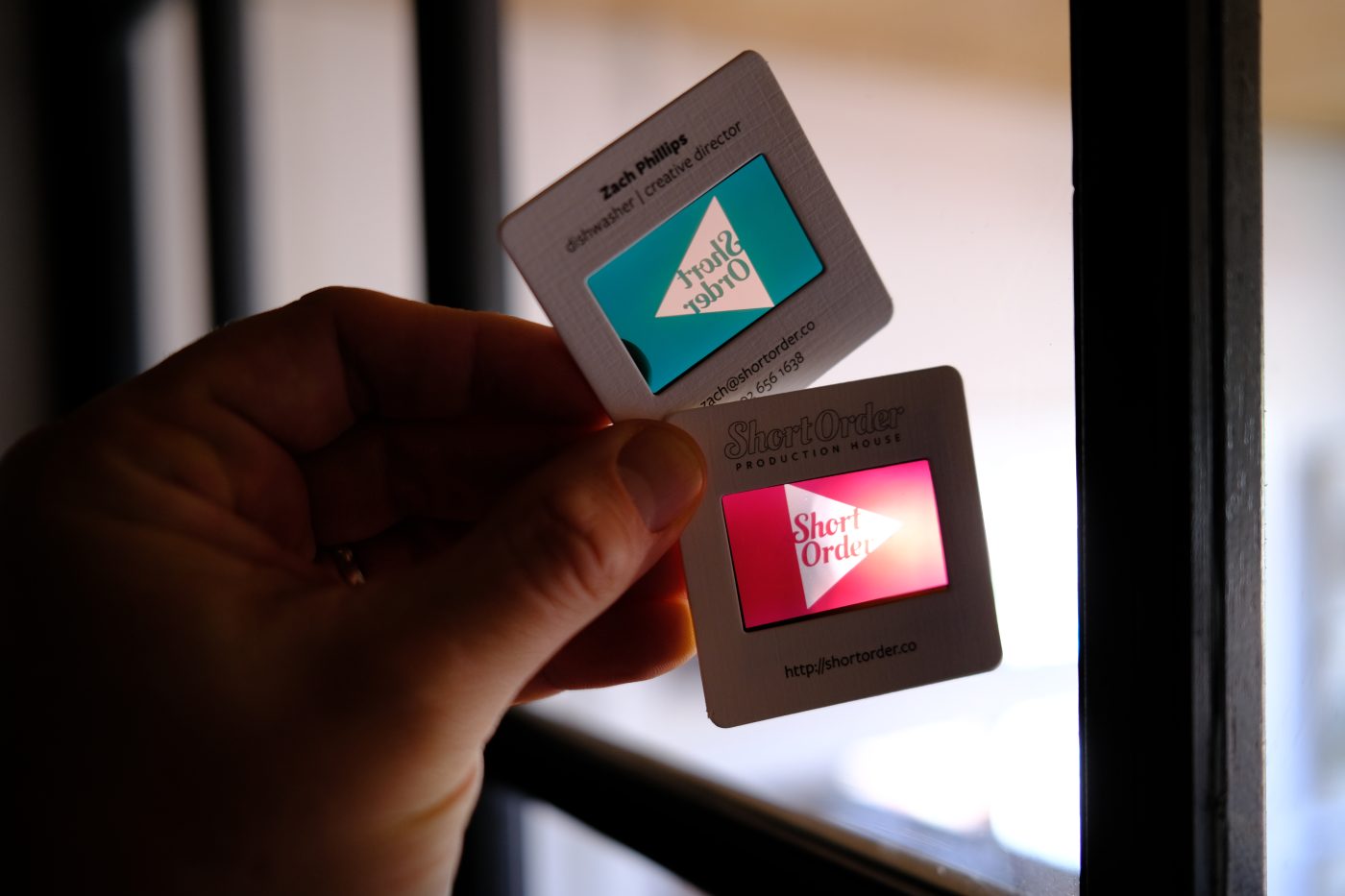
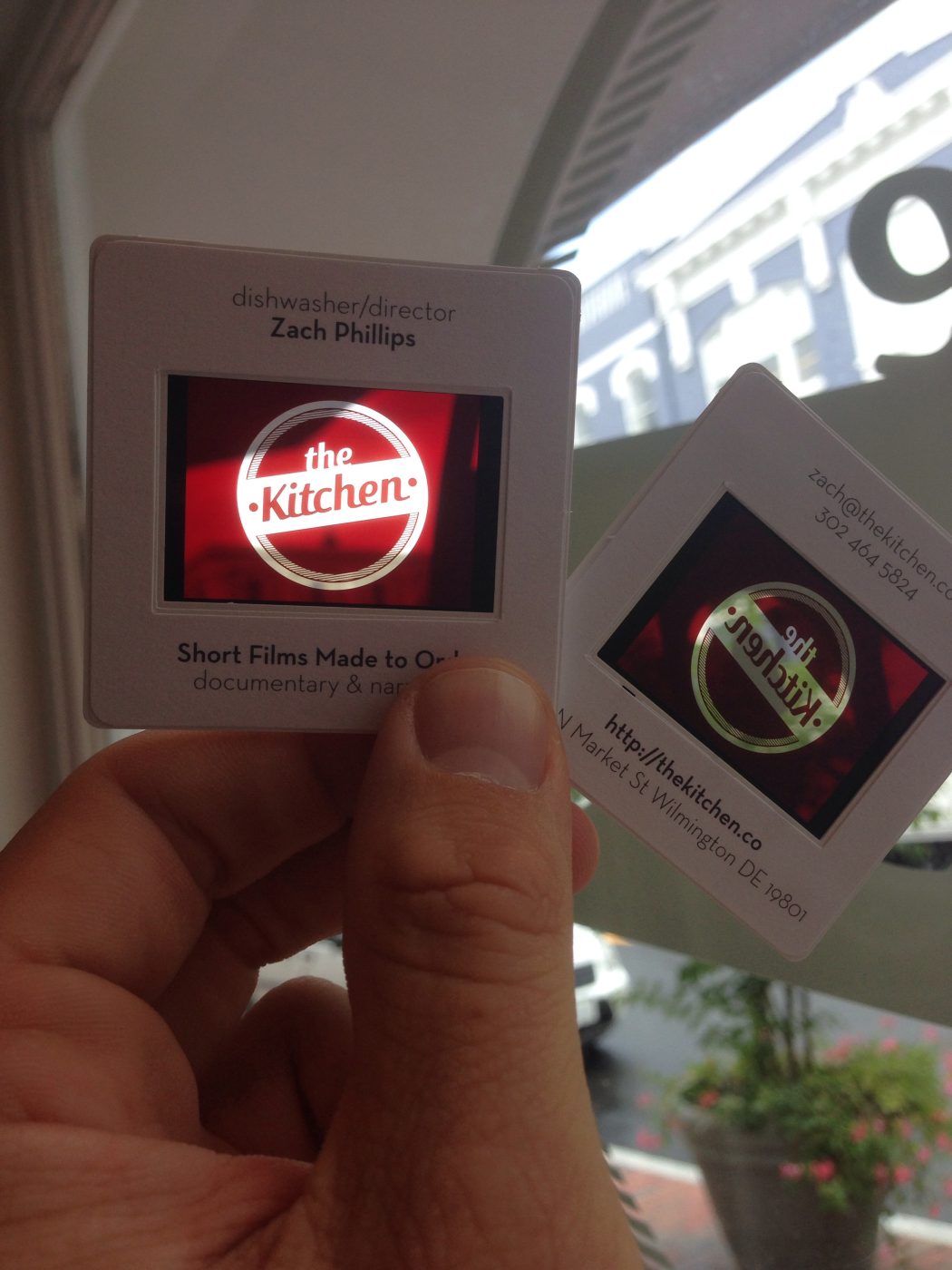
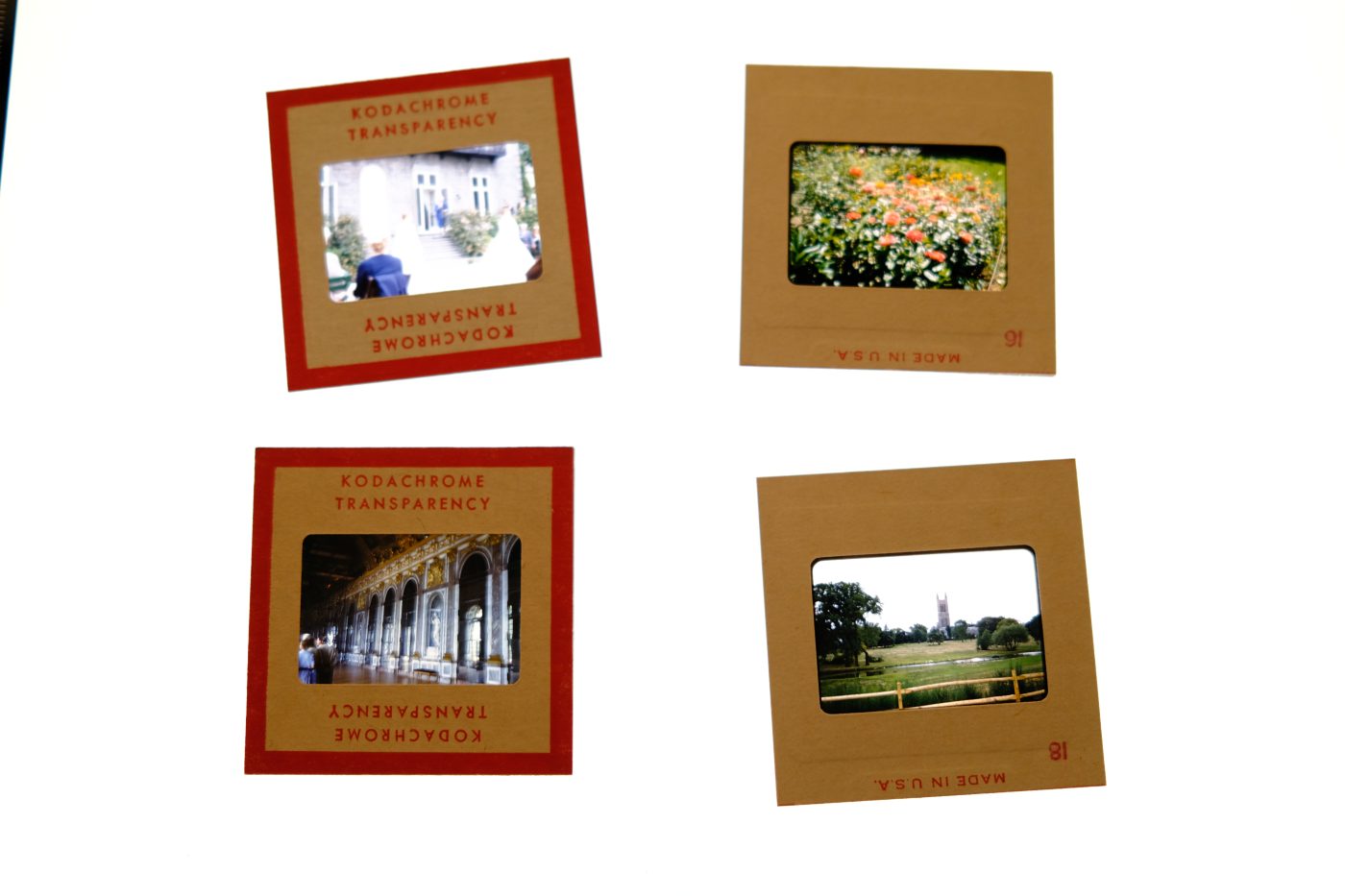
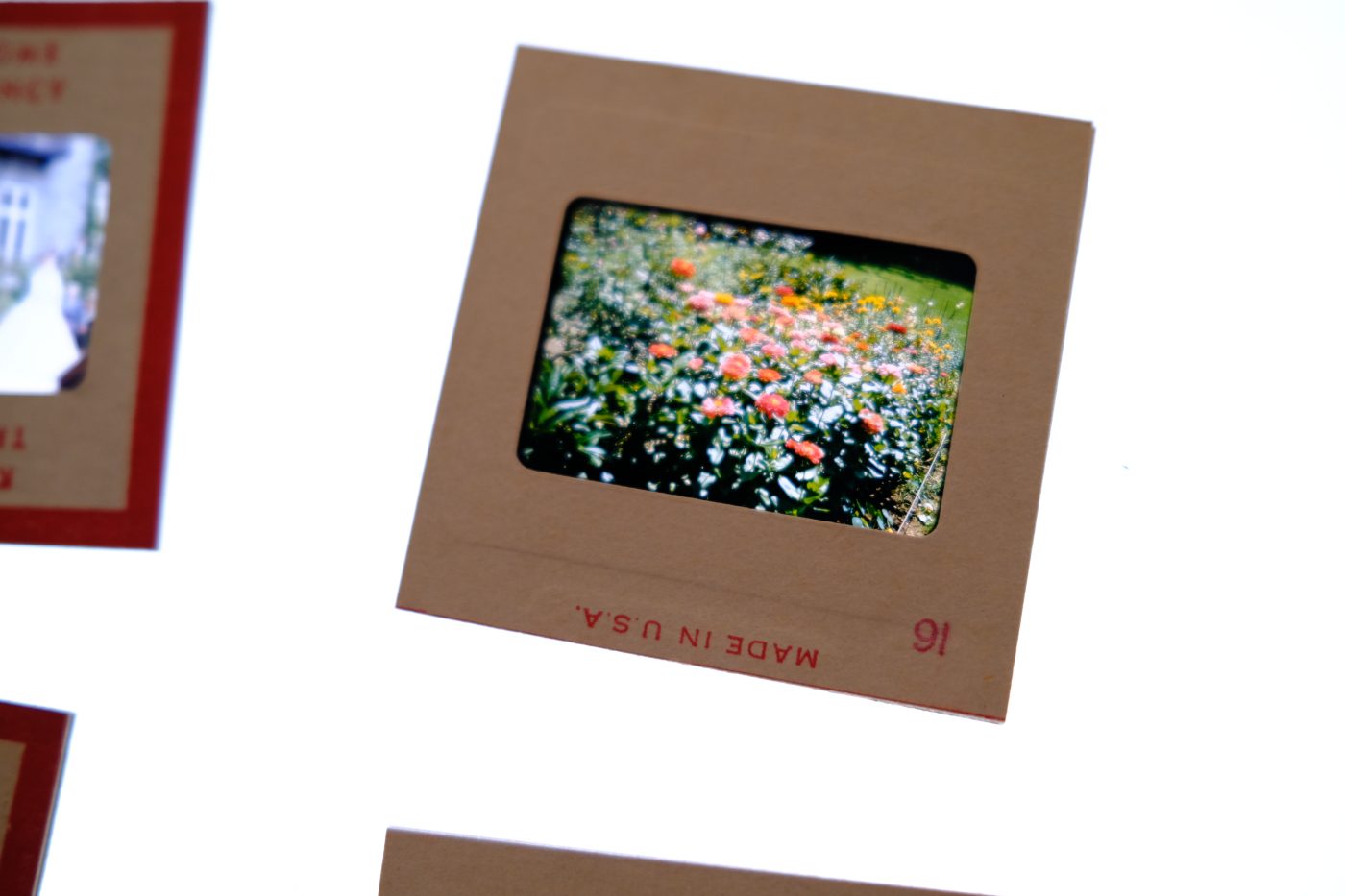
-
A Photographer's Business Card
I wrote about a variation on my business card that you should totally copy if you're a photographer.
If you're a photographer, I have the best business card for you. It reuses beautiful things that will otherwise be thrown away, it's unique (for now), and handing it to someone creates immediate delight, conversation, and connection.
This is my business card (it's not this). 👇

Right now, in your parents' and grandparents' closets and attics, there are thousands of these 35mm slides, intricately detailed, each one unique, and I can't stress this enough, they are what that light was physically captured on, directly exposed at that time in that place.
Millions of these beautiful, one-of-a-kind objects are being thrown out every day. They should become the business cards of photographers everywhere. But photographers everywhere won't take the time. YOU will, because you're an interesting, fun-loving, enterprising go-getter.
My first stab at this idea was right out of college in 2005 using old slides and a rubber stamp. This is still the best way to do this, in my opinion. Rubber stamps have a beautiful quality all their own. The issue is that many slides are plastic or have writing all over them.
When I ultimately had my own company (film/video, not photography), using old slides didn't make as much sense and it was more important that the logo be prominent. This defeats at least 61% of the coolness of the idea, and they're also TERRIBLE to make:
Eventually we did find a great company, J.S. McCarthy Printers in Maine, who came up with a much better way to do these for us, still with a bit of manual assembly, but nothing like before.
The way we had done them previously (with our original name) was with die-cut stickers.
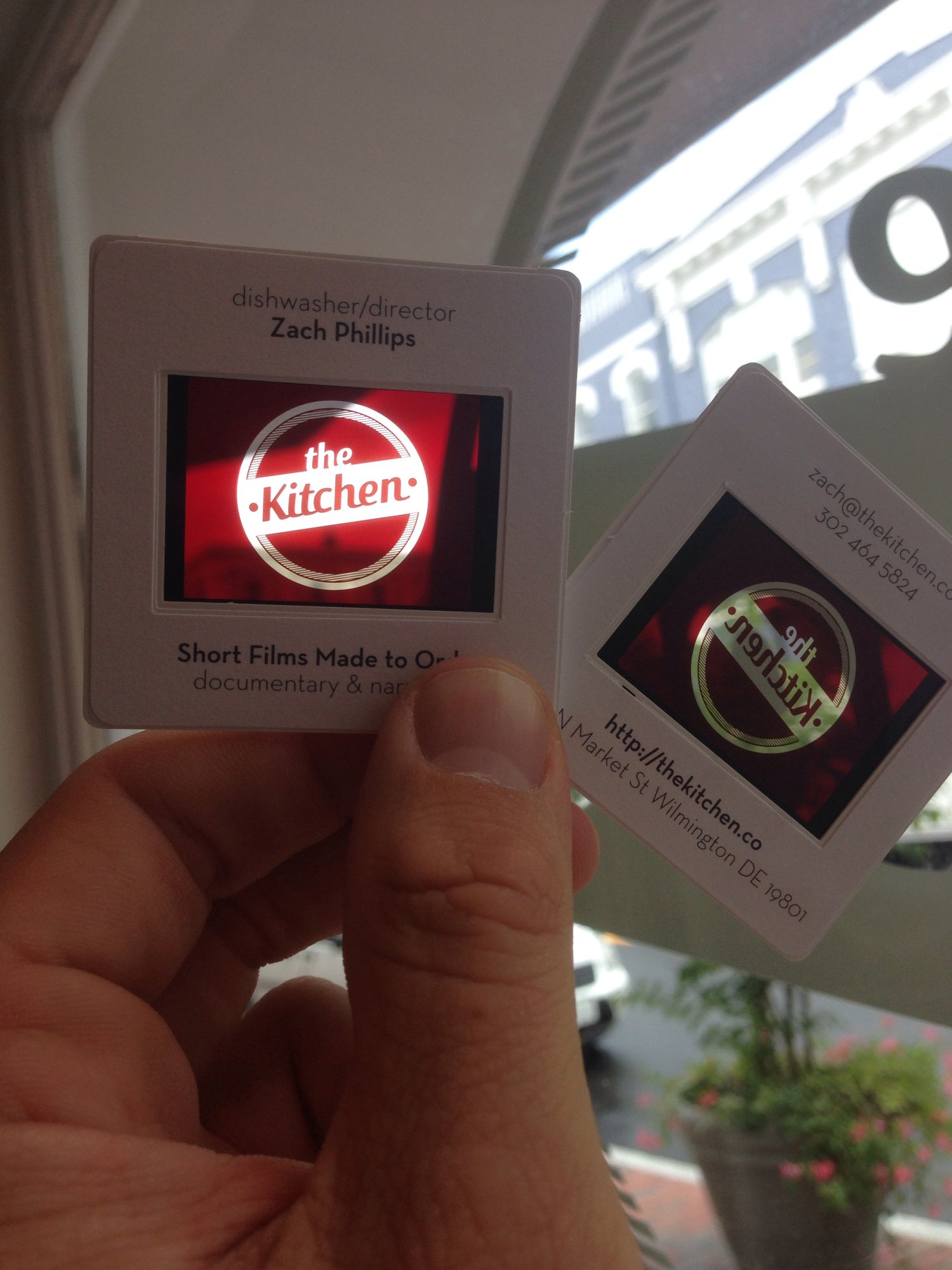
Now that I'm reconnecting with photography and taking portraits of neighborhoods and strangers who live in those neighborhoods, I finally have a reason to do my original idea. I found some low-priced eBay auctions for old Kodachrome slides and I'm making a rubber stamp.
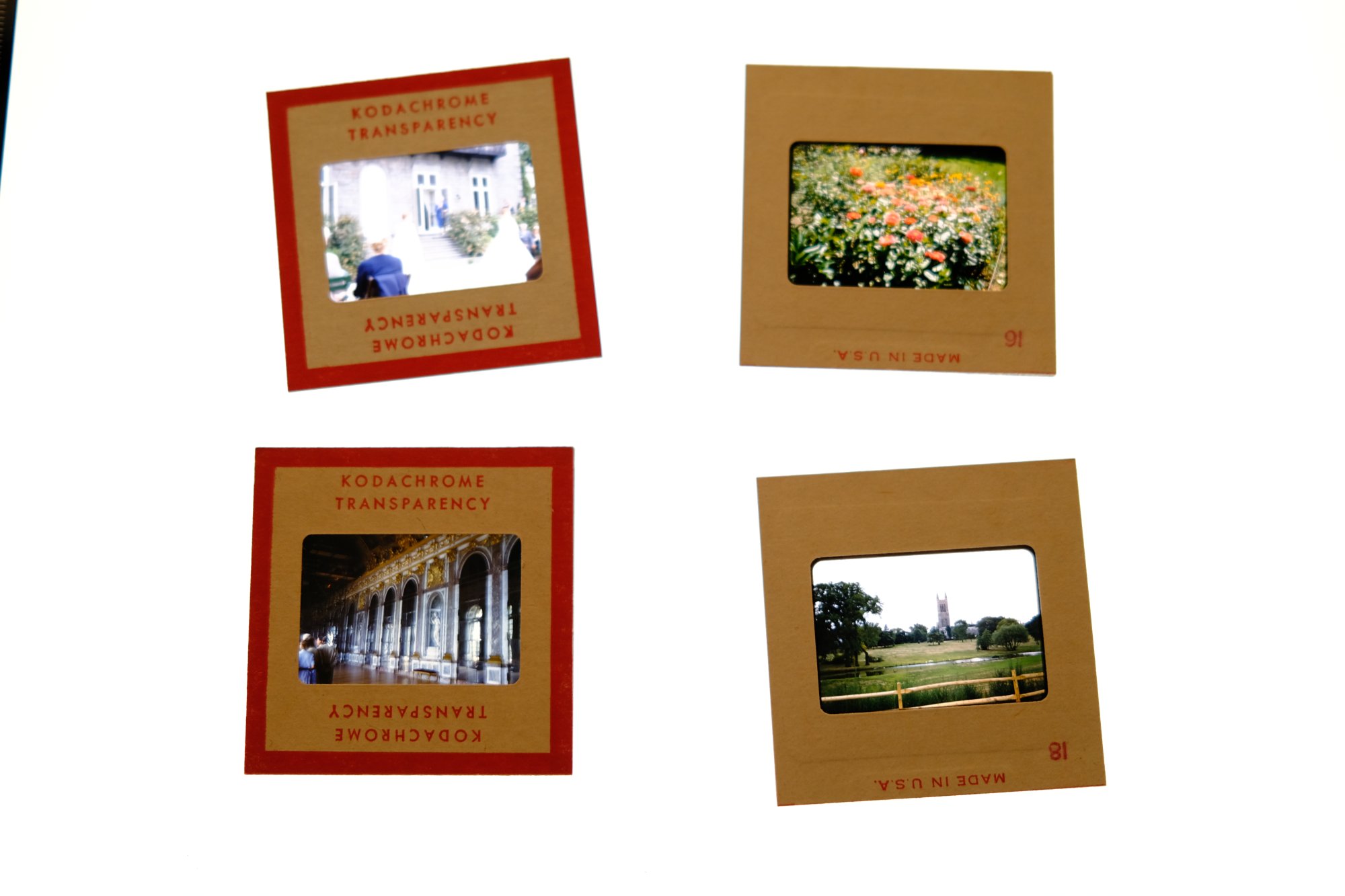
The cool thing about Kodachrome slides is that the colors are incredibly vibrant like an old Technicolor movie and one side is blank for rubber-stamping.
For those who don't know, Kodachrome was a complicated development process with brilliant colors and it no longer exists.
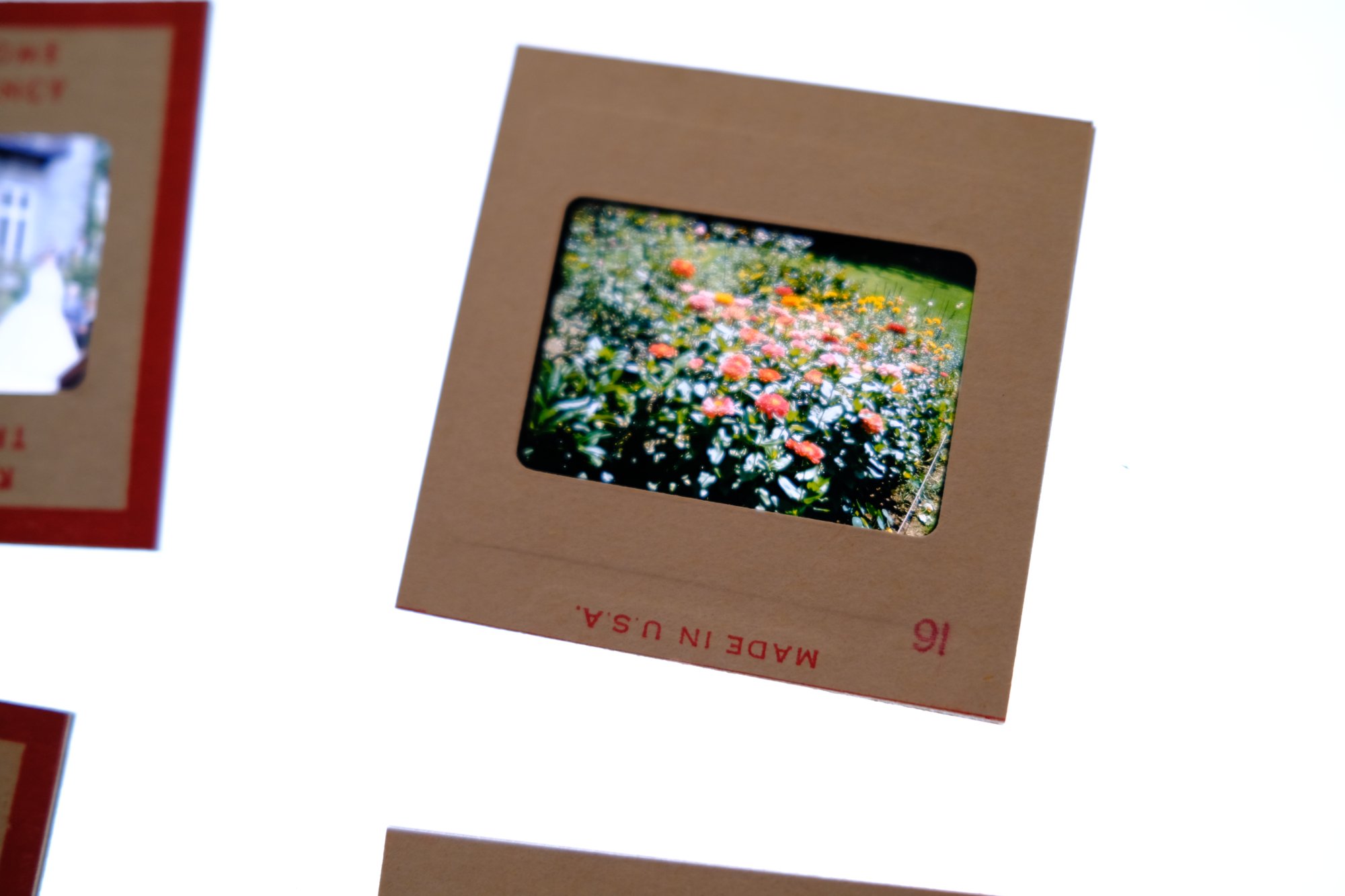
Now, when I meet a stranger whose photo I would like to take, in addition to dressing myself well and some other strategies I'm experimenting with, I'll be able to hand them a piece of film with my name and a website where their portrait might show up.
You should totally use slides as your business card if you're a photographer. And if you're not a photographer, what might be out there, readily available, with a little bit of space on it where you could print or rubber stamp your contact info?
-
Reading Doesn’t Have to Be a Thing
I picked up a few books yesterday and looked at them, nothing more. I opened the books and saw some words on the pages, thought a little bit about what the words said. I think I enjoyed this. It doesn’t have to be a Thing. 👇
For the last many years, I’ve made reading a Thing. I’m doing it to Get Better, to Unlock Secrets, to Improve Myself.
That was miserable. Well, maybe not miserable, but it certainly wasn’t fun. And so eventually I stopped doing it.
I’m surrounded by books. I’ve got hundreds of them. These are books I’m interested in.
For the past 20 years, I’ve thought “I should read these.”
I read some of them. A lot of them actually, but only those that were justified. Also, I didn’t read them well enough.
Also, I’m a slow reader, so I read a dozen books about how to read faster. https://twitter.com/zachphillips/status/1380987390857207815?s=20
Now the pile of books I was supposed to read at one point is so large that I walk past it, vaguely resentful. Under the resentment is a sadness.
I miss exploring.
Exploring is a different concept from reading, at least the way I’ve perverted the concept of reading.
Exploring isn’t a Thing. Reading has become a Thing. I’m done with Reading.
So I’m going to go grab another book off the shelf, look at it, see what it looks like on the pages for a few minutes. Maybe there will be something there. If so, great. If not, it doesn’t matter. It doesn’t have to be a Thing.
Holy shit Jefferson Davis eloped with Zachary Taylor’s daughter (Zachary Taylor hated his ass) and then she immediately died and then Davis won some war shit for Zachary Taylor and Zachary Taylor said his daughter was a better judge of character than he was.
How ’bout that shit?
-
Reading Doesn't Have to Be a Thing
I wrote about a strategy I'm using to reconnect with reading for pleasure, something I haven't done in far too long.
I picked up a few books yesterday and looked at them, nothing more. I opened the books and saw some words on the pages, thought a little bit about what the words said. I think I enjoyed this. It doesn't have to be a Thing. 👇
For the last many years, I've made reading a Thing. I'm doing it to Get Better, to Unlock Secrets, to Improve Myself.
That was miserable. Well, maybe not miserable, but it certainly wasn't fun. And so eventually I stopped doing it.
I'm surrounded by books. I've got hundreds of them. These are books I'm interested in.
For the past 20 years, I've thought "I should read these."
I read some of them. A lot of them actually, but only those that were justified. Also, I didn't read them well enough.
Now the pile of books I was supposed to read at one point is so large that I walk past it, vaguely resentful. Under the resentment is a sadness.
I miss exploring.
Exploring is a different concept from reading, at least the way I've perverted the concept of reading.
Exploring isn't a Thing. Reading has become a Thing. I'm done with Reading.
So I'm going to go grab another book off the shelf, look at it, see what it looks like on the pages for a few minutes. Maybe there will be something there. If so, great. If not, it doesn't matter. It doesn't have to be a Thing.
Holy shit Jefferson Davis eloped with Zachary Taylor's daughter (Zachary Taylor hated his ass) and then she immediately died and then Davis won some war shit for Zachary Taylor and Zachary Taylor said his daughter was a better judge of character than he was.
How 'bout that shit?
-
Kintsukuroi
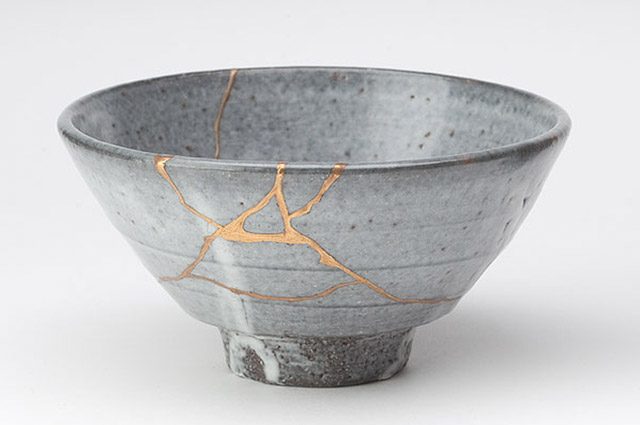
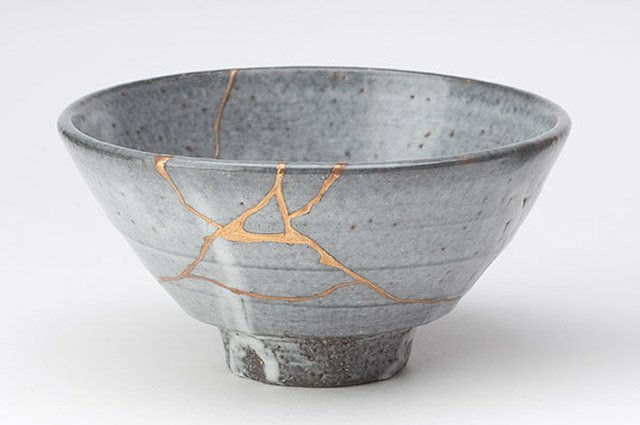
One of my very favorite concepts in the infinite ocean of metaphor is kintsukuroi, the Japanese art of repairing broken pottery with resin mixed with precious metals. The repaired object is both stronger and more beautiful than the original. 👇
Kintsukuroi is a reminder that things are worth fixing, and not simply to recoup losses.
Kintsukuroi is a reminder that much of life should be spent fixing things that are broken, in ourselves, in others, in the world around us.
Kintsukuroi is a reminder that no matter how broken we feel at times, our brokenness is ultimately no more than an expression of our beauty.
Kintsukuroi is a reminder that every setback can make us stronger and better in a way that only a setback can.
Kintsukuroi is a reminder that life is messy, that evolution is a series of mistakes, that growth in resilience is inevitable, unstoppable, automatic.
Someday I would love to own one of these objects or make one myself. I can’t think of a more beautiful or hopeful artistic expression of the truth of lived experience.
-
Kintsukuroi
I wrote about kintsukuroi, probably my single favorite metaphor.
One of my very favorite concepts in the infinite ocean of metaphor is kintsukuroi, the Japanese art of repairing broken pottery with resin mixed with precious metals. The repaired object is both stronger and more beautiful than the original. 👇
Kintsukuroi is a reminder that things are worth fixing, and not simply to recoup losses.
Kintsukuroi is a reminder that much of life should be spent fixing things that are broken, in ourselves, in others, in the world around us.
Kintsukuroi is a reminder that no matter how broken we feel at times, our brokenness is ultimately no more than an expression of our beauty.
Kintsukuroi is a reminder that every setback can make us stronger and better in a way that only a setback can.
Kintsukuroi is a reminder that life is messy, that evolution is a series of mistakes, that growth in resilience is inevitable, unstoppable, automatic.
Someday I would love to own one of these objects or make one myself. I can't think of a more beautiful or hopeful artistic expression of the truth of lived experience.
-
Subvocalization
I was almost 35 when I found out that all of you voracious, fast, “good readers” have been CHEATING FOR THIS ENTIRE TIME.
No one told me that reading doesn’t have to be Alec Baldwin’s voice in your head, speaking aloud every word of every sentence in perfect dramatic cadence. 👇
There’s a word for this, it’s called “subvocalization,” and it’s why it takes me two months to read a book that my wife can “read” in three days. It’s also one of the reasons I’ve felt like a stupid and inadequate reader my whole life.
I’ve tried six or eleven methods to stop subvocalizing but it always goes a) this is uncomfortable and disrespectful to the person who has crafted these words, b) I’m cheating, c) why am I cheating?, d) am I getting any of this?, and e) back to Alec Baldwin’s dulcet tones.
Imagine a child reading aloud in class, tripping on a word or an incorrect emphasis in a sentence, then going back and starting that sentence again. This is how I read a book. This is what’s going on in my head. No one told me there was any other way to do this.
I guess I should have deduced from my basic understanding of physics and the time/space continuum when I saw the reading list of a graduate student or a bunch of discovery material in the hands of a lawyer that these motherfuckers aren’t actually reading this stuff.
But why didn’t you at least tell people like me the secret, like “Hey Zach, listen… no one is reading every word of these books. That’s not a thing. That takes forever. We just kind of figure out what the ideas are and move along.”
There have been a lot of people who have helped me in my life, but somehow, it never even occurred to a “fast reader” to let me know that they aren’t actually reading and that I can stop feeling like a big dummy.
In fact when I’ve told “fast readers” of my slowness, they’ve said “Oh, that is slow, poor guy.” That’s it.
I’d like to be charitable and say it’s just that they take it for granted but that would betray that upon discovering how to cheat they hid it for life.
Not charitable.
The one casualty of my subvocalization (listen to me, talking about actually reading words like it’s some kind of disease) is that I haven’t found time to read fiction as an adult. I write fiction, and I enjoy reading it, but I have work and kids and… that’s a lot of time.
You better believe that even if one day I do learn to consume nonfiction and history rapidly without subvocalization, I am not reading fiction that way. Hell no. Someone wrote that shit. There are characters experiencing things and shit. Every em dash has—dramatic meaning.
Are these words or what? Why spend time crafting a decent sentence when people are going to read them like bullets on a stock PowerPoint slide?
The truth is I’m bitter. I’ve got a bookcase full of books and I’ll never have time to read them all the way I want to.
I’m not bitter at the “fast readers” for this, because they don’t have time to read them either. I’m bitter at them because they’ll say they did.
-
Subvocalization
I wrote about being a slow reader and how angry I am that all the "fast readers" never let me in on the fact they all cheat.
I was almost 35 when I found out that all of you voracious, fast, "good readers" have been CHEATING FOR THIS ENTIRE TIME.
No one told me that reading doesn't have to be Alec Baldwin's voice in your head, speaking aloud every word of every sentence in perfect dramatic cadence. 👇
There's a word for this, it's called "subvocalization," and it's why it takes me two months to read a book that my wife can "read" in three days. It's also one of the reasons I've felt like a stupid and inadequate reader my whole life.
I've tried six or eleven methods to stop subvocalizing but it always goes a) this is uncomfortable and disrespectful to the person who has crafted these words, b) I'm cheating, c) why am I cheating?, d) am I getting any of this?, and e) back to Alec Baldwin's dulcet tones.
Imagine a child reading aloud in class, tripping on a word or an incorrect emphasis in a sentence, then going back and starting that sentence again. This is how I read a book. This is what's going on in my head. No one told me there was any other way to do this.
I guess I should have deduced from my basic understanding of physics and the time/space continuum when I saw the reading list of a graduate student or a bunch of discovery material in the hands of a lawyer that these motherfuckers aren't actually reading this stuff.
But why didn't you at least tell people like me the secret, like "Hey Zach, listen... no one is reading every word of these books. That's not a thing. That takes forever. We just kind of figure out what the ideas are and move along."
There have been a lot of people who have helped me in my life, but somehow, it never even occurred to a "fast reader" to let me know that they aren't actually reading and that I can stop feeling like a big dummy.
In fact when I've told "fast readers" of my slowness, they've said "Oh, that is slow, poor guy." That's it.
I'd like to be charitable and say it's just that they take it for granted but that would betray that upon discovering how to cheat they hid it for life.
Not charitable.
The one casualty of my subvocalization (listen to me, talking about actually reading words like it's some kind of disease) is that I haven't found time to read fiction as an adult. I write fiction, and I enjoy reading it, but I have work and kids and... that's a lot of time.
You better believe that even if one day I do learn to consume nonfiction and history rapidly without subvocalization, I am not reading fiction that way. Hell no. Someone wrote that shit. There are characters experiencing things and shit. Every em dash has—dramatic meaning.
Are these words or what? Why spend time crafting a decent sentence when people are going to read them like bullets on a stock PowerPoint slide?
The truth is I'm bitter. I've got a bookcase full of books and I'll never have time to read them all the way I want to.
I'm not bitter at the "fast readers" for this, because they don't have time to read them either. I'm bitter at them because they'll say they did.
-
My “12 Favorite Problems” (One Year Ago)
A year ago I took @fortelabs’s course Building a Second Brain. If you’re ready to be done organizing forever because you’ve spent hundreds of hours designing complex systems that don’t work, I highly recommend BASB.
One early exercise was to write our 12 Favorite Problems. 👇
These 12 Favorite problems are supposed to help focus and prompt me, but it appears I was in a philosophical mood. Not sure how focusing these questions are:
-
Why is suffering necessary? Why is violence necessary? Is competition possible without violence in some form? Do non-competitive people need to be protected from competitive people?
-
Do the ends justify the means?
-
Are there things that can’t be reduced to data or science? Do completely unknowable things have value? Perhaps more value than knowable things?
-
Can great things (in incredibly expensive fields) be achieved without opportunistic investment? Can resources be equitably distributed?
-
Why is privacy sacred (because it is)?
-
Can anything, even the most volatile, radioactive material, be diluted out with enough water? Can the deepest darkness actually be overwhelmed by the tiniest amount of light?
-
Can a human being actually help more than they hurt?
-
Does guilt and shame actually serve a useful purpose?
-
Which presumed “Rules of Nature” are actually just cultural/human-designed rules that can be changed/discarded?
-
Are there things that feel like suffering that are not, in fact, suffering?
-
Are people basically good? Is there a grain of good at the core of even the most evil acts?
-
If free will is the last bastion of magical thinking, does that change anything about how we must act?
Are these problems still my 12 Favorite Problems today? Mostly, I think, yes. But there are some more real, tangible problems that I explore in my day-to-day that might point toward these things.
These types of questions don’t seem to respond as well to direct inquiry.
-
-
My "12 Favorite Problems" (One Year Ago)
I wrote about an exercise I did in a course I took a year ago.
A year ago I took @fortelabs's course Building a Second Brain. If you're ready to be done organizing forever because you've spent hundreds of hours designing complex systems that don't work, I highly recommend BASB.
One early exercise was to write our 12 Favorite Problems. 👇
These 12 Favorite problems are supposed to help focus and prompt me, but it appears I was in a philosophical mood. Not sure how focusing these questions are:
1. Why is suffering necessary? Why is violence necessary? Is competition possible without violence in some form? Do non-competitive people need to be protected from competitive people?
2. Do the ends justify the means?
3. Are there things that can't be reduced to data or science? Do completely unknowable things have value? Perhaps more value than knowable things?
4. Can great things (in incredibly expensive fields) be achieved without opportunistic investment? Can resources be equitably distributed?
5. Why is privacy sacred (because it is)?
6. Can anything, even the most volatile, radioactive material, be diluted out with enough water? Can the deepest darkness actually be overwhelmed by the tiniest amount of light?
7. Can a human being actually help more than they hurt?
8. Does guilt and shame actually serve a useful purpose?
9. Which presumed "Rules of Nature" are actually just cultural/human-designed rules that can be changed/discarded?
10. Are there things that feel like suffering that are not, in fact, suffering?
11. Are people basically good? Is there a grain of good at the core of even the most evil acts?
12. If free will is the last bastion of magical thinking, does that change anything about how we must act?
Are these problems still my 12 Favorite Problems today? Mostly, I think, yes. But there are some more real, tangible problems that I explore in my day-to-day that might point toward these things.
These types of questions don't seem to respond as well to direct inquiry.
-
The First Step
It has begun. I did the first short walk today with my friend and colleague Newton. I have a tendency to make projects bigger than they need to be, and I’ve done that here, but with an emphasis on ease and sustainability. 👇 https://twitter.com/zachphillips/status/1371624441952755712?s=20
Now, in addition to shooting a roll of film, I’m also wearing a GoPro. I just think it would be a cool hyperlapse to really quickly walk down every road in Philadelphia (I mean, come on, that would be cool) and it takes little effort other than to remember to charge the GoPro.
Then I realized that since I’m wearing a GoPro and walking with a friend, I may as well mic us both up running our separate wireless audio into the GoPro. This way if we have a cool conversation I could maybe use it for something later. I don’t know, a podcast?
And of course, since I have video of each walk, I could easily turn that video into little photo walk videos where when you hear the shutter you can then cut away to the picture that’s been taken.
Another thing I’ll need to have is a “calling card” I can give to people if I ask to take their portrait. This way they can go check out the project somehow, see if their portrait made it in. I have a very specific idea for this business card of course… More on that later.
You can see how this project is spiraling out of control, right?
Anyway, this is what’s wrong with me. But I think I’m actually doing this.
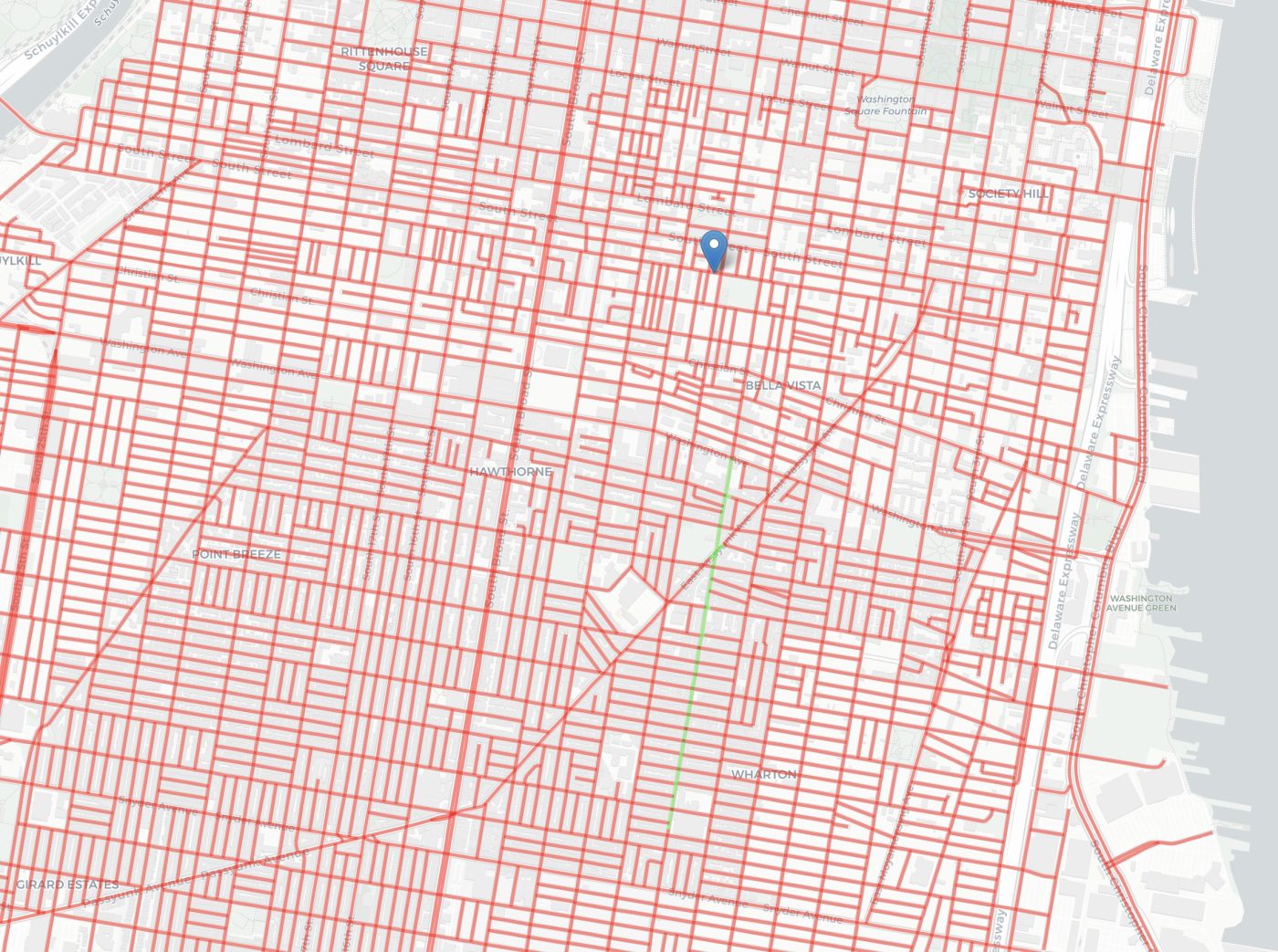
Look at that first little sprout of green… Can you see it?
Can you see it now? I’m gonna ALL that red to green. Just watch.

-
The First Step
I wrote about The first step on the journey to walk every street in the city of Philadelphia. -
The Original Recipe: Authenticity
Here’s some more detail on the second core ingredient of story that we measure in my production house’s creative process. It’s the trickiest of all: Authenticity
It’s also the only ingredient that should never be compromised. 👇 https://twitter.com/zachphillips/status/1356984868954132480?s=20
Authenticity is about point of view. Who is telling this and why should I trust them? Vulnerability is not a core competency of Brands™ and when most of them “speak,” they sound like the most insufferable person you got stuck with at your table at the networking luncheon.
Vulnerability is a scary concept for marketers, and honestly it shouldn’t even be necessary here. The reason I go all the way to Vulnerability is because we usually start in a place that’s so far from Authenticity that if we aim for Vulnerability we might end up at Authenticity.
Everyone already knows your organization isn’t perfect. Everyone already knows you have an agenda, that you’re conflicted and struggling and don’t know what to do/who you are sometimes. But what are your real aspirations? How do you wish you were?
Fun fact: Who you most wish you were deep down is actually who you really are. Okay, back to marketing speak.
When I say authenticity is tricky, what I mean is that there can appear to be an incredibly sharp drop off a cliff from authentic to “phony garbage, instantly ignore.”
Politicians are the absolute worst at this, which is a problem because authenticity is increasingly the most important political currency. Voters are getting more and more sharply attuned to it.
These days, the most authentic-feeling (emphasis on “feeling”) candidate wins.
You can walk into a room, look someone in the eye, and almost immediately get a read on what their intentions are, whether they mean well or you just “have a bad feeling about them.” Cats to this too. Startle a cat and where does the cat look? Right at your eyes. To get a read.
I don’t have a uniform way to enhance any story’s level of Authenticity, but I can tell you that one way to ensure authenticity is to talk about something you’re passionate about (not yourself, as it’s scientifically impossible to be passionate about yourself).
This means to tell someone else’s story. To speak to the most exciting change you’re hopeful about. Saying how great you are leads only to one of three reactions:
- Of course YOU think you’re great.
- You don’t believe that.
- Yuck.
Stop talking about yourself.
Start describing what you do and why you do what you do and notice what brings on the most emotion.
What gets you fired up or choked up?
Follow that feeling to your authentic point of view. That’s the place you must tell your story from.
-
The Original Recipe: Authenticity
I wrote about Authenticity, the second core ingredient in my production house's Original Recipe™ creative process. -
Sensations and Stories of Sensations
I sometimes worry that I’ll never be able to reconnect with bodily sensations. I shut them down and out so hard for so long.
But I then I can realize that the worry is a bodily sensation and prove the worry false. 👇
Today I was feeling a kind of resistance that is very familiar to me. It comes up whenever something I want to do lines up with something I must do. https://twitter.com/zachphillips/status/1358586981660377088?s=21
I was able to let myself get past it this time simply by noticing the sensation. Not the story of the reason for the sensation, but just the sensation itself.
The story of the reason for the sensation is something like “As soon as I want to and must do something, a voice pops into my head, immediately applying thousands of pounds of pressure: I better do a good job. Underneath that voice is the whisper: ‘You aren’t good enough.’”
The story of the reason for the sensation is actually very helpful to understand, and the experience of the story itself is a kind of sensation, but I digress…
Thinking about/acknowledging the story can weaken it, but it can also strengthen it, unfortunately.
But noticing the sensation itself without the story—a tightness in the jaw, shallowness of breath, a sense of weight, heaviness, the desire to get the hell away from something unpleasant—really noticing it, I can sometimes break free from the power of that resistance.
Suddenly, I can find myself not only doing the thing I was resisting, but enjoying it. No negotiation, no dialogue, no fight. Simply noticing.
The bottom line, I think, is that a felt sense will always be more powerful, more interesting, more captivating than any language I can make up to describe it. Even a brilliant complex narrative will grow stale and bland and boring with time.
A sensation is always fresh, tingly.
-
Sensations and Stories of Sensations
I wrote about noticing the sensation of resistance as a solution to resistance.
I sometimes worry that I'll never be able to reconnect with bodily sensations. I shut them down and out so hard for so long.
But I then I can realize that the worry is a bodily sensation and prove the worry false. 👇
I was able to let myself get past it this time simply by noticing the sensation. Not the story of the reason for the sensation, but just the sensation itself.
The story of the reason for the sensation is something like "As soon as I want to and must do something, a voice pops into my head, immediately applying thousands of pounds of pressure: I better do a good job. Underneath that voice is the whisper: 'You aren't good enough.'"
The story of the reason for the sensation is actually very helpful to understand, and the experience of the story itself is a kind of sensation, but I digress...
Thinking about/acknowledging the story can weaken it, but it can also strengthen it, unfortunately.
But noticing the sensation itself without the story—a tightness in the jaw, shallowness of breath, a sense of weight, heaviness, the desire to get the hell away from something unpleasant—really noticing it, I can sometimes break free from the power of that resistance.
Suddenly, I can find myself not only doing the thing I was resisting, but enjoying it. No negotiation, no dialogue, no fight. Simply noticing.
The bottom line, I think, is that a felt sense will always be more powerful, more interesting, more captivating than any language I can make up to describe it. Even a brilliant complex narrative will grow stale and bland and boring with time.
A sensation is always fresh, tingly.
-
Practical Paradoxes
A growing list of practical paradoxes. 👇
The human fixation on bad things is strong evidence of our deepest goodness.
Constraints are necessary for freedom.
Pursuing happiness leads to less happiness.
Making everything easier makes everything harder.
Effort produces much less than non-effort produces.
Attempting to lose weight almost always leads to weight gain.
Focusing on quality over quantity leads to lower quality.
For a game to work, everyone needs to be invested in the game, meaning that they need to suspend their disbelief that it is a game. And every attempt at organizing or cooperating in the world is a game.
Speed of learning is limited only by how much one can slow down.
The best way to remember things is not to try to remember them.
The best way to achieve goals is to no longer care about them.
The only way to give up drug use/drinking/smoking is to stop trying to control them in any way.
Assuming that a choice can be rational is deeply irrational.
Free will is the last bastion of magical thinking, but there is no choice but to behave as though free will exists.
There is no predestination, but there is also no free will: This is equivalent to predestination.
Getting what one wants can only be truly achieved by not wanting it anymore.
Everything that you think is true has once and will once again be shown to be false.
The more someone hates someone else’s shortcoming, the more likely it is a shortcoming of their own.
The more willing one is to fail, the more likely one is to succeed.
The more one learns, the less one knows.
The more one keeps, the less one has.
-
Practical Paradoxes
I started a list of practical paradoxes that I have experienced.
A growing list of practical paradoxes. 👇
The human fixation on bad things is strong evidence of our deepest goodness.
Constraints are necessary for freedom.
Pursuing happiness leads to less happiness.
Making everything easier makes everything harder.
Effort produces much less than non-effort produces.
Attempting to lose weight almost always leads to weight gain.
Focusing on quality over quantity leads to lower quality.
For a game to work, everyone needs to be invested in the game, meaning that they need to suspend their disbelief that it is a game. And every attempt at organizing or cooperating in the world is a game.
Speed of learning is limited only by how much one can slow down.
The best way to remember things is not to try to remember them.
The best way to achieve goals is to no longer care about them.
The only way to give up drug use/drinking/smoking is to stop trying to control them in any way.
Assuming that a choice can be rational is deeply irrational.
Free will is the last bastion of magical thinking, but there is no choice but to behave as though free will exists.
There is no predestination, but there is also no free will: This is equivalent to predestination.
Getting what one wants can only be truly achieved by not wanting it anymore.
Everything that you think is true has once and will once again be shown to be false.
The more someone hates someone else's shortcoming, the more likely it is a shortcoming of their own.
The more willing one is to fail, the more likely one is to succeed.
The more one learns, the less one knows.
The more one keeps, the less one has.
-
A Twitter Thread of Threads
I write threads every day and copy them as blog posts to little dot zachphillips dot blog (my big blog gets no love).
This is a growing thread of threads that provide an introduction to my interests and why someone might care to be internet pals with me. 👇
Here’s one where I fight in vain (I do that a lot) against one of my least favorite words: https://twitter.com/zachphillips/status/1344380428229218310?s=20
The main reason for publishing all this is to learn in public/show my work. I do write about the metawork of that work. Eventually I will focus less on this but it’s a prominent topic at the moment. https://twitter.com/zachphillips/status/1365488179768393731?s=21
The fact that this thread exists, or any of the writing in it, is thanks to a major attitude shift I had about work in 2020. I switched to a non-coercive approach. The shift has been so incredible and so “productive” that I’ve written a lot about it. https://twitter.com/zachphillips/status/1352656836890157060?s=21
I have more useful outlets for my politics, but when emotions run high I do have takes. My persuasions are leftward but I’m open/gentle to conservative ideas and always gentle to people. After the murder of George Floyd I was angry about the media focus. https://twitter.com/zachphillips/status/1267070164287266819?s=20
Here’s a more fun example of my political writing. It’s also an ode to my beloved city of Philadelphia. https://twitter.com/zachphillips/status/1378328063247781889?s=20
I love photography. I hope I can help other people love it too. Here’s me trying to deliver a complete photography course in 5 tweets. https://twitter.com/zachphillips/status/1345391314632896514?s=20
I love filmmaking/radio/storytelling and have devoted most of my professional life to it. Here’s one where I offer some beginner screenwriting tips. https://twitter.com/zachphillips/status/1366770658689097732?s=20
I write other things about filmmaking too. This one is about 24 frames per second and some fundamental misconceptions about the medium. https://twitter.com/zachphillips/status/1343560660555329536?s=21
Oh, and I LOVE mechanical tools, mostly cameras and watches, but other things too. Here’s me talking about one of my favorite mechanical things (there’s also video of me actually talking). https://twitter.com/zachphillips/status/1352444772863139840?s=21
My love for mechanical things extends also to bicycles and trains and a general nostalgia/yearning for things that I believe society prematurely threw in the trash. https://twitter.com/zachphillips/status/1353155123460132864?s=21
I’m definitely not all gears and springs. I also love—love isn’t the right word—let’s say I “have an unhealthy obsession with” software. I’m the chief of product at a web startup and I’m always thinking about ways to make the web better. Here’s one idea. https://twitter.com/zachphillips/status/1342888423057743872?s=20
I have product ideas on a daily basis—way too many to ever dream of making them all. I’ve found writing about them and offering them as wishes to the world is a nice way to make the ideas not bother me so much. Here’s one example. https://twitter.com/zachphillips/status/1341437359934623746?s=20
I’ve been “on my own” as a freelancer and eventually a business owner dealing with things like payroll and performance reviews for the past 10 years. I sometimes write about lessons learned from that experience. https://twitter.com/zachphillips/status/1344653061843775489?s=21
I’ve been practicing various forms of meditation for a few decades. This doesn’t mean I’m “good at it,” whatever that means, but I do write about it in the hope it might leave some breadcrumbs for similar-minded folks looking for entrypoints to practice. https://twitter.com/zachphillips/status/1350497218982248451?s=21
-
A Twitter Thread of Threads
Heading to the Little Blog (Annaliese Bach use Twitter Embed to embed all the tweets below in the blog post)
I wrote a Twitter thread of threads to pin to the top of my Twitter profile where I can just keep the ones I think are a good introduction to me.
All of my daily microblog posts are also posted to Twitter as threads, and while I hate the existence of Twitter as a company/monopoly, composing posts as threads has been an incredibly useful constraint for me. I've also met some wonderful people on Twitter, so for now, I'll keep putting these things in both places until the day that Twitter eventually meets its deserved fate.
Here's the main thread of threads now pinned to my profile, and below it is that full list of threads as it stands today.