The Little Rebellion
The social feed — little posts written here and everything syndicated elsewhere, in one stream.
-
No Reasons
How can you make it so that everything you do is for no reason at all?
In my case, I’ve needed to lose trust that reasons help. I’ve needed to become suspicious of reasons in general. 👇
It seems like having reasons to do a thing should help motivate you to do it. This assumption sure seems reasonable.
But what if it’s the opposite? What if reasons apply pressure which creates unnatural resistance to the thing which you would already naturally do for no reason?
Ask a child why they’re building a tower or moving on from the current crayon to choose another color. They’ll just look at you funny or mumble something incoherent.
The real answer is something like “…..because fuck you, that’s why, stop asking dumb questions.”
Studies have shown over and over again that if you take a kid who naturally doodles and draws pictures and then institute a “reward” (reason) for their drawing, they will draw less.
Yet we try to motivate ourselves with reasons.
The truth is that there’s no real reason to do almost anything. When we transform our self-orientation to boss/worker or drill-sergeant/cadet, reasons emerge as just another tool to coerce ourselves to do things. To BE BETTER.
When reasons emerge for why I should do something, the most effective strategy I’ve found is to notice them. There they are. Like clockwork. These reasons think they’re very important and interesting. They think they can help me.
They are boring and useless.
DRILL SERGEANT Okay, time to do that thing. You really should do this thing because—
CHILD Because fuck you, that’s why. Gimme that plastic vegetable. I’m gonna put it in this pot. I’m not playing with you right now.
-
No Reasons
I wrote about how demotivating reasons are. -
I Love to Argue
It turns out, some people don’t like argument. Worse than that: Argument makes them feel attacked. 🤯
Debate might be my favorite thing: for understanding, for fulfillment, or just for fun. It took until my thirties for me to learn there are many who don’t like it at all. 👇
Of all the things I’m not proud to have taken so long to learn, this might be the worst.
All the times I was puzzled when someone shrunk away or changed the subject or simply avoided disagreement with me altogether… It never occurred to me that they might not enjoy arguing.
I thought maybe they weren’t as committed to their positions or not as quick with their rebuttals but… how could you not enjoy arguing? That’s like not enjoying winning. Or something.
To make matters worse, many of these people who don’t like argument have been those closest to me.
In recent years I’ve begun to learn to tone it down, but I would say I still have a ways to go.
I really would never want to make anyone feel attacked. Particularly not when I’m just having fun.
This kind of disconnect makes me wonder what other sources of strife in the world are simply people not being able to conceive of how different their personalities might be.
-
I Love to Argue
I wrote about an aspect of my personality that I didn't know was an aspect of my personality.
It turns out, some people don't like argument. Worse than that: Argument makes them feel attacked. 🤯
Debate might be my favorite thing: for understanding, for fulfillment, or just for fun. It took until my thirties for me to learn there are many who don't like it at all. 👇
Of all the things I'm not proud to have taken so long to learn, this might be the worst.
All the times I was puzzled when someone shrunk away or changed the subject or simply avoided disagreement with me altogether… It never occurred to me that they might not enjoy arguing.
I thought maybe they weren't as committed to their positions or not as quick with their rebuttals but… how could you not enjoy arguing? That's like not enjoying winning. Or something.
To make matters worse, many of these people who don't like argument have been those closest to me.
In recent years I've begun to learn to tone it down, but I would say I still have a ways to go.
I really would never want to make anyone feel attacked. Particularly not when I'm just having fun.
This kind of disconnect makes me wonder what other sources of strife in the world are simply people not being able to conceive of how different their personalities might be.
-
The Failure of AOL Instant Messenger
I don’t want to represent that I have a comprehensive understanding of the history of business, but I can say that in my lifetime, the single greatest corporate failure was America Online not following AOL Instant Messenger to its obvious conclusion. 👇
AIM was the place where an entire generation, the first generation of Digital Natives™ (with experience of the prior world of rotary payphones), connected with one another online, and AOL got nothing from it. The failure is truly astounding.
AIM was where all kids lucky enough to have computers lived, particularly during those awkward sit-on-the-phone-for-hours-sometimes-in-silence-with-boys/girls years. AIM let us conduct multiple conversations with boys/girls simultaneously.
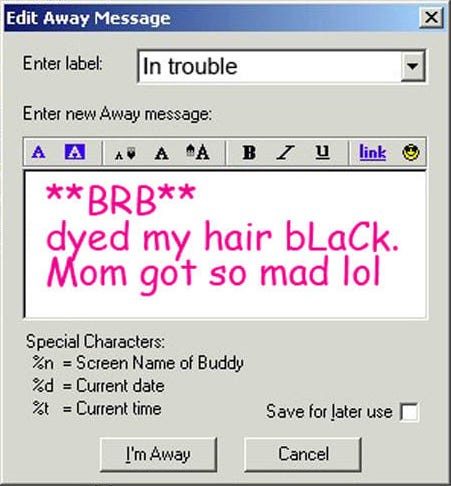
So addicted were most of us to AOL Instant Messenger that, when there was no one around, we would look at each other’s AWAY MESSAGES. These could be styled in different colors.
An entire generation of, the FIRST generation, of web citizens, spent hours curating AWAY MESSAGES.
All these kids were screaming, in bRiGht, cOlorFUL, aLteRnATe CAPS, for a Facebook timeline, for a place to post. AOL had them all!
It’s no wonder they became the first company to fail at trying to own the Internet.
To run AOL Instant Messenger the way it ran in the late 90s is leaving a trillion dollars (actual approximate number) in cash sitting in your car (and not even locking the door because you don’t want to have to fish the key out, yes we unlocked car doors with a key back then).
You can tell me if you think you’ve seen a bigger, more obvious miss. A more catastrophic result of business incompetence. A more spectacular wildfire of hundred dollar bills just from pure negligent oblivion.
I have never seen one. AOL’s failure is truly astonishing.
-
The Failure of AOL Instant Messenger
I wrote about the greatest business failure of my lifetime. -
This Version of Capitalism Is Terrible Game Design
Every time I bring this point up to economically-minded friends, they respond with some version of “alas, this is just how math works 🤷♂️.”
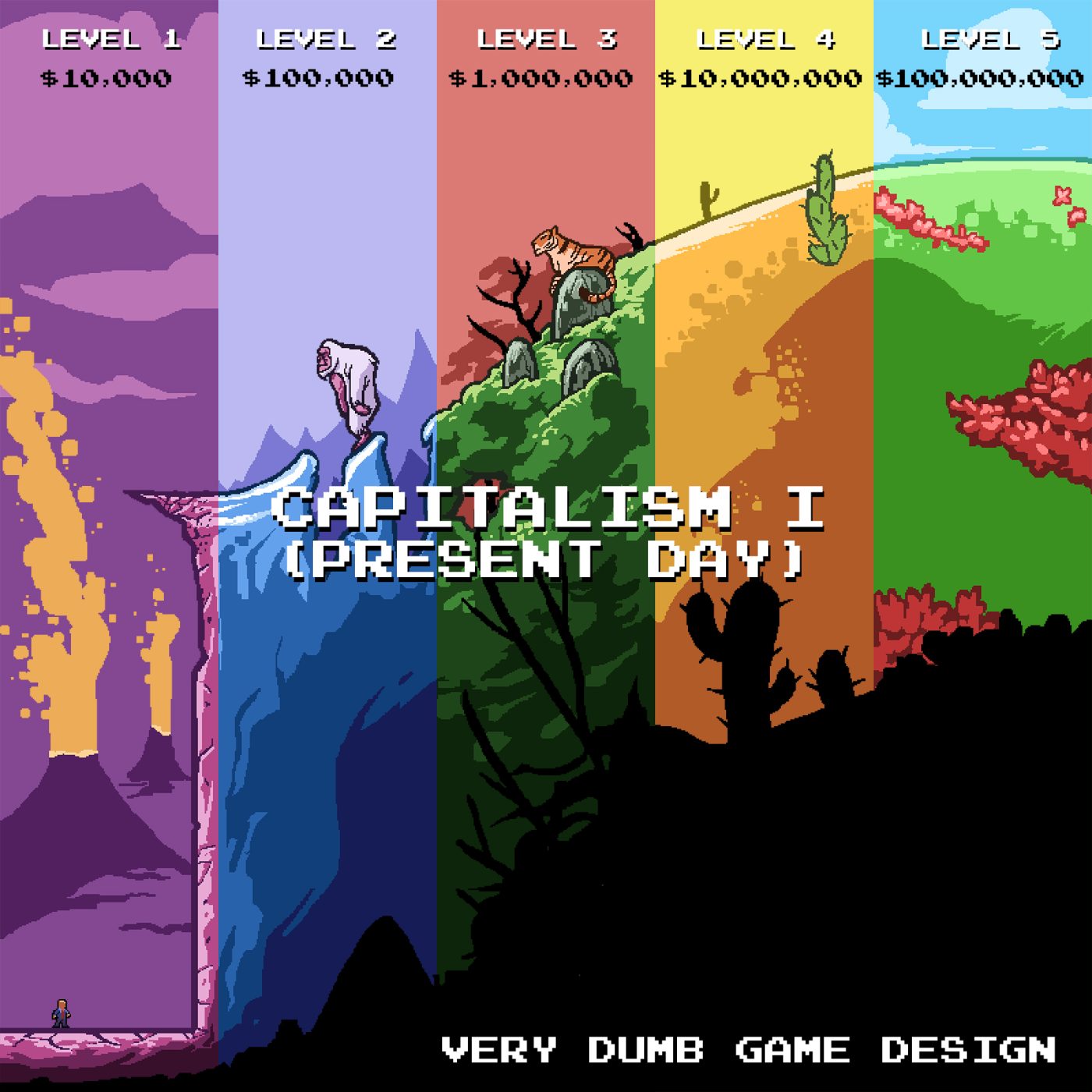
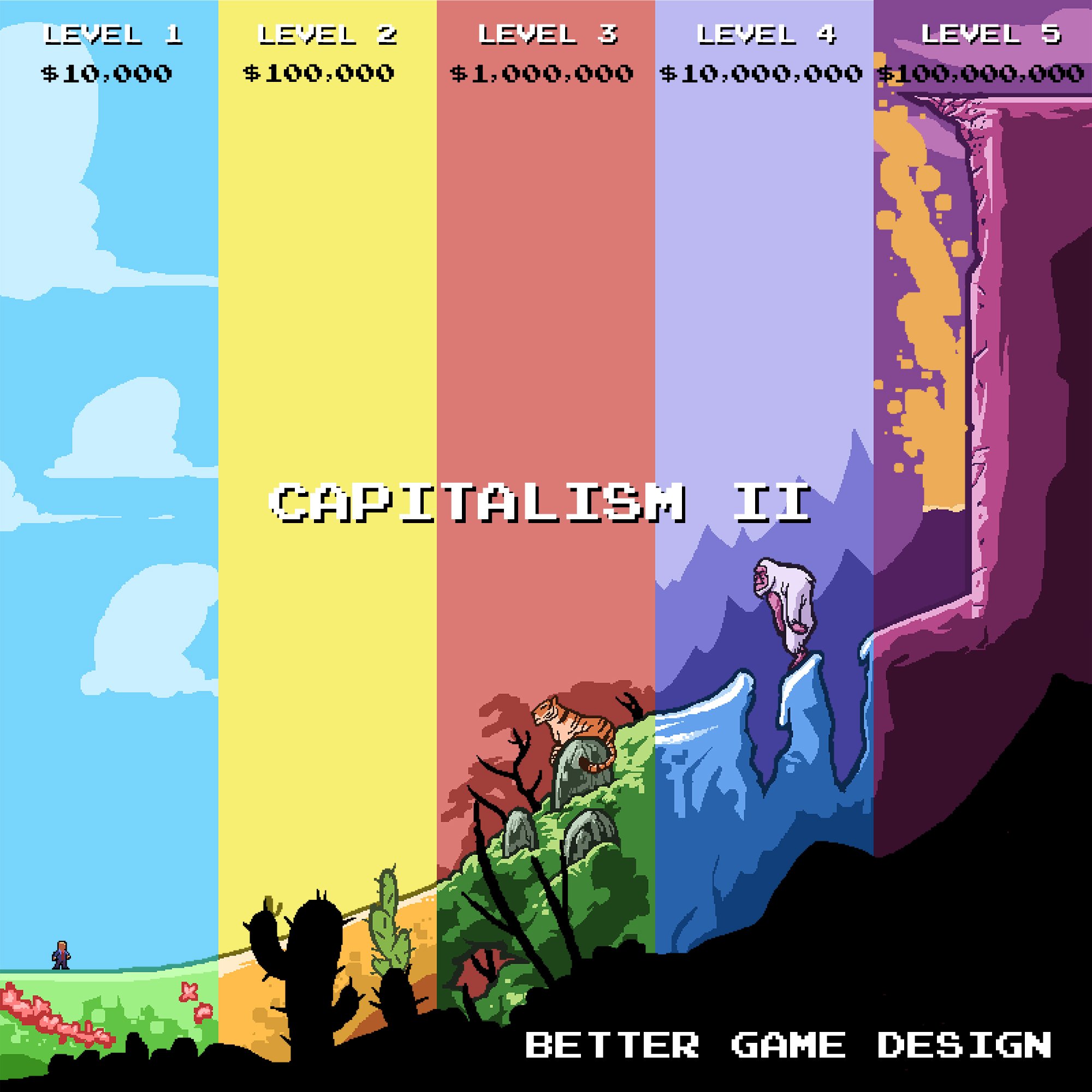
The version of the Capitalism Game we’re playing right now is designed terribly. This is how the levels work, roughly:
There is no good game that is designed like this. The first level is supposed to be easy, then the next level is supposed to be a little harder, and then a little harder, and then it should become very hard.
We’ve set up the rules of Capitalism Game I exactly opposite this.
And to make the design even dumber/more tragic, the “points” in this game translate to actual alleviation of suffering but only in the first few levels. The points amassed beyond that are the equivalent of confetti explosions that don’t even benefit the people who win them 🤦♂️.
And the curve just continues to get flatter. If we’re honest, it ends up going downhill. Once you get to a certain level, the game just starts giving you money.
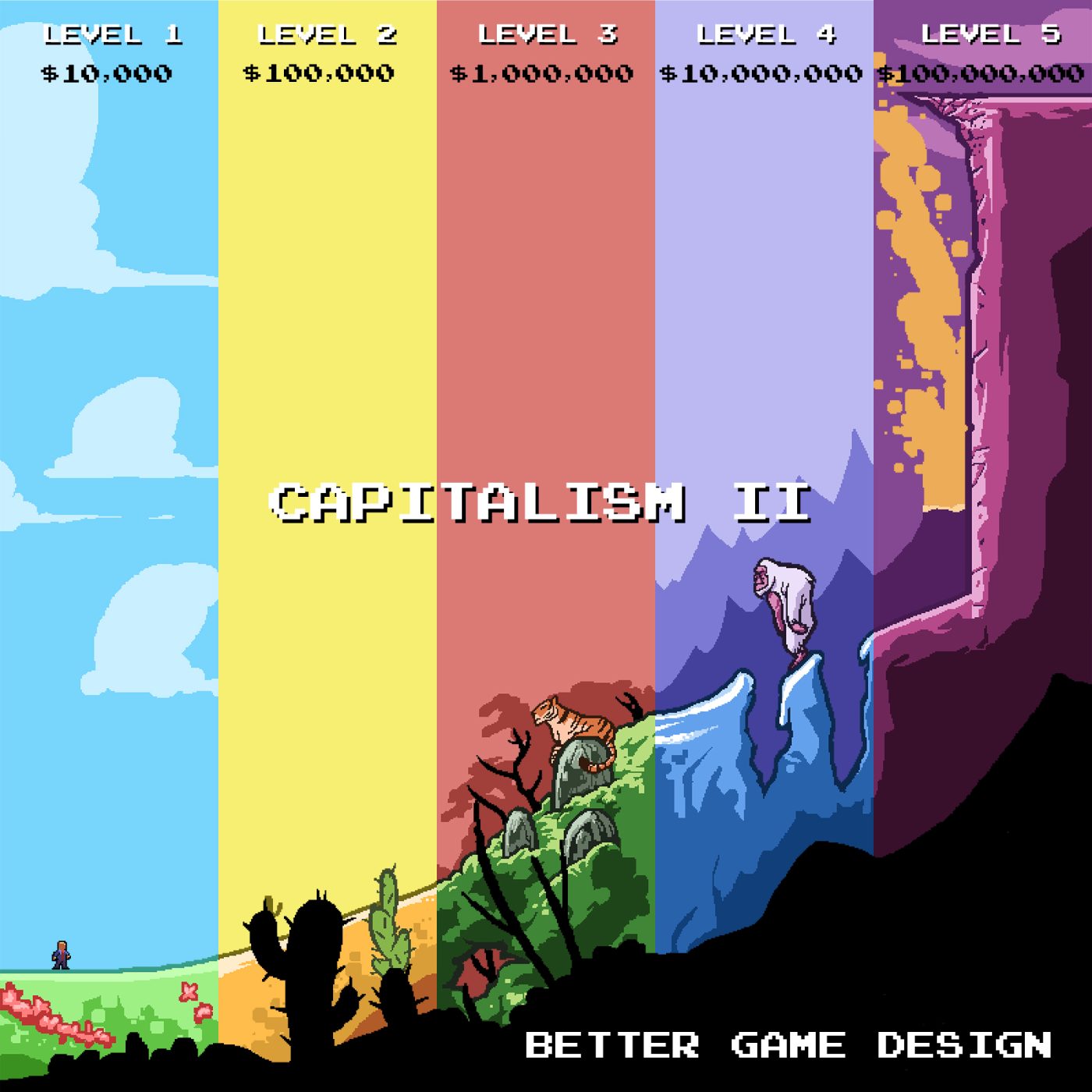
Is there any wonder why people hate this game? What child would play a game where you start at the hardest level?
This is how the Capitalism Game is supposed to work. This is how you design a more fun and humane game. This is a game that would make sense to a human child (it even makes sense to other mammals, in fact).
“So, errrm, the compounding nature of—” use your imagination!
“Actually, errrm, the incentive to invest—” maybe take like eight seconds to think of new ideas while people everywhere lose faith in every institution.
“Well, errrm, punishing success—” USE YOUR FUCKING IMAGINATION.
-
This Version of Capitalism Is Terrible Game Design
I wrote about what I see as the main flaw in the design of our current economic system.
Every time I bring this point up to economically-minded friends, they respond with some version of "alas, this is just how math works 🤷♂️."
The version of the Capitalism Game we're playing right now is designed terribly. This is how the levels work, roughly:
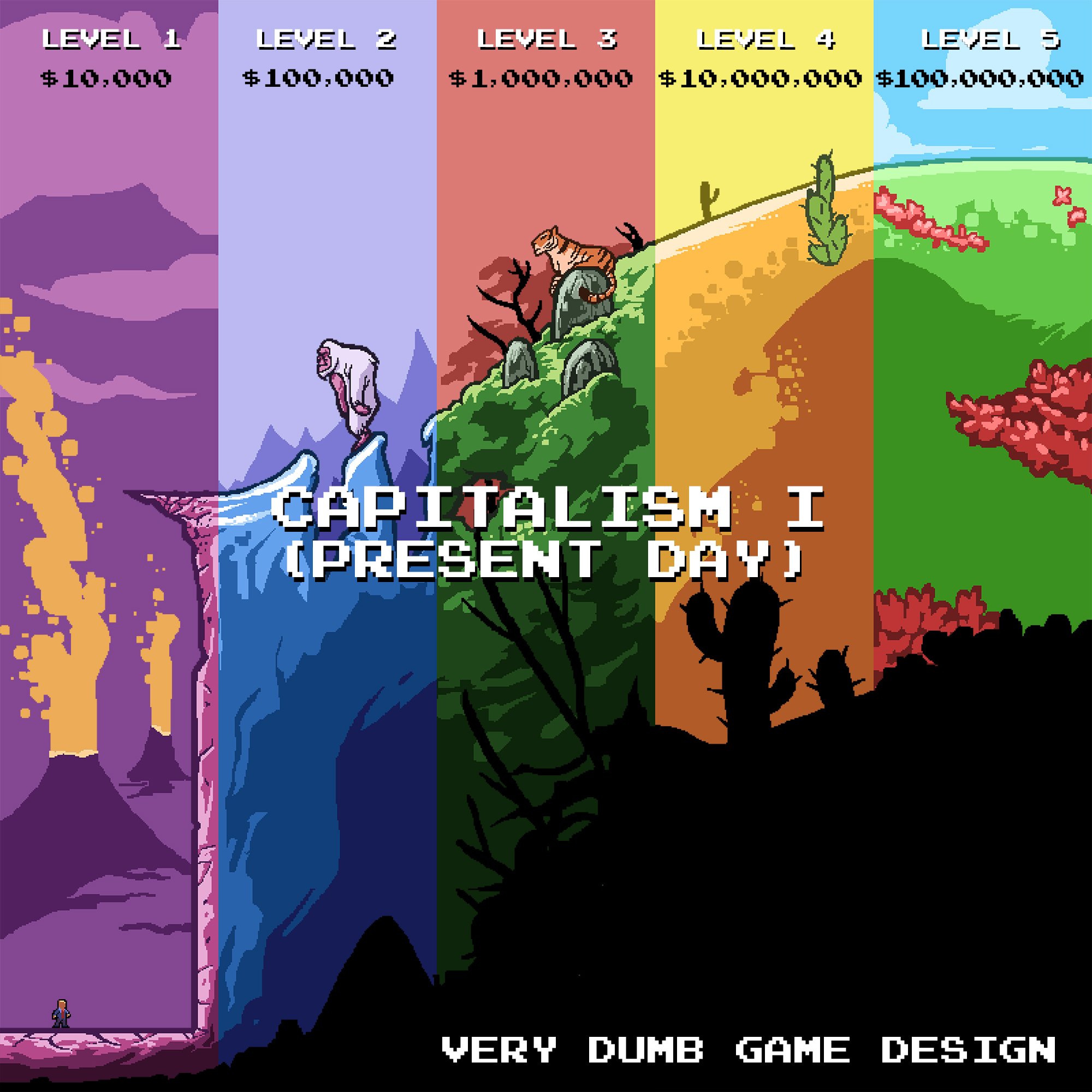
There is no good game that is designed like this. The first level is supposed to be easy, then the next level is supposed to be a little harder, and then a little harder, and then it should become very hard.
We've set up the rules of Capitalism Game I exactly opposite this.
And to make the design even dumber/more tragic, the "points" in this game translate to actual alleviation of suffering but only in the first few levels. The points amassed beyond that are the equivalent of confetti explosions that don't even benefit the people who win them 🤦♂️.
And the curve just continues to get flatter. If we're honest, it ends up going downhill. Once you get to a certain level, the game just starts giving you money.
Is there any wonder why people hate this game? What child would play a game where you start at the hardest level?
This is how the Capitalism Game is supposed to work. This is how you design a more fun and humane game. This is a game that would make sense to a human child (it even makes sense to other mammals, in fact).
"So, errrm, the compounding nature of—" use your imagination!
"Actually, errrm, the incentive to invest—" maybe take like eight seconds to think of new ideas while people everywhere lose faith in every institution.
"Well, errrm, punishing success—" USE YOUR FUCKING IMAGINATION.
-
Hardware Is Good, Now It’s Software’s Turn
It’s one of the three annual Apple holidays tomorrow. Holidays I used to celebrate.
I used to stand in line each year for the new iPhone, and my career has proven over and over again that my fanaticism was 100% justified. Apple products have paid huge dividends for me. 👇
They are the tools I’ve used to create just about everything I’ve ever traded for money. The improvements year over year were reliably excellent and I credit the amazing ecosystem of software developers on iOS for any design thinking (and most of the skills) I have.
I’ve been fascinated by creative tools of all kinds for my entire life and software is particularly exciting: Someone can make a tool that allows an entirely new means of creation. That tool can then be distributed to anyone else in the world, at scale, and virtually for free.
The person building one of these tools, like an Excel or a JavaScript web framework or @RoamResearch, are 100% equivalent to the first human to figure out how to use a hammer and nail. Here’s the thing: The world of software tools is still in its terribly awkward adolescence.
Software is somewhere in the summer between sixth and seventh grade, with braces and the start of some bad acne… It’s a real mess, but with so much potential.
The current class of hardware, however, is pretty mature. Consider the last time you’ve thought the following?
- “Man… This phone is slow.
- “I wish my screens had higher resolution or better color fidelity.”
- “This camera sucks.”
I bet it’s been a while.
There’s a good reason for this: Microprocessors have reached a totally acceptable speed for our brains and fingers to be able to accomplish most of the tasks we need to do. There hasn’t been a noticeable difference in iPhone performance for 99.9% of people since the iPhone X.
While this portends bad things for Apple’s annual-upgrade business plan of the past 13 years, this is a moment for celebration. In terms of hardware, this is it. We made it. We’re here. Our TVs, screens, camera sensors, and microprocessors are… great.
Digital camera sensors have mostly caught up to film (though film is still better/more fun/cheaper/friendlier for the environment/economy), TVs are high resolution (you’ll never need to throw out another DVD collection), phones are fast… Hell, even the Internet is pretty fast.
What’s NEXT? Augmented reality glasses? Plugging computers right into our brains? Hold up, nerds: We aren’t even using good tools/abilities/ecosystems for the devices we have yet. We have the tools, but the functional equivalent of zero people are using them.
You think we’ll be able to make good and useful things for AR glasses? Things that will make an impact like multitouch screens in 2007 or the mouse in 1984?
Look around.
People are mostly scrolling Facebook and Instagram right now. We haven’t done shit with what we have yet.
The next wave of Big Software will be tools that actually benefit people’s lives, not “platforms” that exploit their animal weaknesses. The end of the race to the bottom is nigh. There’s nothing holding us back. We have everything we need, and it’s all pretty good.
-
Hardware Is Good, Now It's Software's Turn
This one is revision of an early PEN in observation of the Apple holiday tomorrow.
It's one of the three annual Apple holidays tomorrow. Holidays I used to celebrate.
I used to stand in line each year for the new iPhone, and my career has proven over and over again that my fanaticism was 100% justified. Apple products have paid huge dividends for me. 👇
They are the tools I’ve used to create just about everything I’ve ever traded for money. The improvements year over year were reliably excellent and I credit the amazing ecosystem of software developers on iOS for any design thinking (and most of the skills) I have.
I’ve been fascinated by creative tools of all kinds for my entire life and software is particularly exciting: Someone can make a tool that allows an entirely new means of creation. That tool can then be distributed to anyone else in the world, at scale, and virtually for free.
The person building one of these tools, like an Excel or a JavaScript web framework or @RoamResearch, are 100% equivalent to the first human to figure out how to use a hammer and nail. Here’s the thing: The world of software tools is still in its terribly awkward adolescence.
Software is somewhere in the summer between sixth and seventh grade, with braces and the start of some bad acne… It’s a real mess, but with so much potential.
The current class of hardware, however, is pretty mature. Consider the last time you’ve thought the following?
1. “Man… This phone is slow. 2. "I wish my screens had higher resolution or better color fidelity.” 3. “This camera sucks.”
I bet it’s been a while.
There’s a good reason for this: Microprocessors have reached a totally acceptable speed for our brains and fingers to be able to accomplish most of the tasks we need to do. There hasn’t been a noticeable difference in iPhone performance for 99.9% of people since the iPhone X.
While this portends bad things for Apple’s annual-upgrade business plan of the past 13 years, this is a moment for celebration. In terms of hardware, this is it. We made it. We’re here. Our TVs, screens, camera sensors, and microprocessors are… great.
Digital camera sensors have mostly caught up to film (though film is still better/more fun/cheaper/friendlier for the environment/economy), TVs are high resolution (you'll never need to throw out another DVD collection), phones are fast… Hell, even the Internet is pretty fast.
What’s NEXT? Augmented reality glasses? Plugging computers right into our brains? Hold up, nerds: We aren't even using good tools/abilities/ecosystems for the devices we have yet. We have the tools, but the functional equivalent of zero people are using them.
You think we'll be able to make good and useful things for AR glasses? Things that will make an impact like multitouch screens in 2007 or the mouse in 1984?
Look around.
People are mostly scrolling Facebook and Instagram right now. We haven’t done shit with what we have yet.
The next wave of Big Software will be tools that actually benefit people's lives, not "platforms" that exploit their animal weaknesses. The end of the race to the bottom is nigh. There's nothing holding us back. We have everything we need, and it's all pretty good.
-
Knob Feel
I’m asked this once a week: “Which microphone|camera|lens|mixer|etc. should I buy?” This always requires a conversation (which I do love to have).
Most of the time, there’s an option that’s 90% as “good” as the 10x-as-costly option, but the expensive one has great knob feel. 👇
Most people don’t really have a choice here. They need to get in as unspendily as possible and even the “cheap” option represents a big investment. But if budget is available, the choice is not as simple as it would seem.
Knob feel matters. A lot.
The difference between a sound file that comes out of a cheap mixer/recorder and a Sound Devices mixer/recorder is like the difference between a filet mignon from Outback and a same-source filet mignon from Ruth’s Chris. Ruth’s Chris will be better, but they’re both filets.
The difference between the feel of using a cheap mixer/recorder and the feel of using a Sound Devices mixer/recorder is the difference between eating an Amtrak-microwave hamburger and a 12-course meal prepared by a Michelin-starred chef.
By the way, I’m mentioning Sound Devices here because they are one of the OG grandmasters of knob feel, but I do have to mention that the legendary Sound Devices knob feel is absent from their MixPre series (which are totally fine, I have one, but that ain’t knob feel, folks).
You can try to convince yourself that you don’t care about the feel of using a tool, but that isn’t true. The creative process is complex and psychologically messy. Sensations, emotions, and friction that come from using creative tools always affect the process and the output.
The good news is that if the only thing that matters to you is output sound/image quality, audio/video prices have never been lower, and quality is pretty much maxed out. https://twitter.com/zachphillips/status/1365690376120582144?s=21
The better news is that, in many cases (I can tell you which ones), investing in tools with knob feel is less costly in the long run than investing in tools with cheap plasticky knobs.
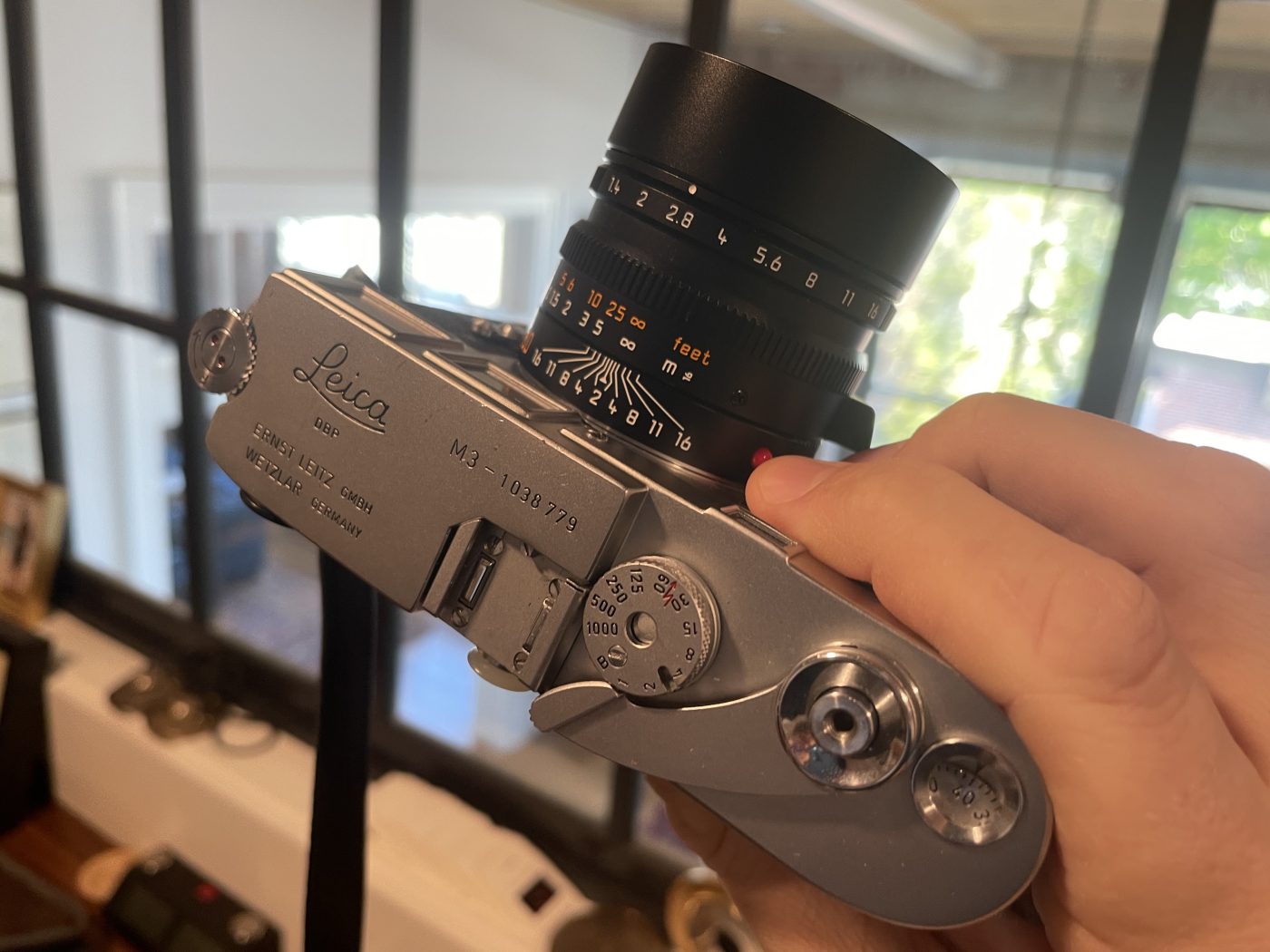
This is my Leica M3. It was manufactured in the 1960s. I could sell it right now to a happy buyer for $2,000 or my great-great-granddaughter can just use it for her entire life and then leave it for her great-great-granddaughter. And the knobs, by God, these knobs…
You’ll always have to pay up front for knob feel.
True knob feel cannot be mass-produced or outsourced. Knob feel requires attention and care. There’s no recurring revenue to attract investment in knob feel.
Many product categories may have experienced their last great knobs…
-
Knob Feel
I wrote about the usual difference between the $500 version and the $5,000 version.
I'm asked this once a week: "Which microphone|camera|lens|mixer|etc. should I buy?" This always requires a conversation (which I do love to have).
Most of the time, there's an option that's 90% as "good" as the 10x-as-costly option, but the expensive one has great knob feel. 👇
Most people don't really have a choice here. They need to get in as unspendily as possible and even the "cheap" option represents a big investment. But if budget is available, the choice is not as simple as it would seem.
Knob feel matters. A lot.
The difference between a sound file that comes out of a cheap mixer/recorder and a Sound Devices mixer/recorder is like the difference between a filet mignon from Outback and a same-source filet mignon from Ruth's Chris. Ruth's Chris will be better, but they're both filets.
The difference between the feel of using a cheap mixer/recorder and the feel of using a Sound Devices mixer/recorder is the difference between eating an Amtrak-microwave hamburger and a 12-course meal prepared by a Michelin-starred chef.
By the way, I'm mentioning Sound Devices here because they are one of the OG grandmasters of knob feel, but I do have to mention that the legendary Sound Devices knob feel is absent from their MixPre series (which are totally fine, I have one, but that ain't knob feel, folks).
You can try to convince yourself that you don't care about the feel of using a tool, but that isn't true. The creative process is complex and psychologically messy. Sensations, emotions, and friction that come from using creative tools always affect the process and the output.
The better news is that, in many cases (I can tell you which ones), investing in tools with knob feel is less costly in the long run than investing in tools with cheap plasticky knobs.
This is my Leica M3. It was manufactured in the 1960s. I could sell it right now to a happy buyer for $2,000 or my great-great-granddaughter can just use it for her entire life and then leave it for her great-great-granddaughter. And the knobs, by God, these knobs...
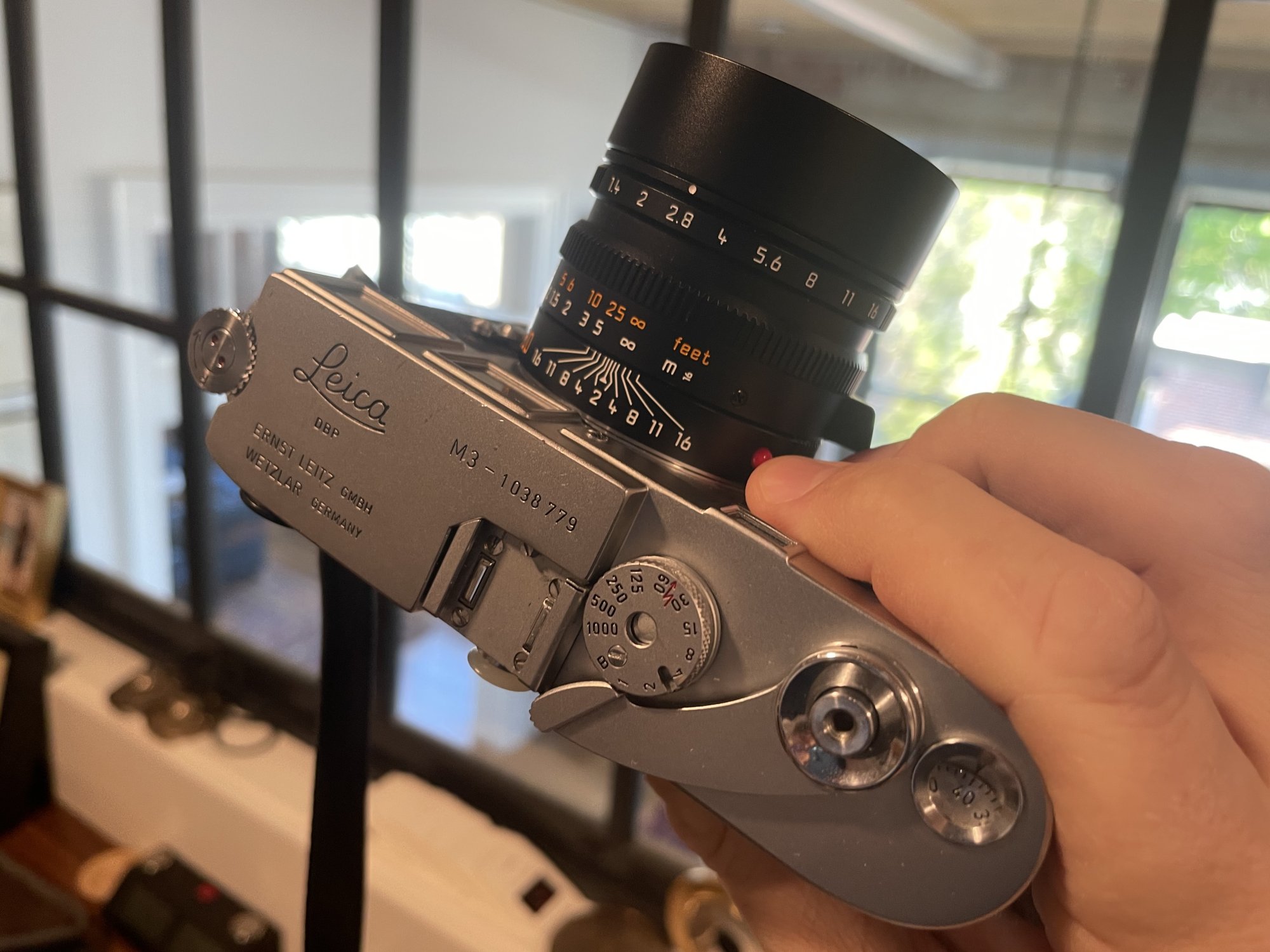
You'll always have to pay up front for knob feel.
True knob feel cannot be mass-produced or outsourced. Knob feel requires attention and care. There's no recurring revenue to attract investment in knob feel.
Many product categories may have experienced their last great knobs…
-
Fake Company Logos
One thing that’s been fun in the creation of these first Markee videos is making up five fake companies. I’ve always loved naming things. I love it. Well, we had five characters for whom we needed to come up with five companies.
Together with our amazing designer Euge (who is taking some much needed vacation for the next two weeks), these are the five characters I came up with and their fake company names and logos (we had to knock these out in a day).
First, there’s Valeria Gutierrez, a sales team lead for a big multinational corporation.
Next, there’s Charlie Larkin, a creative consultant with a small design/content marketing agency.
Then, Lara, an operations manager for a big tech company.
Mona, the director of a non-profit theatre company.
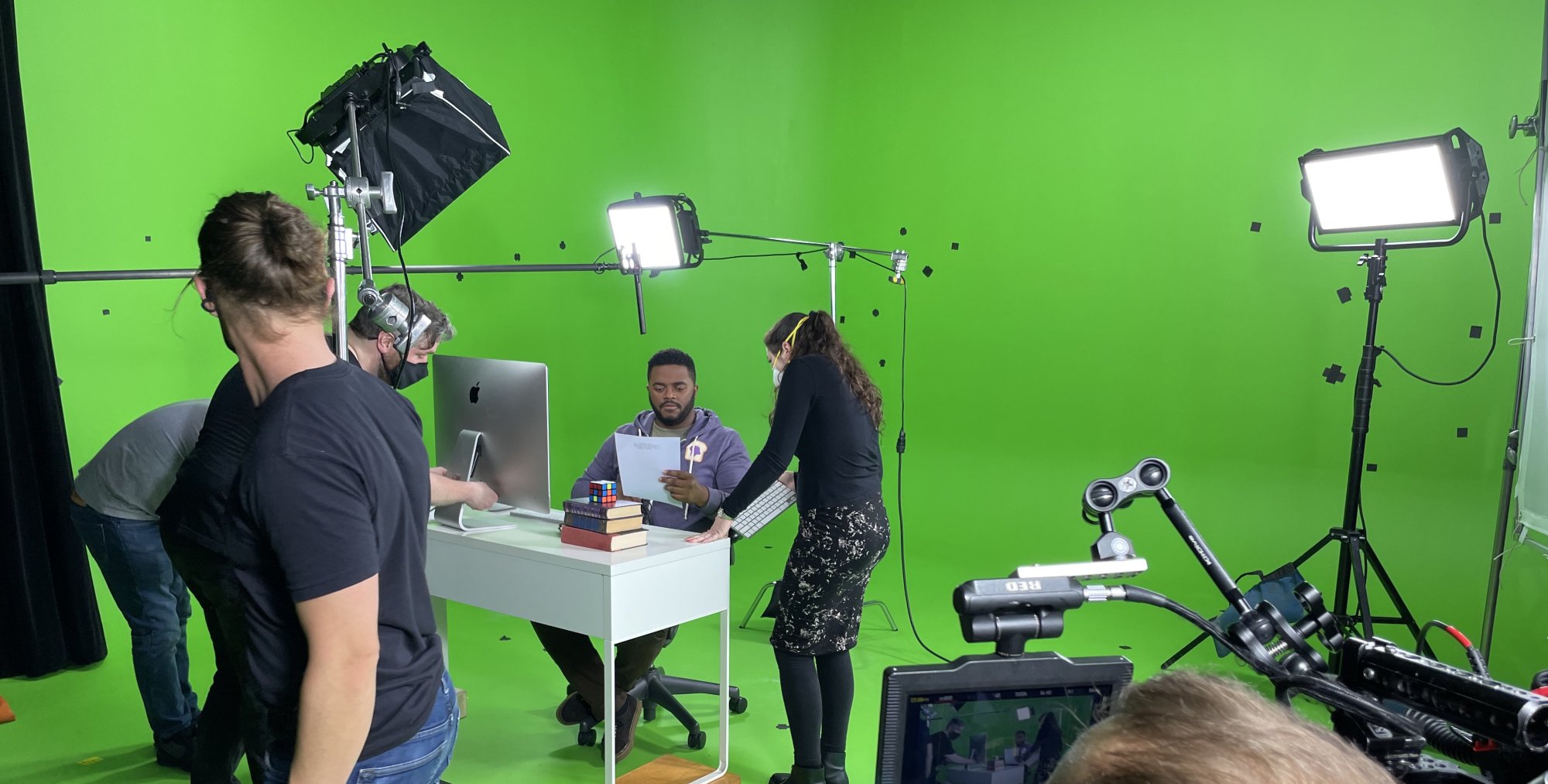
Lastly, there’s Newton, a customer support director. The funny thing with Newton is that he’s actually Markee’s customer support director and he’s actually an extremely talented actor (and he served as casting director for these videos). This logo is my personal favorite.
We loved the Toasty concept and logo so much that we made a hoodie out of it (thanks to Kim for the iron-on graphic magic).
Are these the best fake company names and logos ever created? No. Do I love them as if they were? Yes.
From this point forward, whenever you hear the word “Toasty,” your mind just might say… “We got you.” Thanks for that, Eu.



-
Fake Company Logos
Today I wrote about one of my favorite things to do: Naming things. In this case, fake companies, along with their logos.
One thing that's been fun in the creation of these first Markee videos is making up five fake companies. I've always loved naming things. I love it. Well, we had five characters for whom we needed to come up with five companies.
Together with our amazing designer Euge (who is taking some much needed vacation for the next two weeks), these are the five characters I came up with and their fake company names and logos (we had to knock these out in a day).
First, there's Valeria Gutierrez, a sales team lead for a big multinational corporation.

Next, there's Charlie Larkin, a creative consultant with a small design/content marketing agency.
Then, Lara, an operations manager for a big tech company.

Mona, the director of a non-profit theatre company.

Lastly, there's Newton, a customer support director. The funny thing with Newton is that he's actually Markee's customer support director and he's actually an extremely talented actor (and he served as casting director for these videos). This logo is my personal favorite.
We loved the Toasty concept and logo so much that we made a hoodie out of it (thanks to Kim for the iron-on graphic magic).
Are these the best fake company names and logos ever created? No. Do I love them as if they were? Yes.
From this point forward, whenever you hear the word "Toasty," your mind just might say... "We got you." Thanks for that, Eu.
-
High Street Hoagie Packaging
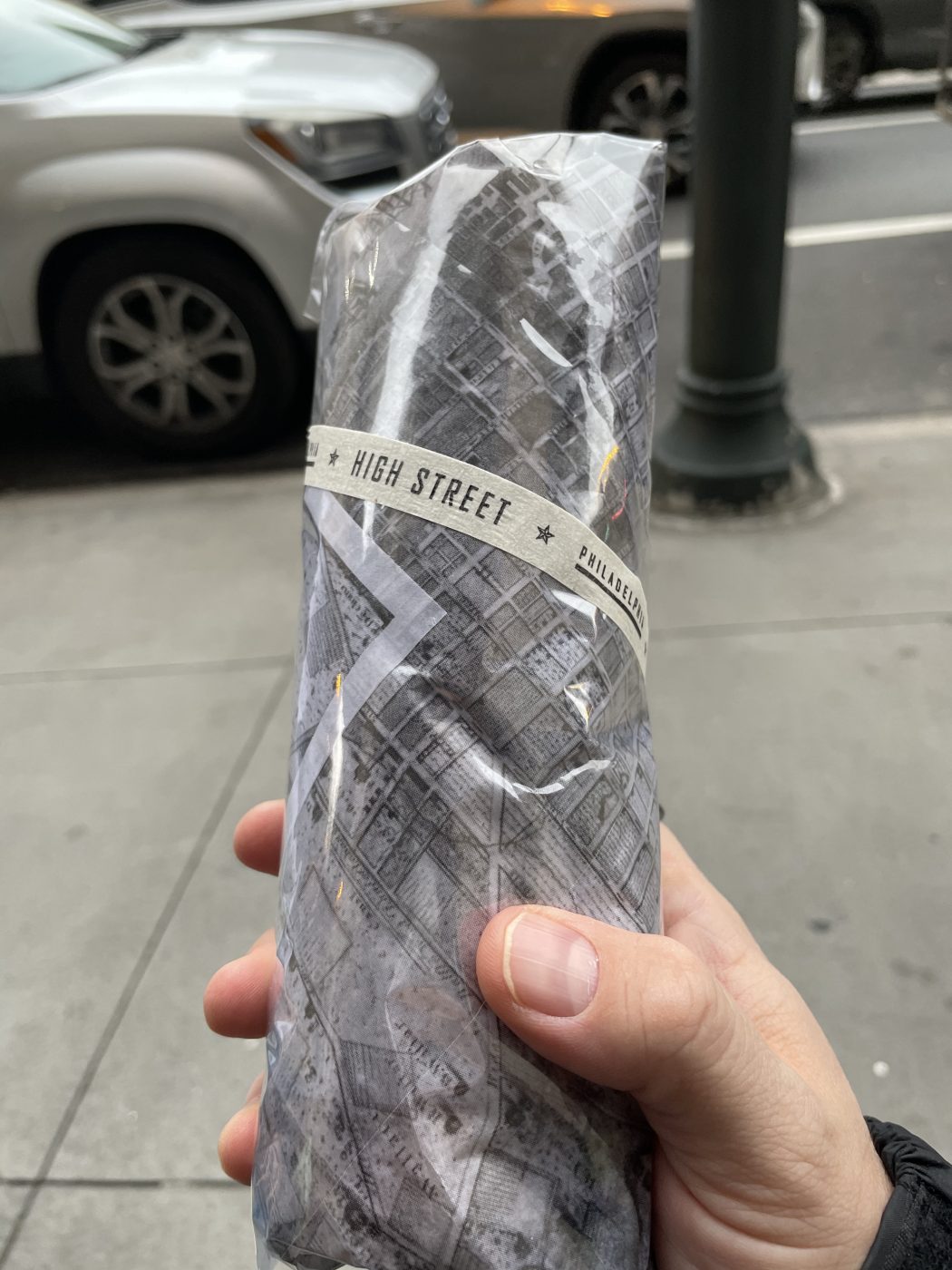
I really love when extra attention to detail has been put into something where no one asked for it. This is a hoagie I bought from @highstphilly yesterday. This packaging is delightful.
Yes, that’s custom-printed masking tape holding closed a double-layered wrapper. The inner layer of the wrapper is deli paper with an oldschool (presumably Philly) street map printed on it. The outer layer is clear plastic, holding in all that traditional Italian hoagie goodness.
Here’s the thing: This is really beautiful, thoughtful, and elaborate packaging for a hoagie, but really the most important adjective of those three for me is the middle one: it’s thoughtful.
Being thoughtful lets customers know you care about what you’re doing.
High Street also happens to make some of the best breads in the city and we always have a couple of loaves sliced up and frozen for toastmaking (we love toasts). But I think you could probably already tell that from the way they wrap their hoagies.
By the way, the hoagie was good, the bread was better, and the buttermilk fried chicken sandwich was Top 10 best sandwiches I’ve ever experienced in my life, without question.
Good packaging/thoughtful details will always get a hat tip from me.

-
High Street Hoagie Packaging
I wrote about High Street, a truly superlative bread bakery in Philadelphia, and the attention to detail in their packaging.
I really love when extra attention to detail has been put into something where no one asked for it. This is a hoagie I bought from @highstphilly yesterday. This packaging is delightful.
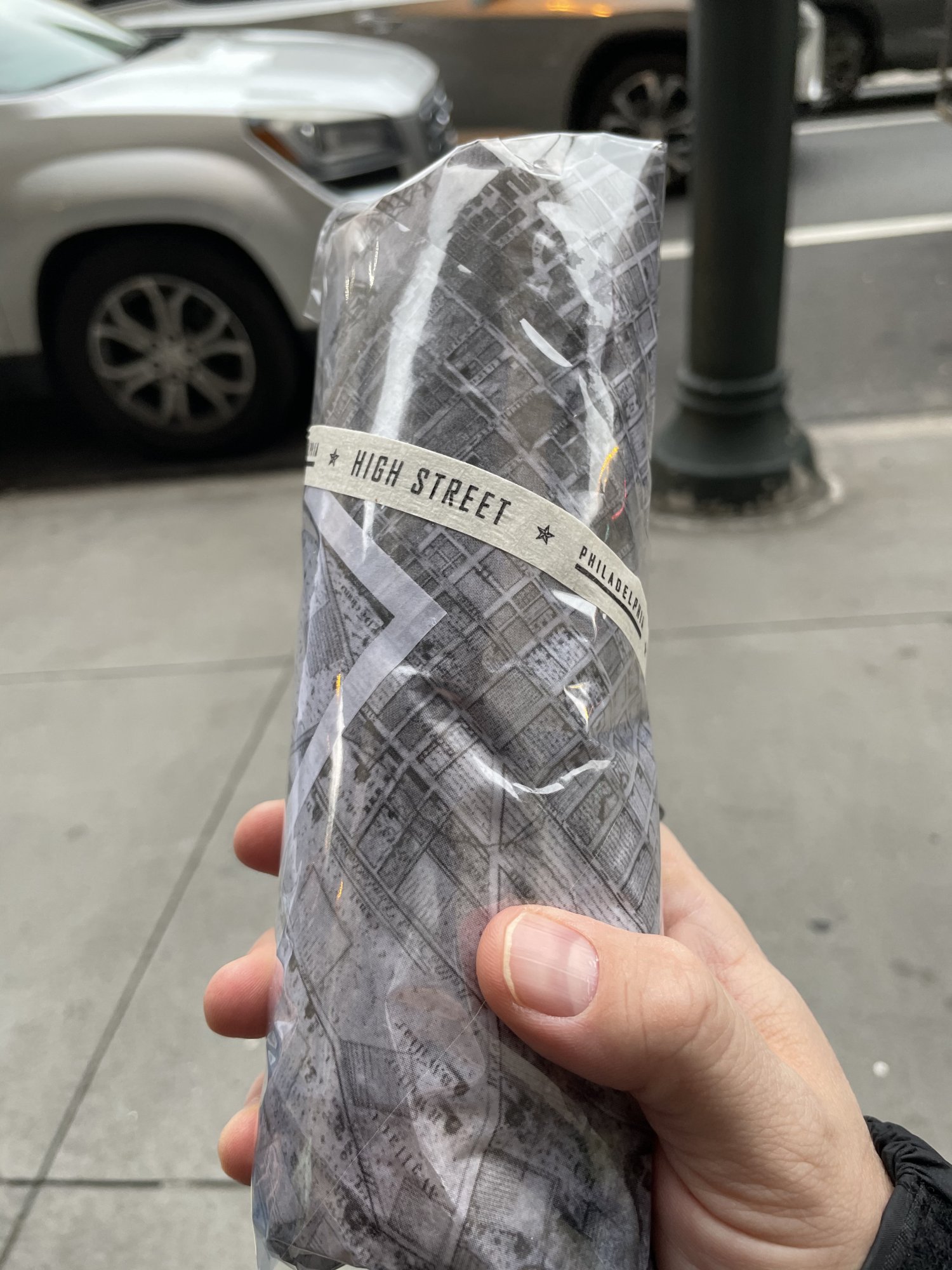
Yes, that's custom-printed masking tape holding closed a double-layered wrapper. The inner layer of the wrapper is deli paper with an oldschool (presumably Philly) street map printed on it. The outer layer is clear plastic, holding in all that traditional Italian hoagie goodness.

Here's the thing: This is really beautiful, thoughtful, and elaborate packaging for a hoagie, but really the most important adjective of those three for me is the middle one: it's thoughtful.
Being thoughtful lets customers know you care about what you're doing.
High Street also happens to make some of the best breads in the city and we always have a couple of loaves sliced up and frozen for toastmaking (we love toasts). But I think you could probably already tell that from the way they wrap their hoagies.
By the way, the hoagie was good, the bread was better, and the buttermilk fried chicken sandwich was Top 10 best sandwiches I've ever experienced in my life, without question.
Good packaging/thoughtful details will always get a hat tip from me.
-
Creative Attention in Production
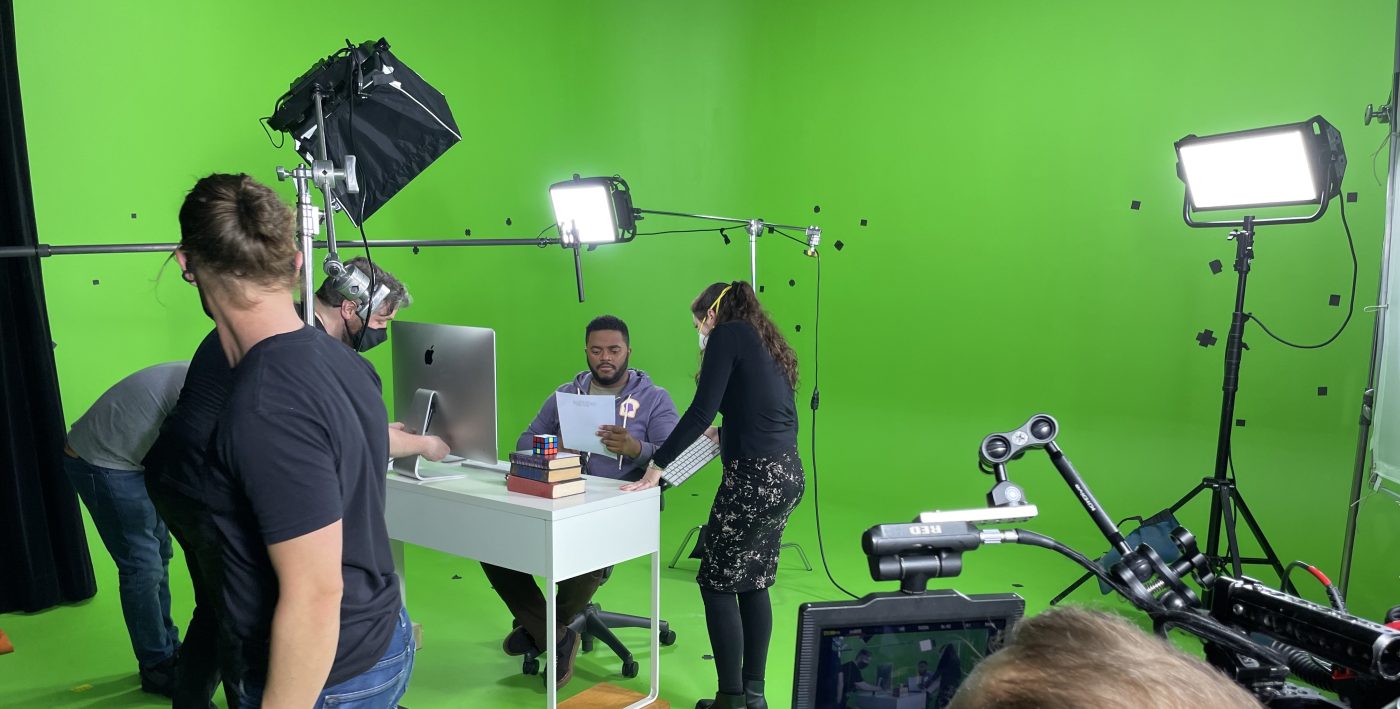
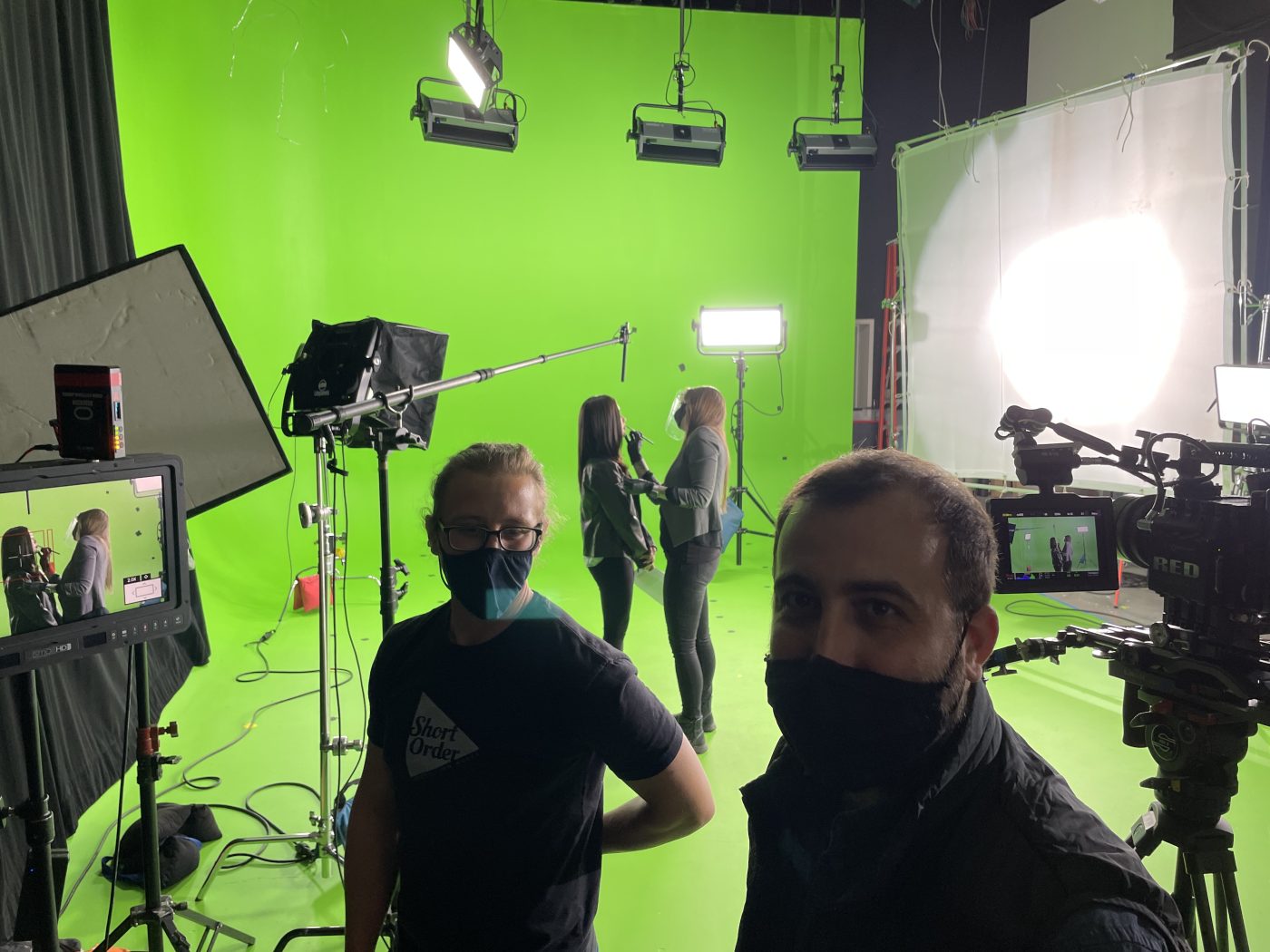
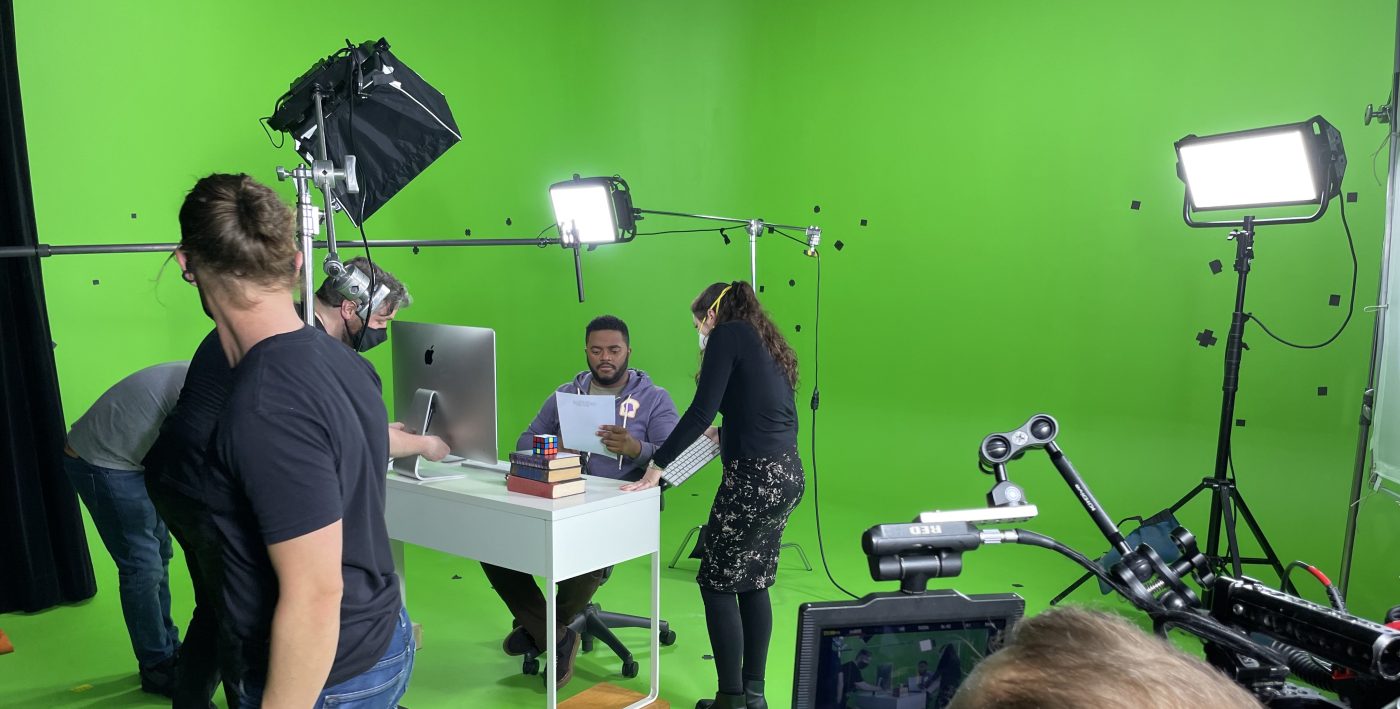
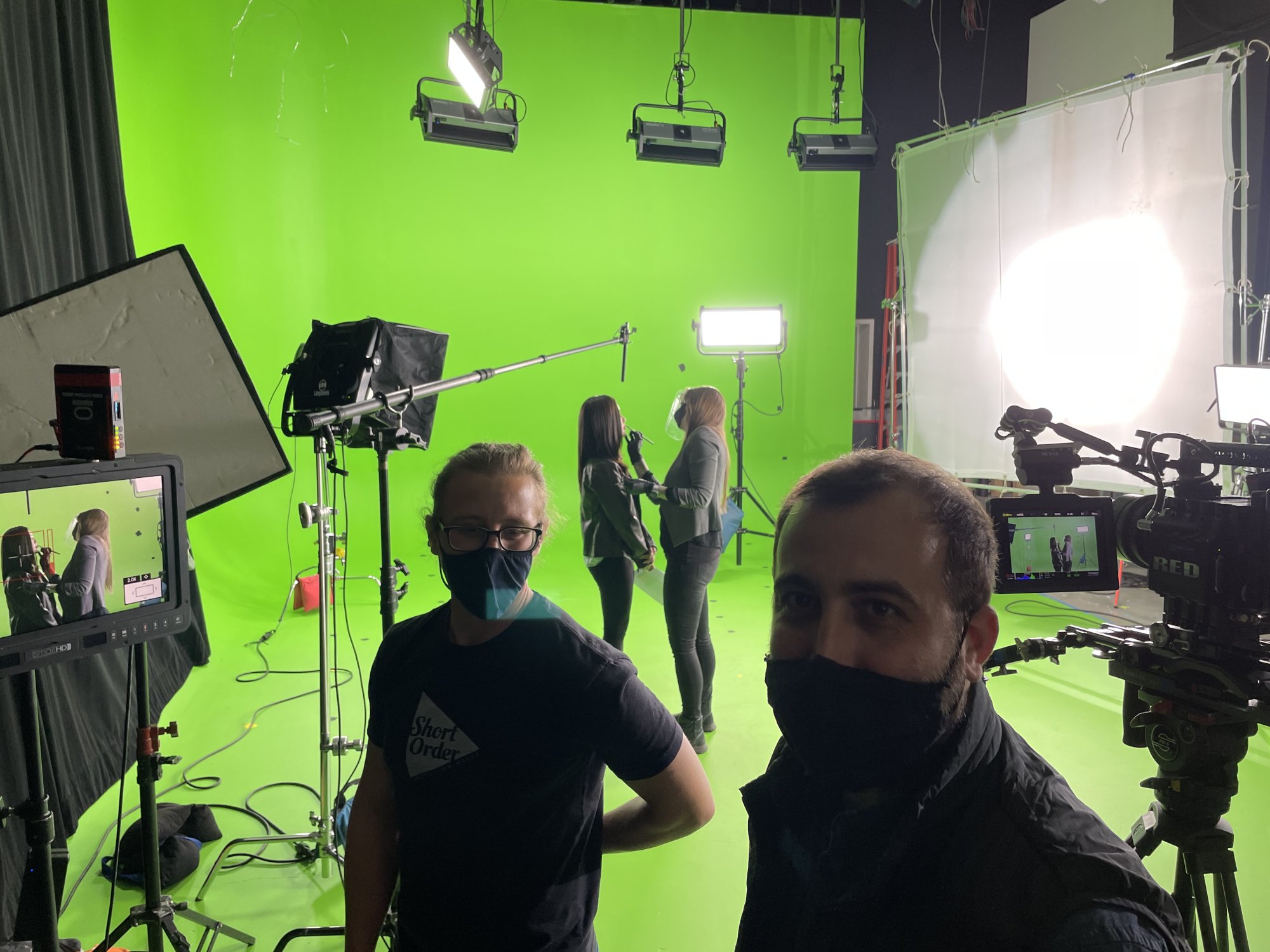
I’m on a real film set today for the first time in quite a while. Two years ago, I transitioned to a more businessy role at my production house. I’m still involved in the creative process, but I’m pretty much out of the execution part.
This is as it should be. 👇
I love the film medium and I love the shooting process. I love the collaboration, the melding together of so many different art forms. Part of me even loves the pressure. Unfortunately, most of the pressure comes from the overwhelming cost of the process.
For most crew on a production, the jokey characterization is “Hurry up and wait.” The larger the film crew, the more specialized each person is on set. One person’s job could be just to watch a couple of strands of hair on an actor’s head for continuity or post-production needs.
Someone unfamiliar with the process can look at a film crew, maybe one who has shut down a couple of blocks in your city, and think “What are all these people doing? No wonder these things are so expensive. There’s gotta be a better way…”
They’re not completely wrong…
But as with most things, there’s a reason it’s done this way: Creative attention is a hyper-limited resource and this has never been more stark than when a camera is rolling, microseconds are elapsing, and dozens of nuanced interactions are simultaneously unfolding in the frame.
When directing an actor’s performance, as I was today, I am fundamentally unable to notice anything about what the actor is wearing. I can’t check lens focus. I don’t know what else is in frame. All I’m focused on is “Do I believe and understand this character?”
Now, I’m a particularly monofocused person in general and there are some people with the talent to take in a whole frame, every detail, and give actors good notes on top of that.
For the record, I could have a wider awareness of the frame, the shot, and how it fits into the edit if I had rehearsal time ahead of the shoot to dial in performance, but that’s rarely available in commercial work.
And I’m still never going to notice a stray hair.
I used to be able to creatively lead multiple projects at once, and I think I did an adequate job (customers were happy and came back), but it eventually led me to burnout, one of the reasons I switched roles.
Context switching between high stakes creative projects and further context switching to business/sales/management and the hundreds of little details involved in each of these… I spent a few years pulling an all-nighter at least once a week.
I really fucked myself up.
Creative projects, especially complex creative production projects, deserve focused, loving attention. And creative people can’t provide that level of attention to six projects at once, at least not healthily. And everyone deserves to be healthy.
It’s a treat when I can let myself become fully enveloped in a film production but in the meantime I’m very happy assisting at the idea stage and watching my amazing colleagues execute at a level they (usually mostly hopefully?) have the creative attention for.
-
Creative Attention in Production
I wrote about my experience with the extremely limited resource of creative attention in production and in running a production business.
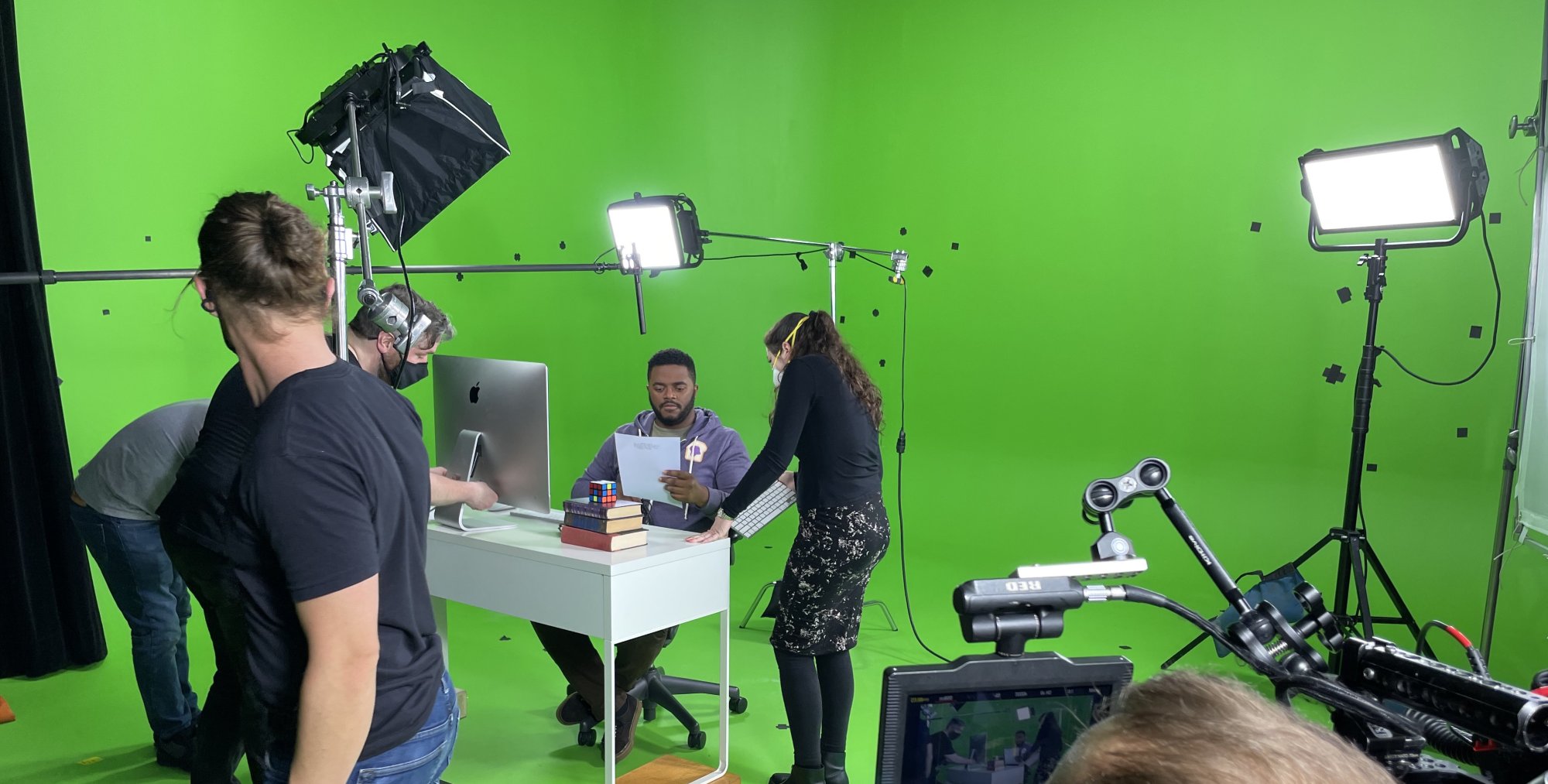
I’m on a real film set today for the first time in quite a while. Two years ago, I transitioned to a more businessy role at my production house. I’m still involved in the creative process, but I’m pretty much out of the execution part.
This is as it should be. 👇
I love the film medium and I love the shooting process. I love the collaboration, the melding together of so many different art forms. Part of me even loves the pressure. Unfortunately, most of the pressure comes from the overwhelming cost of the process.
For most crew on a production, the jokey characterization is "Hurry up and wait." The larger the film crew, the more specialized each person is on set. One person's job could be just to watch a couple of strands of hair on an actor's head for continuity or post-production needs.
Someone unfamiliar with the process can look at a film crew, maybe one who has shut down a couple of blocks in your city, and think "What are all these people doing? No wonder these things are so expensive. There's gotta be a better way..."
They're not completely wrong…
But as with most things, there's a reason it's done this way: Creative attention is a hyper-limited resource and this has never been more stark than when a camera is rolling, microseconds are elapsing, and dozens of nuanced interactions are simultaneously unfolding in the frame.
When directing an actor's performance, as I was today, I am fundamentally unable to notice anything about what the actor is wearing. I can't check lens focus. I don't know what else is in frame. All I'm focused on is "Do I believe and understand this character?"
Now, I'm a particularly monofocused person in general and there are some people with the talent to take in a whole frame, every detail, and give actors good notes on top of that.
For the record, I could have a wider awareness of the frame, the shot, and how it fits into the edit if I had rehearsal time ahead of the shoot to dial in performance, but that's rarely available in commercial work.
And I'm still never going to notice a stray hair.
I used to be able to creatively lead multiple projects at once, and I think I did an adequate job (customers were happy and came back), but it eventually led me to burnout, one of the reasons I switched roles.
Context switching between high stakes creative projects and further context switching to business/sales/management and the hundreds of little details involved in each of these… I spent a few years pulling an all-nighter at least once a week.
I really fucked myself up.
Creative projects, especially complex creative production projects, deserve focused, loving attention. And creative people can't provide that level of attention to six projects at once, at least not healthily. And everyone deserves to be healthy.
It's a treat when I can let myself become fully enveloped in a film production but in the meantime I'm very happy assisting at the idea stage and watching my amazing colleagues execute at a level they (usually mostly hopefully?) have the creative attention for.
-
False Horns on Real Unicorns
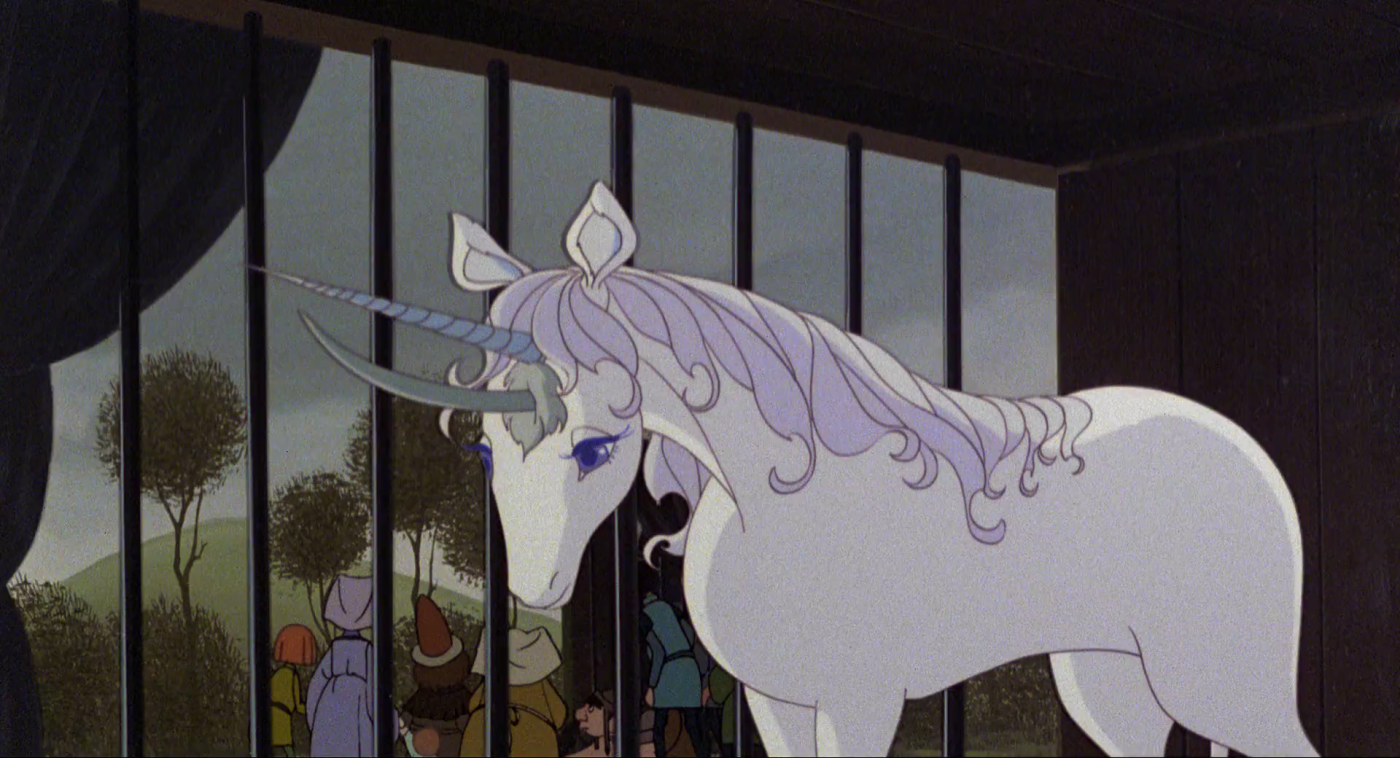
An archetype from the 1982 movie The Last Unicorn: The witch Mommy Fortuna (played by Angela Lansbury) captures the Unicorn (Mia Farrow) for her Midnight Carnival. People no longer believe in unicorns so she puts a false horn on the real unicorn so people can see her. 👇
We put false horns on real unicorns because the emotional resonance of a simple fact often isn’t enough to inspire a desired change.
This is the game in politics/behavior change marketing: Whether our intentions are noble or nefarious, what false horn can we put on this unicorn?
Nature also puts false horns on real unicorns. When you avoid something smelly, you aren’t avoiding germs. The part of you that recoils from gross, smelly things doesn’t know what germs are. Your nose has evolved to put a false horn on that real, potentially pathogenic, unicorn.
When you tell your child that if they want to be big and strong or gain magical powers they’ll need to eat their vegetables, you’re putting a false horn on a real unicorn.
A lot of our societal debates aren’t even about unicorns themselves. They’re about which false horn applied to the unicorn will be most effective in getting everyone else to see the unicorn (which they can already see and are busy fashioning their own false horns for).
We are always stuck working with incomplete information but we need to act regardless. It seems to be pointing somewhere, and so we use what we can assure ourselves we are making the right choices. We put a false horn on the real unicorns.
100 years from now, scientists will think all of the false horns we’ve been putting on our Big Question Unicorns were SO CUTE as they proceed to invent a few more of their own.
On some level, all of our stories are simply false horns put on real unicorns so that we will be inspired to believe and follow the underlying lessons of those unicorns. This is our special ability.
We are soft, meaty, imperfect bodies and minds. We need a horn to grab ahold of.
-
False Horns on Real Unicorns
I wrote about an archetype from one of my favorite childhood movies.
An archetype from the 1982 movie The Last Unicorn: The witch Mommy Fortuna (played by Angela Lansbury) captures the Unicorn (Mia Farrow) for her Midnight Carnival. People no longer believe in unicorns so she puts a false horn on the real unicorn so people can see her. 👇
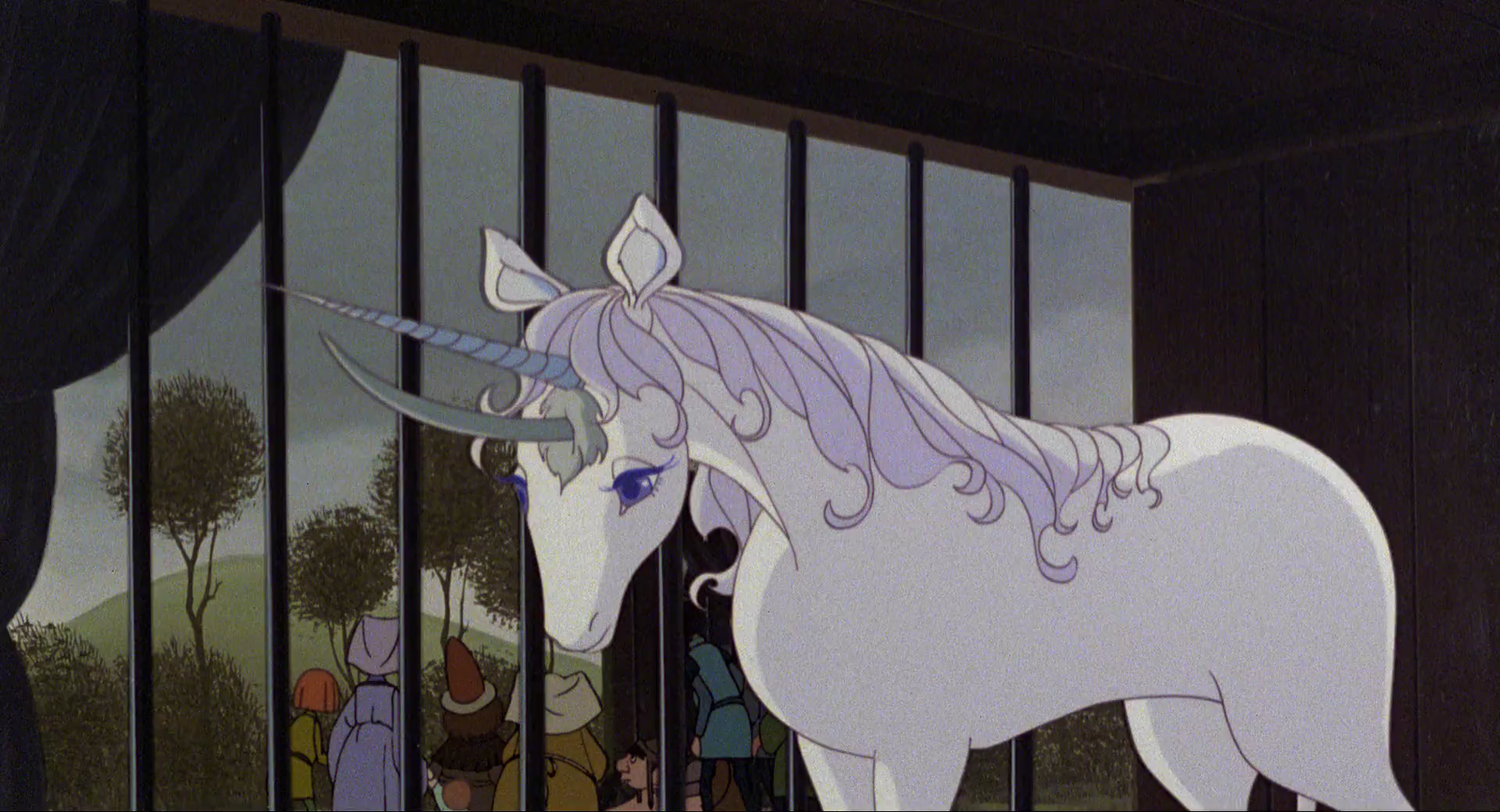
We put false horns on real unicorns because the emotional resonance of a simple fact often isn't enough to inspire a desired change.
This is the game in politics/behavior change marketing: Whether our intentions are noble or nefarious, what false horn can we put on this unicorn?
Nature also puts false horns on real unicorns. When you avoid something smelly, you aren't avoiding germs. The part of you that recoils from gross, smelly things doesn't know what germs are. Your nose has evolved to put a false horn on that real, potentially pathogenic, unicorn.
When you tell your child that if they want to be big and strong or gain magical powers they'll need to eat their vegetables, you're putting a false horn on a real unicorn.
A lot of our societal debates aren't even about unicorns themselves. They're about which false horn applied to the unicorn will be most effective in getting everyone else to see the unicorn (which they can already see and are busy fashioning their own false horns for).
We are always stuck working with incomplete information but we need to act regardless. It seems to be pointing somewhere, and so we use what we can assure ourselves we are making the right choices. We put a false horn on the real unicorns.
100 years from now, scientists will think all of the false horns we've been putting on our Big Question Unicorns were SO CUTE as they proceed to invent a few more of their own.
On some level, all of our stories are simply false horns put on real unicorns so that we will be inspired to believe and follow the underlying lessons of those unicorns. This is our special ability.
We are soft, meaty, imperfect bodies and minds. We need a horn to grab ahold of.