Elsewhere
Everything I ever posted to other people's platforms, brought home. 461 posts and counting.
-
Healthcare and Entrepreneurship
If US leaders were actually interested in talented people starting businesses, they would implement these two policies IMMEDIATELY:
-
Universal healthcare not tied to employment
-
Universal childcare
Right now, we needlessly eliminate most businesses through dumb policies. 👇
The idiotic lack of these wildly popular, zero-downside policies destroys potential jobs, INNOVAY-SHUN, and particularly scalable businesses.
Even those with the moxie and hubris and acumen to succeed in business have to hedge their bets and start non-scalable services companies.
Now, there’s nothing wrong with non-scalable services companies and many business starters (and potential ones) love the work, but in my anecdotal experience a solid percentage of them would (and have tried to) pursue more scalable concepts but couldn’t risk healthcare/family.
“But that’s what venture capital is for. Raise the money.”
91% of VC money goes to men, and 94% of VC money goes to white or Asian (17%) people. And the biggest checks always go to the same guys from the same colleges cycling through the same circuit.
“But immigrants with nothing start businesses all the time. We’re just lazy.”
Immigrants with nothing have two choices: Work the jobs Americans aren’t interested in for low wages or start businesses chosen from a proven list of formulas a la franchising.
“But real entrepreNEURRRS will take the risks necessary to succeed.”
Dude, I’m probably the riskyest risktaking riskyboy I know, but I’m not risking my children’s lives. No one should.
Hundreds of thousands of potential JAHHHB creators are stuck in a job for the healthcare.
“They shouldn’t have kids if they want to start a business!”
Go think about that and wait for the heat death of the universe.
Also, having been both a parent and a non-parent business owner, I can assure you that parents are better at business (sorry non-parents, you’re great).
There are many reasons why US leaders will never do these obvious things, but it’s actually worse than that (and I’m giving them the benefit of the doubt): They will actually never even UNDERSTAND why they might do these things.
The Venn Diagram of US leaders looks like this.
I’m done with leaders saying that small business is important while standing in the way of everything that actually leads to more and better businesses.
Both parties are complicit. One is just shameless while the other lies through its teeth and wonders why people don’t trust it.
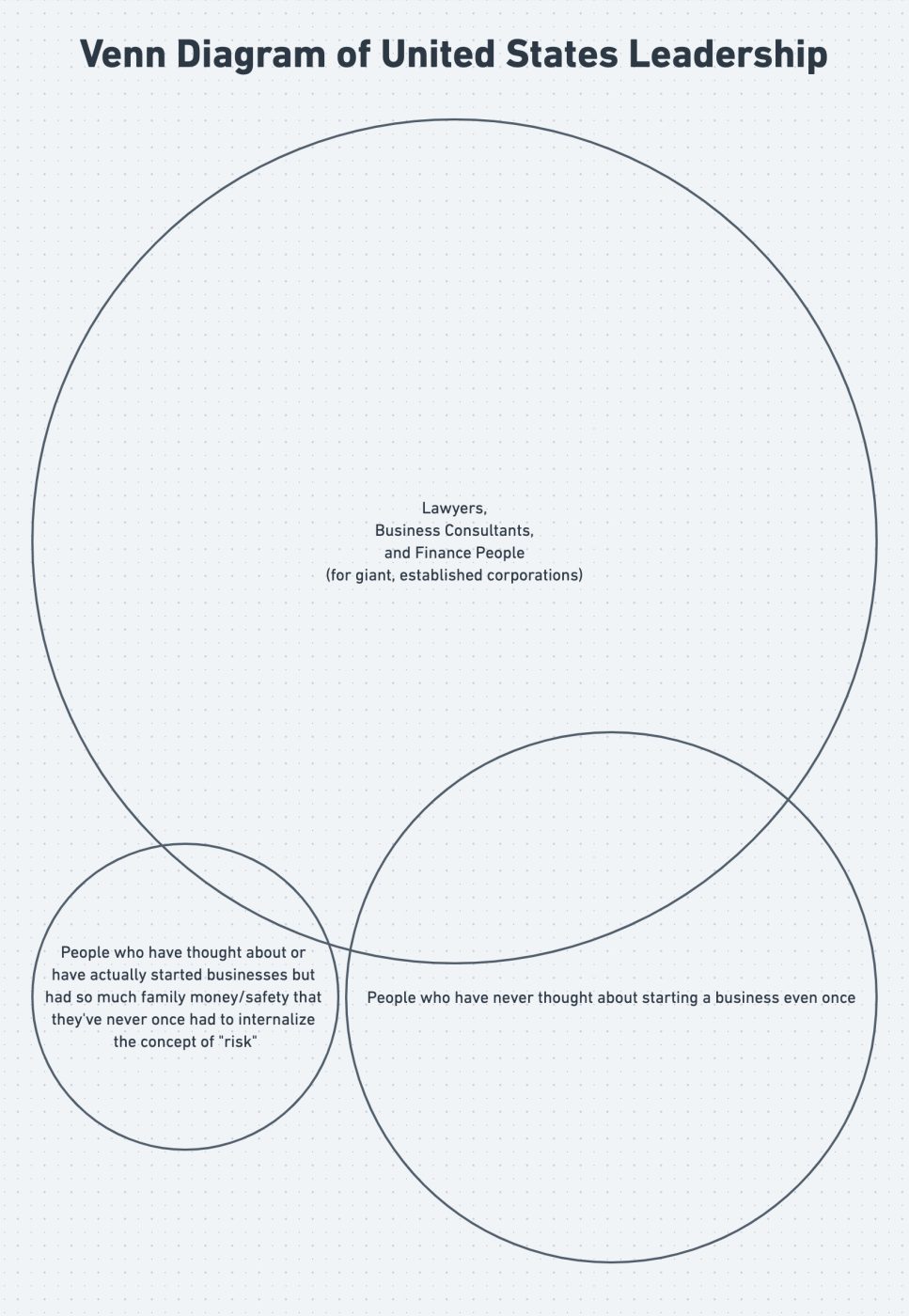
-
-
Failure Mode
As someone who has frequently felt like a failure, I’d like to talk about the importance of Failure Mode: No system can truly be trusted if it has not yet failed. And the more times it has failed without dissolving, the more it can be trusted.
Common example: For better mental health, you decide to go to the gym for one hour, five days a week, every week. Six weeks in, you are perfect…
6 weeks is a long time. There is cause for optimism. But this is an unstable system. You have no idea what failure mode looks like.
Something goes wrong. You get sick, lose momentum. A week passes. Next week comes and your engine is stalling out. You wake up late. There’s a big project at work…
Six weeks later: “I feel terrible. Remember when I was taking care of my mental health by going to the gym?”
You can extrapolate this out for any length of time and it’s still true. You’ve exercised five days a week for 146 weeks, no exceptions. Your system is probably pretty good, BUT YOU CAN’T BE SURE, because you haven’t seen what happens yet when it fails.
You’d much rather be in a position where you’ve exercised 5 days a week for 118 of the previous 146 weeks and had two missed months and a whole bunch of weeks that got blown up by a variety of excellent failure modes.
THAT is a stable system that you can trust.
In some systems, failure means death or worse, so it isn’t an option.
My friend Dustin runs a nuclear reactor and he follows what we all hope is a good system when running that reactor. He has never had the reactor melt down on him (which is good).
When she crosses the street, I make sure my three-year-old daughter always holds my hand and we both look to see if any cars or trucks or buses are coming before we step out.
We haven’t yet been crushed by a motor vehicle. 🤜🪵
These systems that MUST NOT FAIL can never fully be trusted which is good because fear and caution are desirable features in matters of life and death.
But in most cases, not only is failure NOT a matter of life and death, it is the most important component of the system.
To be clear, I’m not talking about “learning from failure” or “there there little one, we all fail and that’s okay” (true as that is). I’m talking about failure mode as THE MOST IMPORTANT TEST of any system, because it is inevitable.
The post-failure message of “Go easy on yourself” misses the mark. Failure is in fact the only reassurance we can have that our system works.
“Two steps forward, one step back” isn’t a compromised reality we all just have to live with… It is, in fact, the only path to success.
How many systems do we set up for ourselves that don’t account for (or softly welcome) their failure modes? For me, it’s too many. I need to stop that shit.
-
No Pain, No Gain
“No pain, no gain” is a lie. At least in the way it’s conventionally presented.
The truth is more like “You will probably experience lots of self-inflicted pain unless and until you realize that you can stop punching yourself in the face.” 👇
The Puritan fetishization around pain as part of your penance for being a no-good slobbery sinner must have served some purpose at some time, but it certainly wasn’t the purpose of happiness or even getting more work done. Pain leads to less work getting done.
Adding pain to any endeavor is the surest way to cause the part of you that actually cares for yourself to avoid that endeavor. This avoidance comes in many forms. People who believe in “no pain, no gain” usually call it “procrastination” or “laziness.”
This doesn’t mean that it’s not usefull to do things hard (vigorously), but the way to “go hard” is by first going softly, easily, and the easily naturally warms up to vigorously, all by itself, faster and more fruitfully than you can get there by “going hard.”
And because your body and mind got to this state naturally, easily, without any pain from “pushing yourself,” you didn’t encode any painful cues that could tend to make you want to avoid this activity in the future.
And to be clear, you went just as hard.
Most self-inflicted pain isn’t muscular or cardiovascular (though its manifestation is whole-body). For me, it’s a voice that says COME ON, WHAT’S THE MATTER WITH YOU? YOU’RE NEVER GOING TO ACTUALLY DO ANYTHING ARE YOU? THERE YOU ARE WASTING TIME AGAIN.
To date, this voice has never once helped me get a single thing done, but for most of my life I didn’t know there was an alternative way to “get myself to work.” It always seemed the only option was to press harder, the exact opposite of what would help.
I never NOTICED that the part of me that would occasionally get into a flow state and make cool things would do that all on its own as long as the scary voice wasn’t around. When I let that part of me run free, without pain, I’m both happier and more prolific.
“No pain, no gain” is bullshit.
“Hustle” is bullshit.
“Work ethic” is bullshit.
Not because gaining or getting things done or being prolific is wrong, but because all of these slogans/attitudes produce the OPPOSITE of what they claim.
And more importantly: They make you sad.
-
Learning Dvorak and Learning in General
I didn’t (really) learn to type until I was almost thirty.
I was always a fast typist but I had bad habits. There was no chance that I would ever touchtype on QWERTY. I tried hard.
So I learned Dvorak. Here’s why it was a great decision and what it taught me about learning. 👇
It’s much harder to learn to do something BETTER than it is to learn to do something NEW. It’s helpful to be bad at something for a while.
“Picking things up quickly” is a specious talent. It means you can gouge bad habits into your brain and become an Arrogant Novice fast.
I pick things up quickly. This means that I usually skip fundamental steps like:
-
Stopping my palm from touching the basketball during a jumpshot (or a dribble)
-
Positioning my wrist properly when touching the fretboard of the guitar
-
Always using my pinky to type a P or a Q
Once you’ve gone a certain distance with bad habits, it’s very unintuitive to improve because a big step backward is required before you can go forward.
This is why when it came time to touchtype (I’m a writer and a developer, my job is the keyboard), I had to switch to Dvorak.
The first few weeks of typing Dvorak could be excruciating at times. I was SO slow and made tons of errors. I had no crutch to lean on. The keyboard had no labels on it to guide me.
But when I relaxed into it, the process of learning/carving new pathways felt awesome.
It’s conventional wisdom that learning new things gets harder as you get older. I no longer believe this is necessarily true.
The reason it FEELS true is because when we’re older we get the idea that we already know things. It’s disorienting to access Beginner’s Mind.
The good news is that Beginner’s Mind can be accessed at any age. There are many techniques to get there, but a really simple one is to just slow way, WAY down, to the point where what you’re doing becomes foreign and doesn’t even make sense to your brain anymore.
This is a great way to practice almost anything. Slow it down until it requires all of your attention to make a single move, ring a single string, touch a single key. Relax into that kind of focused attention and get comfortable not focusing on ANY resulting song, move, or skill.
A lot of meditation practice can be seen as simply accessing Beginner’s Mind, not becoming attached to all the things you think you already know. Letting them become new to you, objects of curiosity. With this kind of attention, you can learn, or relearn, anything.
Aside from touchtyping, here are a few other Dvorak benefits:
-
It’s an objectively better layout, with all the vowels on the lefthand home row and the common consonants on the righthand home row
-
If someone asks to touch your computer you can say “but you don’t know the layout”
-
-
Ready to get back in the swing of developing film regularly. This was from a mystery roll. Wendell getting taken care of by @a.rzasa77 this summer. He misses you, Agnes!



-
eBay Selling Principles
Since the beginning of eBay (mid-90s), I’ve consistently gotten MUCH higher prices for items I sell online than I expect, sometimes as high as 50% above the market rate.
I list things differently than most. I follow two principles that I think can apply to selling anything. 👇
Principle 1 that seems to work for selling on eBay (or anywhere else): Let Them Know You’re A Human
When I’m buying anything, the most important thing to me is trust. Reviews do little more than check a box for me (⭑⭑⭑⭑⭑ A+++++ SELLER). I’d much rather hear an authentic voice.
Letting Them Know You’re A Human means that you convey who you really are, even exposing faults e.g. “I have two kids under the age of 3 so I might take a couple days to ship. Apologies in advance.” I instantly trust this seller 10x more than a listing that says “FAST SHIPPING!”
Principle 2 that seems to work for selling on eBay (or anywhere else): Convey That You Care About What You’re Selling More Than They Do
This is also about trust. As someone selling a thing, you know much more about it than the buyer does. Convey your true feelings about it!
Restaurant servers take note (I can speak on this because I’ve waited on 1000s of tables): If a customer asks if they should order this or that, THEY WANT YOUR EXPERT OPINION. “Well, it depends what you’re in the mood for” is not an answer.
I’m in the mood for your expert opinion.
Often, a buyer is excited to buy but they have doubts and fears and they just need to ask “Should I really buy this? I REALLY THINK I WANT IT, SHOULD I?” You know the answer. Be honest with them. Address caveats and drawbacks as enthusiastically as features and benefits.
This runs counter to the way most sellers talk. They focus on representing only the rosy stuff and say things like YOU CAN TRUST ME BECAUSE which is inherently untrustworthy.
Know the questions people have and be generous with your knowledge.
Another benefit of selling things this way is that you might make a friend. That someone is buying your thing is a good indicator that you share interests. I’m still in touch with people I’ve bought things from or sold things to years later.
You could sum up these principles for selling things online as “sell it like you would to a friend.”
I think these principles carry over to sharing ideas and even online behavior generally. “How would you say this to a friend?” This has me thinking about @visakanv’s work.
I’m going to experiment with getting even MORE human with how I list stuff to sell: I’ll record little videos about each item. Listing things can feel like such a chore so maybe this will make it fun?
I’ll call them Farewell Reviews and post them unceremoniously.
-
Google: Driving vs. Biking vs. Walking
I’m going to attempt to explain one of many reasons I have a dead-inside feeling when I use Google. I’ll use the analogy of Driving vs. Biking (vs. Walking). 👇
I had a nice phone call today with a film professor from my time at Syracuse, Richard Breyer. I haven’t seen him in 15 years. An intern I had is a student of his. We reconnected on Facebook.
Professor Breyer had a reputation for always bicycling. In Syracuse, that’s not normal.
Syracuse is both the snow capital of the USA (125 inches/yr) and a town with LOTS of hills (called “drumlins”). It’s a tough city to bike.
It wasn’t until halfway through my 20s that I discovered just how superior a mode of transportation the bicycle really is. Even in Syracuse.
The problem with driving is that there’s very little experience of the journey. There isn’t time to take in the senses of neighborhoods you pass through, whether familiar or new.
All drivers have had the experience, a little scary, of arriving not even remembering the drive.
Walking, on the other hand, is wonderful, the most natural human movement and best exercise currently known, and you really get to experience that journey, but we’re all kind of busy, and it can take FOREVER. Once you get beyond a couple of miles you get to impractical territory.
Then there’s the bicycle, or as Goldilocks would call it, the mode of transportation that is “just right.” You get there fast (in a city like Philadelphia, often faster than driving). You get some gentle exercise. You use no power.
But most importantly, you are IN that journey.
Professor Breyer and I talked about Google and how little true exploration it facilitates. It’s like only driving and only ever using a GPS. Its algorithm is designed for everyone to get to the same, clean, “good enough” answer. It’s just… autopilot.
Just before COVID hit (my timing is awesome) I rediscovered the Library, which is goddamn MAGIC.
Walk up to a librarian and ask them about a thing and they will show you WAY cooler stuff than Google ever could.
And here’s the thing: There are other books around!
Along the library aisles leading to your book are OTHER books. Sometimes just arbitrarily related, alphabetically, by subject, and sometimes, as happened to Professor Breyer, a book will literally drop off a shelf into your hands on a page relevant to a film you’re making.
Google is driving blind, with only a GPS guide that you’re watching the whole time. It’s just not a satisfying thing, and as the algorithm gets “better,” there’s less and less serendipity, less journey, less human experience.
I can’t wait to ride my bike to the library again.
-
Computer Brain vs. Bonfire Brain
I’m very excited! I figured out why pretty much all “frameworks” can never spark creative work. They all look exactly in the wrong direction.
They address the Digital Brain rather than the Analog Brain.
Better frame: They address the Computer Brain vs. the Bonfire Brain. Thread 👇
Admittedly, I never got through Twyla Tharp’s book, The Creative Habit, but I’ve realized that you only really need the very first couple of pages where Tharp talks about GETTING WARM.
Getting Warm is about the Bonfire Brain and it’s so exciting I can’t contain myself.
So I have some bad news about the Computer Brain, but it will be accompanied by some world-changing, joyous-reunion-of-peace-love-joy-and-everything-transcendent good news about the Bonfire Brain.
Computer Brain: It can process tasks, hold about five things, but beyond that…
-
It’s always the same, in all contexts, and as long as you’re awake, it works… fine.
-
It never changes. It’s always just as you left it.
-
It doesn’t actually know how to do or create ANYTHING.
Most task systems/habit frameworks/productivity hacks focus on the Computer Brain and try to satisfy its binary bits in the hope that if it can somehow just be clean/organized/processed/planned enough then the Bonfire Brain will be freed up to get going.
This is FUCKING WRONG.
Computer Brain can NEVER get Bonfire Brain going. It has nothing whatever to do with it. It produces no heat, no signal, nothing analog at all. It’s pure binary. Done/not done. On/off. Yes/no. 1/0.
Computer Brain won’t be satisfied. It doesn’t even have feelings to satisfy.
So that’s the bad news about Computer Brain… It can never spark or warm up the Bonfire Brain. It’s got nothing. And yet pretty much every framework being sold in the Productivity Porn Industrial Complex targets the Computer Brain.
Here comes the good news about the Bonfire Brain.
The Bonfire Brain is analog, messy, chaotic, and generative. It knows how to do EVERYTHING. And here’s the amazing explode-the-whole-universe Good News about the Bonfire Brain: All it needs is heat and fuel. And it already has unlimited fuel.
SO ALL IT ACTUALLY NEEDS IS HEAT.
The heat that Bonfire Brain needs isn’t something you can just turn on the way you can turn on Computer Brain. You need to warm it up. But here’s the AMAZING THING:
-
You can warm it up with ANY sustained creative or embodied act.
-
It heats up faster/better with LESS difficulty.
When I say “creative or embodied act,” this applies to everything from walking to writing to singing.
The first few steps are stiff and cold. Once you get warmer, you could go forever. This is an analog process. Take it easy and it will burn brighter and brighter all on its own.
I won the fire-building contest every year at nature camp as a kid. A well-tended bonfire can get as big or as hot as you like, and it takes care of all the hard parts itself. You can use yesterday’s embers to start today’s big blaze. The hotter they remain, the faster it goes.
Forget habit trackers and todo lists. JUST GET WARM and stay warm. When you cool off completely, just get warm again. Something easy, and if it’s ANY EFFORT AT ALL, even easier.
Before you know it, you’ll have a blazing, magical Bonfire that can create absolutely anything.
By the way, the Bonfire isn’t “you.” It’s the same thing we all have access to. All it needs is a gentle little spark and some very light tending and it’ll keep itself going.
The even more positive news is that it’s going whether you’re all caught up in your Computer Brain or not.
Notes
The Left Brain/Right Brain binary is inherently Left-Brained.
-
-
The Fully Mechanical Bolex
I love mechanical things, both for their objective coolness and their implications for a green future. A future with nice things that we take care of, less waste, and dignified manufacture.
Among my top 5 mechanical favorites is the Bolex H16 16mm camera. I made a video about it: https://youtu.be/pJnMQgxb3Ao 👇
My friend (and filmmaking colleague) Mauro and I and our baby daughters and our pregnant wives went to Avalon, NJ and Mauro shot me explaining how the Bolex works. I included some Bolex footage of my daughter Louisa on the beach. Here’s one roll/100 feet/3 minutes of Kodak 16mm:
Here are a few mindblowing things about the Bolex.
Better than HD resolution (arguably better than 4k)
The thing is 50 years old and still works perfectly
It’s FULLY MECHANICAL, NO BATTERY, NO POWER, just a spring that you wind up and it goes
We don’t make things like this anymore.
A Bolex isn’t for most people. Developing and scanning movie film is… costly. BUT it’s perfect for these home movies and it’s my most common wedding gift. I shoot 100 feet, add music, and voilà, A very special document of the day (also helps when you don’t know anyone).
Here’s my cousin Lindsay’s wedding I shot on the Bolex. By the way, I’m removing the music from all these because I don’t have experience with or trust Twitter’s algorithm.
And here’s a more somber occasion shot on the Bolex: The spreading of my grandmother Geema’s ashes at Skaneateles Lake. This was when I had a (really) cheap lens. Still awesome. Music composed by my sister.
Now, the quality of film is beyond the scope of this conversation, but it’s undeniably (and literally) organic. The colors, the dynamic range, the grain… The stuff that comes out of the Bolex just always feels great and has this “forever” quality to it.
The Bolex is as cool as it gets, but while film is practical for 92% of photography (yes, moreso than digital), it’s IMpractical for 96% of cinematography.
But the reason it’s so fascinating is… if we can make something that does THIS with zero power, what else can we make?
-
Delaware/Philadelphia Election Year Connection
Now that @JoeBiden is safely inaugurated, I want to talk about how crazy it has been to be a Wilmington/Philadelphia (née Syracuse) person through this past year.
The word “surreal” has grown soft through overuse, but… this shit has been surreal. 👇
I’ve met Hunter and Beau and I worked on a project (incidentally the project I’m most proud of) with Ashley. But here’s what you need to understand about Delaware: That’s not special. Everyone knows everyone in Delaware. Truly. We have this thing called “The Delaware Twist.”
“The Delaware Twist,” coined by Kristen Kuipers, is this thing when you’re about to talk about someone in Delaware and you look around because it’s entirely possible the person is right behind you.
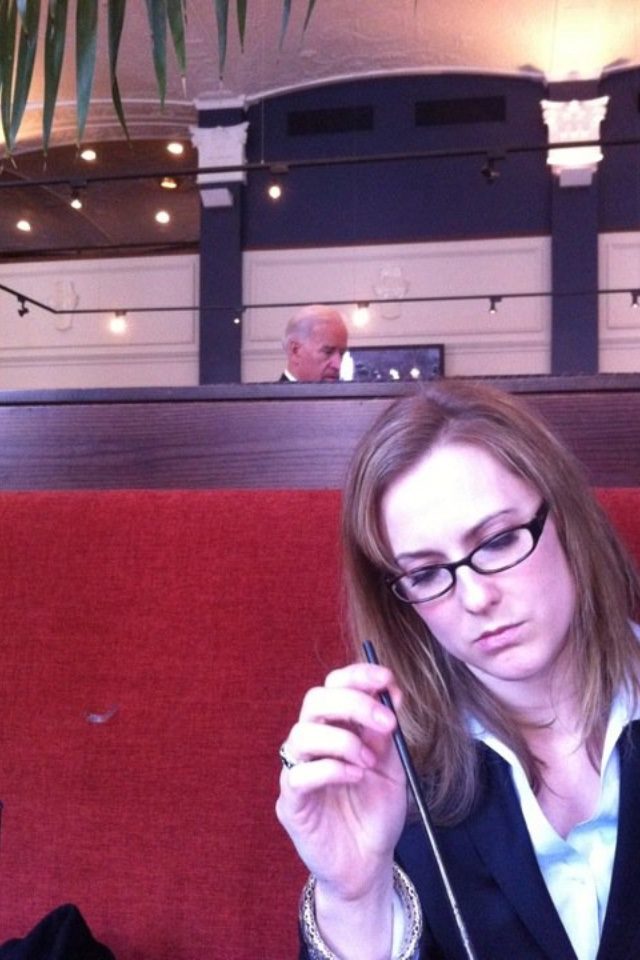
Here’s a picture of my wife. She and the guy behind her both went to Syracuse Law.
I’m not exaggerating about The Delaware Twist. It is a physiological, pre-cognitive, reptilian response. You just check who’s behind you before speaking.
This picture of my wife (girlfriend at the time) was at lunch in our building in Wilmington in 2010. I was in my pajamas:
I spent four years with an office IN the Joseph R. Biden Railroad Station in Wilmington. Our office was ON the platform. When he was VP, we’d have black SUVs pull up in the alley, Biden would get off the train, wave to us, and disappear. I’ll never have an office that cool again.
My current office has a network link and Senator Chris Coons uses it to go on TV.
In March, my COO, in a not-good-joke way, asked Coons “So, are we all gonna die?” He responded: “We’re about to experience the greatest disruption of civilian life since the Second World War.”
“Oh.”
Then I got a call from one of my nerd heroes in California that they potentially wanted to use our studios as Biden Media HQ. I met with the Biden team several times, and I recommended The Queen for one of the things they needed. They ended up using it for everything. 🤦♂️
Then, on election night, when I knew Biden had won Arizona and Georgia (yes I called Georgia election night, I have proof, texts showed the Trump team knew it… use Twitter, it’s amazing), it became clear this thing was going to be called for Biden when Philadelphia was counted…
I live in Philadelphia. Our count put Biden over the top. There was no better place to be in America the day they called the election. It was a lot like the other good thing that happened in the last four years (the Eagles winning The Greatest Game Ever Played).
Then there was Four Seasons Total Landscaping, objectively the funniest thing that happened in the last four years. Here’s the worst brag in this whole unintentional bragthread: My wife and I had stayed in the actual Four Seasons for our one date night of the year that week!
Then there’s this guy, who fixed everyone’s Macs, and whose shop (“shoppe” 🙄) I personally hung out in, nerding out about Steve Jobs/Apple lore with him. He never gave any indication that he was bananapants aside from the hat. For any doubters, he is, definitely, blind.
There’s more but I’ll stop. This thing has just felt really… close to home. Thanks for allowing my unbearable indulgence. Needed to purge this. Philadelphia, Wilmington, and the 30 minutes between them got a front row seat for a really important fight.
Thank God it’s over for now.





-
My friend/twice-roommate Cameron (@llewellynguitars) told me he was building guitars. I’m an acoustic player, mildly interested in electric, but I wanted to support him, so I ordered one.
I just got my guitar. I was NOT expecting this. I think this may truly be the finest guitar ever made.
Cameron made this guitar with chisels and sandpaper. Every detail is perfection. In some ways beyond perfection. Anything above 320 grit sandpaper is considered overkill. He hand-sanded this to 2000.
I can’t even believe what he’s done.
The body is made of thick (thicc) quilted maple, the most beautiful piece I’ve ever seen. It’s a 3-dimensional holographic aquarium of delights. The back is book-matched walnut. The lumber guy called Cameron months later to tell him it was the nicest tree they’d ever processed.
The neck is Brazilian Rosewood. The fret board is a piece of Kingwood with its bottom edge being this perfectly thin strip of sapwood.
The headstock is seamlessly integrated maple, for its weight, so that the guitar is perfectly balanced.
The whole guitar weighs 6 pounds, and he achieved that by using titanium for some of the components and playing with the walnut (heavy) to maple (light) ratio. Parts of this guitar he built multiple times before getting it just right.
There are honestly too many details to go into here. The electronics cover fits perfectly flush, attached by four rare earth magnets. The tuning pegs are geared so that no matter which string, a half turn is a half step. Even the knobs are carefully crafted.
The fret markers are custom stainless steel and brass mosaic pins filled with luminant resin… Yes, the fret markers glow in the dark (for when I’m on stage one day).
The fifth fret marker is flanked by 18 karat gold pins, denoting that this is the fifth guitar Cameron has made.
I specifically requested that my guitar be the fifth (I have a weird brain about numbers), and that he sign it. He apparently doesn’t believe in signing, so these gold pins were his way of signing…
I could say more but just look at it. And maybe order one.
-
Llewellyn Guitars Intro
My friend/twice-roommate Cameron told me he was building guitars. I’m an acoustic player, mildly interested in electric, but I wanted to support him, so I ordered one.
I just got my guitar. I was NOT expecting this. I think this may truly be the finest guitar ever made. 👇
Cameron made this guitar with chisels and sandpaper. Every detail is perfection. In some ways beyond perfection. Anything above 320 grit sandpaper is considered overkill. He hand-sanded this to 2000.
I can’t even believe what he’s done.
The body is made of thick (thicc) quilted maple, the most beautiful piece I’ve ever seen. It’s a 3-dimensional holographic aquarium of delights. The back is book-matched walnut. The lumber guy called Cameron months later to tell him it was the nicest tree they’d ever processed.
The neck is Brazilian Rosewood. The fret board is a piece of Kingwood with its bottom edge being this perfectly thin strip of sapwood.
The headstock is seamlessly integrated maple, for its weight, so that the guitar is perfectly balanced.
The whole guitar weighs 6 pounds, and he achieved that by using titanium for some of the components and playing with the walnut (heavy) to maple (light) ratio. Parts of this guitar he built multiple times before getting it just right.
There are honestly too many details to go into here. The electronics cover fits perfectly flush, attached by four rare earth magnets. The tuning pegs are geared so that no matter which string, a half turn is a half step. Even the knobs are carefully crafted.
The fret markers are custom stainless steel and brass mosaic pins filled with luminant resin… Yes, the fret markers glow in the dark (for when I’m on stage one day).
The fifth fret marker is flanked by 18 karat gold pins, denoting that this is the fifth guitar Cameron has made.
I specifically requested that my guitar be the fifth (I have a weird brain about numbers), and that he sign it. He apparently doesn’t believe in signing, so these gold pins were his way of signing.
As someone who makes tools, I don’t know if there’s any way I can adequately express what a masterpiece Cameron has achieved with this guitar. I have never seen its equal.
I expect this guitar might be played by my children’s children’s children one day.
I tried to capture the spirit of the guitar at my desk with these video clips but I intend to give it a truly proportionate cinematic treatment later. I also interviewed Cameron about its genesis (resentment at every guitar he’s owned, the most common asset of a great toolmaker).
Cameron is on Instagram (llewellynguitars) and Twitter @llewellynguitar. If 1. you have the means, 2. want one of the finest guitars ever built, and 3. don’t mind waiting, I recommend you contact him before he becomes unreachable.
And if you know a rockstar, please pass along.
Again, this really isn’t hyperbole… To my knowledge, I have in my possession the greatest guitar ever built. I do not deserve this thing. And to pre-answer the most common question, I’ll quote Cameron: “It plays like it looks like it plays.”
-
MLK Spiritual Field
As someone who spends a lot of time writing words for other people, I’m very interested in why speeches and performances like the one Martin Luther King Jr. gave at the March on Washington for Jobs and Freedom inspire so much emotion in us.
Here’s the answer I’m pretty settled on. 👇
I don’t think it’s because the “I Have A Dream” speech is so well-written (it is) or because MLK is such a talented orator (he is) or even because the stakes of the historical moment are so high (they are).
All of these make the speech perfect, but they aren’t what move us to tears.
I don’t think it’s because of the hopefulness of Dr. King’s message or the sadness about so much injustice or the devastation of still being where we are.
Here’s why I think Dr. King’s speech moves us so deeply: His willingness to open up his Dream, his deepest desire, in the most vulnerable way, shows us that we have the same desire, and it’s one that most of us don’t allow ourselves to experience.
MLK’s speech evokes qualities in us that are already present. It reminds us of our own core goodness which our egos, and particularly our cultural conditioning, don’t allow us to see.
To be sure, we could not recognize that goodness if it were not who we are.
The moral clarity of this desire burns so hot that it cuts right through to the core of our being and we’re reminded of our own true nature and purpose.
As we consider MLK’s unimpeded truth (and our own deepest desire) that the world be rid of the Evil of racism, let’s also consider the other two great Evils of society that King spoke on with every bit as much moral clarity: the Evils of poverty and war.
Racism should not ever exist.
Poverty should not ever exist.
War should not ever exist.
We already deeply believe this. All the power we need to permanently obliterate these Evils is already within us.
Thank God for people like Martin Luther King who show that to us.
-
Mechanical Writing Device
There’s a product that I want to exist. While it possibly could exist today, it wouldn’t be quite good enough yet: A mechanical writing device that will last 100 years and will build up an entire market ecosystem around it.
Here are the only three requirements: 👇
-
There’s no charging, or even a charging cable. Minimal electronics of any kind. Every press of a key on the mechanical keyboard ever-so-slightly winds a mainspring (or series of mainsprings) which mechanically power the screen/interface/wireless connection via an escapement.
-
It needs to run @RoamResearch (or, even better, the eventual open protocol which comes from Roam’s hierarchical, zoomable, referenceable outliner, which stands on the shoulders of All The Great Outliners That Came Before).
-
Because its software is based on the most robust writing environment ever created, perfectly flexible and better today than the tools most people still write in 40 years later… this device will never need to be replaced. It should last 100 years or longer, like a Leica.
I am aware of products like the Freewrite by Astrohaus (I have both of them) and the AlphaSmart (I have every model). Both have issues and neither thinks big enough.
A writing-only device that has access to the power of the world’s best writing environment, and nothing else, would change everything.
Boutique companies could build their own versions of this, with different finishes and key feel and screen technologies. They could charge incredible amounts of money because the device would last forever, be handed down for generations.
Watchmakers and typewriter repair people and others like them, who have fewer and fewer things to feed their passionate mechanical craft, would have a whole new class of products to work on.
Any comparisons to steampunk are mistaken, because this is the opposite of steam. Not only is there no filthy hot steam… there isn’t even a battery. Just mechanical bliss and the soft whirring of some mainsprings if you put your ear against the device.
I dream of a world where one of the most urgent initiatives to combat waste, pollution, resource depletion, and climate change is to build things that last FOREVER, like film cameras and lenses, bicycles, knives, musical instruments, etc..
Digital is almost ready. THIS close.
-
-
Transcendental Meditation Access Point
I’ve practiced many forms of meditation over the years. While my current practice doesn’t include it much, I’d like to offer my experience with Transcendental Meditation™ and why it’s such a great “beginner” meditation for a certain kind of person (and definitely was for me). 👇
First let’s make fun of Transcendental Meditation™ and the ™ which I went through the “proper channels” and paid $$$ to learn. It smacks of grift at best and Scientology at worst—it’s “just” basic mantra meditation—but I’ll argue that even this is part of why it works for some.
Just as religious and spiritual practices the world over have had to incorporate customs of the local heathen, the genius of Maharishi’s Transcendental Meditation™ is that it properly judged the religion of America/Americanized countries, not as Christianity, but as Money.
The surest way that Americans express their values is by buying things and the amount they pay is the measure of their commitment. Paying for TM™, getting your own secret mantra, celebrity marketing, what better way for a spiritual practice to find its purchase in the USA?
And this is another reason why TM™ appeals particularly well to productivity-obsessed American artists/entrepreneurs: When you look up the list of celebrities who espouse TM™‘s virtues, it’s like the who’s who of the most successful and most creative people ever.
Some Transcendental Meditation™ celebrities: The Beatles, Oprah, David Lynch, Jerry Seinfeld, Russell Simmons, Howard Stern, Tom Hanks, Mick Jagger, Ellen DeGeneres, Clint Eastwood—
So, $$$, fame, creative excellence. But what about the TM™ practice itself?
My anecdotal experience is that many Driven™ people, claiming a strong desire to build great structures/make great art/change the world, have a pretty loud, not too helpful internal dialogue going. This internal dialogue is addressed in a pretty elegant way by mantra meditation.
My understanding of how TM™ worked well as a beginner practice for someone like me goes like this:
The mind thinks, like the heart beats. That’s what it does.
Rather than “stop thinking” (unhelpful) or “simply observe” (advanced/huh?), TM™ provides a sound for the mind to DO.
While most meditation instruction is simple but a mindfuck (what do you mean “notice”?), mantra meditation instruction is actually simple. Just keep your eyes closed and keep making the sound. When you realize you’ve stopped making the sound, just make the sound again. That’s it!
Most people I introduce to TM™ have a similar experience. The short version is “I feel like I just meditated.” This is helpful and positive, again, for a certain type of person.
I rarely use it now, I’m doing other practices, but TM™ was a super important leg of this journey.
Of course, eventually you’ll need to separate meditation from any and all notions of “productivity” or “improvement” or even “doing,” but to start with, if you’re in this culture and have had trouble connecting with meditation, TM™ might be the best practice to start with.
If you want a mantra to play with, I hear you can use the sound “rum” and it works pretty good.
And no, I’m not telling you my mantra. You kidding me? I paid $600 for that shit!
-
The Filmmaking Feedback Loop
The most important difference between “thinkin’ about stuff” and a generative creative process is the feedback loop: Building something outside your brain, looking at it, and iterating.
The tricky thing with filmmaking is just how much work it requires to externalize a film. 👇
Even if you remove all non-visual filmmaking elements: dialogue, sound, music. Even if you remove environments and performances… Left only with blocking/staging of characters, camera movement, and cuts/shot flow, it is crazy difficult (expensive) to build, “see,” and iterate.
The more elements in a medium that need to work in concert, the harder it is to create a meaningful feedback loop.
There are three unusual people that do this well for filmmaking:
- Genius Visualizers
- Genius Sketchers (who draw real fast)
- Super Patient and/or Rich People
For the rest of us, it’s easy to get stuck in a single facet of the movie: the dialogue, the performance, the shots, the sets, the music.
Without the ability to quickly write or sketch these elemental dances and iterate on them, we get stuck thinking about one or two at a time.
I’m now 100% convinced that the problem with the filmmaking feedback loop is not about talent or will. It’s about tools. Seriously.
The technological solution that visual storytelling has been waiting on for 100 years can now be had for $300 (the cost of a VR headset).
I can now scan an environment (or not), walk into virtual space, pose characters, set cameras, build and iterate story, intuitively, like I’m playing with dolls (or $25,000/day worth of cast and crew).
The scale of this shift in accessibility to filmmaking cannot be overstated.
My friend @charlesforman and his team created a storyboarding app called Storyboarder. The cool kids already use it. But an unbelievably robust set of VR features that I’ve been playing with is shipping imminently. It even has multiplayer…
Storyboarder is free, by the way.
I’ll share some more visuals of how this all works next week, and then you’ll start to see me streaming on here and everywhere as I filmmake (actually filmmake, not think about/talk about/write about, but FILMMAKE).
-
Paper and Pen
There are several things I’m ashamed to have discovered way too late in life.
One of them is the incredible problem-solving and generative power of a quiet hour with nothing but a hard or amorphous problem, a single sheet of paper, and a pen. 👇
Features of this set up (uninterrupted 60-90 minutes, single sheet of paper/notebook spread, pen, nothing else), in order of importance:
- The boundaries at the edge of the paper.
- Nothing else to do but fill the paper or stare at the wall (no devices).
- Known ending time.
I have never discovered a better method for increasing clarity. And increasing clarity is tied with exercise as the best way I’ve ever found to reduce anxiety. And anxiety is the greatest impediment to me enjoying anything that I’m doing, which greatly affects how much I can do.
It is remarkable how well a paper and pen work.
As a computer kid (started on a Macintosh 512 in 1988), I sort of skipped that for most of my life. I’m glad I gave it another shot in my 30s, because it’s something I turn to now for the hardest problems, and it never fails.
-
Idea Accessibility
One lesson from design is that there’s no downside to focusing on maximum accessibility. If a website or a kitchen utensil is easier for someone with a disability to use, benefits, many unconsidered, will carry over to everyone else.
This concept also applies to ideas. 👇
The reason to focus on making your idea translate to the hardest-to-reach person isn’t necessarily because you need to reach that person. It’s because the process will strengthen your communication of the idea to everyone else. It will probably even strengthen the idea itself.
Richard Feynman, genius physics lecturer and the subject of many of my most gratifying YouTube spelunks, said that if you can’t explain something in simple terms to a freshman (or better yet, a sixth grader), you don’t understand it yourself.
This also applies to ideas core to identity: our seemingly disparate understandings of morality, right and wrong.
Sometimes, there is something irreconcilable at the root of our disagreements, but often, it’s mostly a lack of understanding.
The whole culture could benefit from expressing our feelings, positions, and beliefs on hard mode, with the intent of reaching the least reachable.
Not because they “deserve” it, not to succeed/change them, but because it helps us reach EVERYONE better and grow in understanding.
-
Earnestly Wrong
The most offensive thing to most people is having their views “misrepresented,” sort of.
“Because you THIS you must be ALL OF THAT.” —> 🤬🤬🤬🤬🤬
What I think this is really about is an innate knowing of ourselves: That we’re complicated, much more than any one facet. 👇
The fear of being misrepresented doesn’t have a lot of good outcomes. In fact, I think they are all bad. We’re in an especially fraught time for this now, when it can be really scary to question one’s own thoughts out loud, which is a lot of what conversation is about.
One result of so many “afraid of saying the wrong thing” is a growing anger against what used to be called “political correctness” and is now called “cancel culture.” But even those of us who scoff at those terms: There IS a feeling in the air, isn’t there? What do we do with it?
The answer can’t be to “get rid of cancel culture.” That’s a cop-out, as is any solution that requires a whole bunch of people (who aren’t you) to change.
Those of us who are afraid of saying the wrong thing—what can WE do?
I think we need to be willing to be Earnestly Wrong.
Being Earnestly Wrong means being curious about what parts of your ingrained thoughts and beliefs might be wrong, being willing to share them with others, and most importantly, being willing to sit with the uncomfortable feeling of being wrong, even publicly wrong.
Judging others for being offended is really just being offended that others are judging you.
You probably aren’t righteously angry at them. Your feelings are hurt.
Whenever you find yourself thinking “that person really needs some thicker skin,” it’s probably you who needs the thicker skin.
Why does it feel so uncomfortable that you made them uncomfortable? You can sit with that. You don’t need any permission. It won’t be the last time.
Being Earnestly Wrong isn’t about prostrations and false apologies and demonstrations of guilt. These are defensive postures. They are about protection from judgment. There’s no earnestness, no humility, no willingness to engage or undergo any real change.
Being Earnestly Wrong, you will at some point be mistaken for being maliciously wrong. Rather than retreating into defensive position or lashing out, notice: If this is happening to you, maybe it’s happening to others as well, and maybe you’re the one doing it.
Breathe a little.
-
Liz Baby Pattern
My sister Liz is a genius. In addition to being a dance instructor, a composer who plays all instruments, and one of the best improv performers I’ve ever seen, she’s now doing surface pattern design.
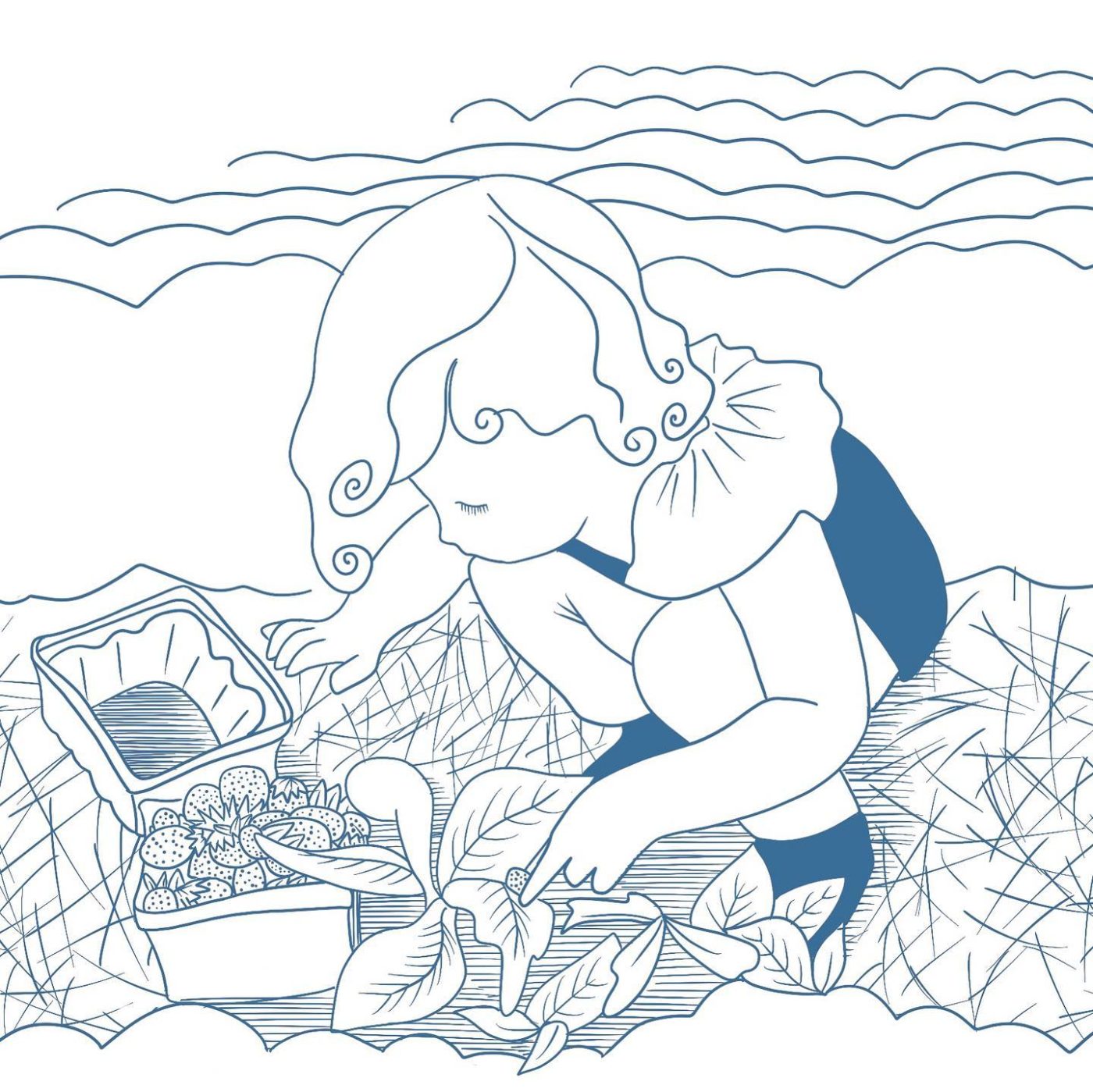
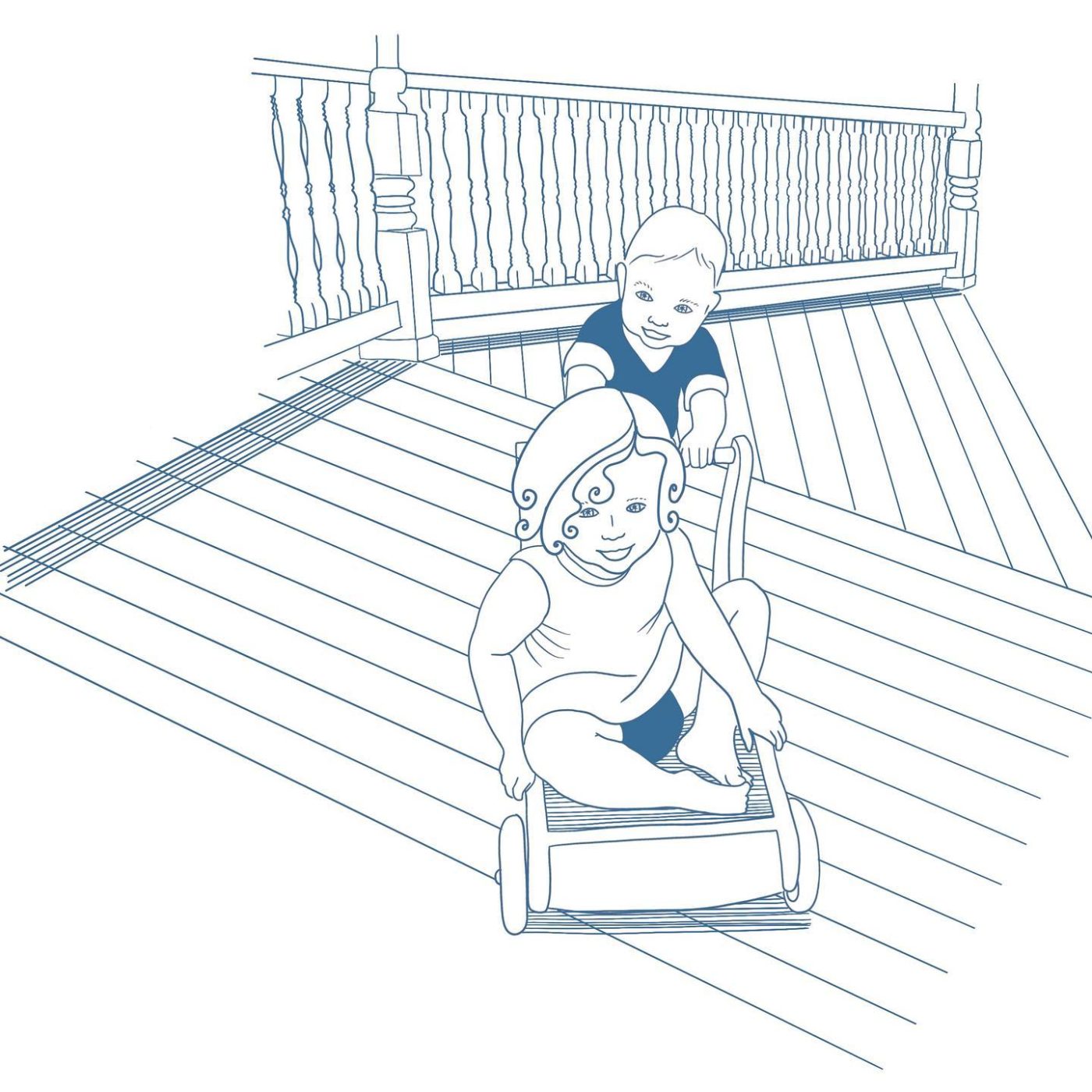
For Christmas, she pulled photos of my kids off Instagram and made this fabric:
Somehow, this pattern manages to maximize cuteness, tastefulness, and versatility. Fully personalized, just stuff she found on my Instagram.
I think people would pay for this (and she would want that). I’m curious if the price that feels fair to the consumer would be enough…
The reason I think it works as a product is that it’s one-of-a-kind but totally repeatable. Send photos, Liz makes the pattern, choose color and items—sheets, napkins, wallpaper—there’s an issue of proofing and “notes” which add to the cost—but this is a serious amount of work…
I have very few followers and I’ve never done a poll, but if you were going to pay for a custom designed pattern based on your photos, which pricing method feels best?
Flat rate for pattern design, items a la carte?
Minimum order size and 100% for design?
Here’s a side-by-side of a photo I took and how she treated it. It’s just so cool. If there are any people with business knowledge in this space that could help my sister evaluate the opportunity, I would be most grateful if you hit her up: https://www.elizabethand.co/.




-
Political “Games”
I can’t get away from games/sports analogies when discussing democracy and economics and friends have told me it leaves a bad taste in their mouths.
“This isn’t a game.”
Honestly, I think it IS a game, and that’s not a pejorative. Games are really, really important. Thread. 👇
What is a constitution or a set of laws if not rules for a game we can agree that we’re playing to cultivate or lose power and influence without resorting to brute force violence?
Even animals have games. Games are foundational.
Certainly, games can be terribly designed, like this current type of capitalism or like a government run completely by private campaign donations and a revolving door of hard regulatory capture and soft corruption, but that just means the rules need to be amended.
In a representative democracy, it’s critical that voters (the fans) are invested in the game. The rules can be dumb, the Yankees can have 10x the money as everyone else but when THE PLAYERS THEMSELVES (the representatives) can’t be trusted, the fans lose all interest in the game.
One of the reasons sports are so popular everywhere is because it’s the one place where everyone is playing by the same rules and where even underdogs can win. For too long our democracy has been an opaque box where popular things never pass and unpopular things pass unanimously.
There are some real opportunities ahead to reform this game (I really do believe that) but one thing we can start doing now, without any permission whatsoever, is simply play the game better. Draft better players, win more votes, meaningfully change lives, and then do it again.
There’s no way to win the game if we’re just distracted by our hatred of the other team’s fans. We need to remember that they’re not in the game and neither are we. They can do what they want to hold their team accountable. The only team we have any input on is our own.
https://twitter.com/zachphillips/status/1347299819677749250?s=21
-
The Cobbler’s Dilemma
“The cobbler’s children have no shoes” is a phrase that rings true for most businesses. My 8-year-old production house has no video about itself 🤦♂️.
The assumed reason is that we’re working on customer work so we don’t have time for our own. This assumption is wrong. 👇
The reason the cobbler’s children have no shoes isn’t because the cobbler is busy making shoes for customers. It’s because the cobbler is paralyzed by the impossible task of making shoes for her children.
This is The Cobbler’s Dilemma: “My children’s shoes must be THE BEST.”
“What will people think if my children’s shoes aren’t the very best shoes they’ve ever seen? I’m a cobbler! I better do a truly perfect job on these shoes and then I need to make sure my children wear them right and keep them clean and don’t pair them with the wrong outfit…”
This cobbler is totally screwed. There’s no way she’s ever going to make shoes for her children.
This type of perfectionist thinking is the surest way to never get a single thing done. Instead, she’ll shrug her shoulders and joke that “the cobbler’s children have no shoes.”
Meanwhile, the cobbler’s children have the best treehouse in town. She loves building treehouses almost as much as making shoes. She could’ve made 28 pairs of shoes in the time it took to build that treehouse.
But no pair of shoes could possibly be good enough for her children.
-
Social Media Monopolies as National Parks
It might be a fun few years for antitrust. The monopolies who control everything and who govern with absolute power might be the biggest reason we’re here.
I have one idea about what to do with a highly visible one like Twitter: Make it into a National Park. 👇
“Breaking up” a social media monopoly can only be accomplished in one way: By opening the protocol it runs on, returning ownership of the data to its users, and allowing them to portably take their data to any network that using the protocol. Anything less is tepid posturing.
This is why network-effect monopolies are so strong. The core value of the company is that so many people are on it (stuck using it). The product itself can objectively suck (Facebook) and it doesn’t matter. “Breaking it up” just creates a vacuum for another one.
In the case of most monopolies, the product being sold is a commodity but the company is proprietary. In the case of social media, the companies (and their shitty apps) are a commodity but their product (billions of entrapped users and their surveillance of them) is proprietary.
So as much as there are risks to nationalizing things, the government isn’t always great at stuff, etc., etc., the best way to deal with social media monopolies is to nationalize them, with strict regulatory oversight, privacy, and at least a chance of due process.
Twitter is perfect to use as a test case:
- It’s relatively small (<200m daily users) while still 100% a monopoly.
- Everything that makes Twitter great was built by its community: developers like @lorenbrichter and @iconfactory and users who invented @s, retweets, threads…
When Twitter becomes a National Park and the protocol is opened up for people to take their portable data to open communities (or stay on the main government one), Trump’s account can be cancelled because he broke 8,310 laws on it, not because Jack Dorsey is getting some heat.
If you’re as interested in monopolies and antitrust as I am, you should get on @MattStoller’s Substack (and follow him on here for strong shitposting). He would almost certainly think this thread is ridiculously dumb, but I posted it freely. Complain to @jack. He owns this shit.
-
An Honest Reckoning
There is nothing interesting or helpful that I, a Blue team voter, can say that shames, insults, or belittles a Red team voter.
Not because I need to somehow cater to the Red team voter, but because Red team voters are 100% irrelevant, and so am I. A thread. 👇
Whether I like it or not (I don’t), in this ineptly designed two-party plutocracy, I vote for the Blue team.
Even though I hate 88% of what they do, they can rely on my vote no matter what… because I hate 99% of what the Red team does.
Also, culture and stuff. Good Reasons.
The problem on both sides (but especially mine) is that the people who VOTE for the team think they are ON the team.
I have news: That’s not how representative democracy works. If you aren’t running, elected, appointed, or working on it, you’re not on the team…
You’re a fan.
As a reliable voter for the Blue team, I am nothing more than a fan watching the game. I have no power other than to cheer, boo, and yell at the GM to fire the coach or draft a new star player.
I will reliably root (vote) for my team and so I am irrelevant to the game’s outcome.
Representatives are the players. Their job is to WIN. Winning means getting elected NO MATTER THE CONDITIONS, advancing popular and effective policy, and then getting reelected.
Representatives are 100% responsible for all of this because they are the ones with or seeking power.
The Red team’s reliable voters are in the stands too. If I punch one of them in the face, I get taken out by security and the game goes on.
Almost the entire discourse from my fellow Blue team fans is the equivalent of dumping a beer on a Red team fan. Useless. At best.
The only thing that matters is WINNING THE VOTES of the people who could go either way or who may not vote at all.
There are tens of millions of these people. Winning their votes is The Game. There is no other game.
When you understand that winning votes is The Game and that you don’t matter, Trump fans don’t matter, that you’re all irrelevant, everything becomes about having the right players, running the right strategy, winning the votes, and enacting policies that make sure you win again.
When you hear someone yelling about the other team’s voters, the absurdity becomes crystal clear: “If they weren’t cheering so loudly, we would have won! If you cheer for the other team, you are a BAD person and NOT MY FRIEND ANYMORE.”
What are we doing?
And then things get really crazy: People blame VOTERS for their team losing (something Democrats do to voters they think are “theirs”) 🤦♂️.
This is exactly equivalent to “We would have scored more points if the ball wasn’t so STUPID. The other team ran so FAST! It’s not FAIR!”
Any cowardly politician or apparatchik who blames a single thing on voters should never be allowed to participate in politics again.
Win the votes, make things better, and then win again. That’s your job, and if you don’t even understand your job, you shouldn’t have the job.
One question, reacting to the current clusterfuck: How might we repair trust in our institutions and even basic facts after decades of relentless lying and grifting by our leaders?
One answer: Maybe try being honest 🤷♂️.
That’s a play I’d run. But I’m just a fan.
-
Airtable’s Missed Opportunity
One of the things that bothers me most (I often can’t sleep at night thinking about it) is a missed opportunity. Not my missed opportunity, but someone else’s.
The one I’m thinking about right now is the missed opportunity of one of my favorite products of all time: @Airtable 👇
Before I go into what I think Airtable has missed, let me start by saying that I was/remain one of its earliest/biggest fans. At a 2015 hackathon (when I used to go to hackathons), I built a CMS backed by Airtable that I called Airguitar which I went on to build many things with.
(side note on Airguitar: it never became a commercial product or left my own company’s use, and surely it would have had some trademark issues 😃, but also, Airtable’s colors were so much cooler back then… that’s not the missed opportunity, sorry for the digression.)
I legitimately believe that @Airtable belongs in the Hall of Fame of user interface design. Using its database for the first time was like watching Michael Jordan play basketball. The only other experience I’ve had in the same league is using @figmadesign. Both web apps. Bananas.
I’ve created hundreds of workflows (and fully-functioning applications) hacked on top of Airtable, not because Airtable made them easier, but because Airtable made them POSSIBLE.
But, in my opinion, Airtable went on to repeatedly make decisions contrary to their mission.
Airtable’s stated mission is “to democratize software creation by enabling anyone to build the tools that meet their needs.”
Airtable, right now, COULD enable this, but over and over, they have needlessly blocked toolmaking functionality in the most frustrating ways imaginable.
To be fair, Airtable is now a unicorn “worth” billions of dollars and I’m just a toolmaking-obsessed chump who sees a tool for toolmaking that is intentionally impaired by its own toolmaker, shaking my fist at the void.
There are too many examples of Airtable’s anti-toolmaker decisions to name here, but I will go over a few:
This first one may in fact be an honest oversight, but it doesn’t make sense because the Airtable team is Michael Jordan:
- The inability to link between bases.
My God, the Zapier hacks we have had to build to get around this, yet Airtable Sync somehow manages to be worse.
-
After building a regular-person-readable alternative database view, perfect for a Normy Dashboard, they released it as a marketing tool called Airtable Universe and didn’t give it’s far-more-usable interface to the toolmakers and the users of the tools themselves. 🤦♂️
-
User/API pricing remain a kaleidoscopic nightmare for actual toolmaker use.
To be clear, I love paying for software. It’s kind of a hobby of mine. But pricing should MAKE SENSE. Our team can do everything for $25/month but add a user field and it’s $400/month… What? https://twitter.com/harper/status/1272549461391290370?s=21
I’ve moved on now to build my own tool which I hope will achieve Airtable’s mission. Who knows, maybe I’ll run into the same problems they had that forced them to torture and rip the guts out of their most fervent believers and fans.
I wish I could have just used Airtable.
(also maybe add a simple messy page model (there are already “comments”) to each record so people can write some stuff (humans need messy places to write stuff) and embed table views and Airtable is suddenly a better @NotionHQ for what Notion is used for… easy peasy)
-
Unjustify Your Next Actions
I’ve been using todo lists/task management systems, in every form, for years. I’ve spent so much goddamned time learning methodologies that I could be a professor in them…
Yesterday, I had a breakthrough talking to @m_ashcroft. The truth is: I hate them all. Here’s why. 👇
Nothing will take the joy out of a task more than focusing on the success it could be a small part of. Project-based task management asks that we break the things we want to manifest into little bite-sized pieces that we can do in service of that Ultimate State of Completeness.
The mindset this creates is one of evaluating every activity in terms of its little tickbox that needs to be checked in order to contribute to the checking of a much bigger, badder tickbox.
In essence, it asks of every activity: Are you serving a Larger Goal? Are you JUSTIFIED?
Now we’ve successfully taken the experience of the present moment, the exploration of our activity, and all possible fun that might be, and transformed it into a square Unit of Productivity for The Future (a Future in which, presumably, we will be justified ourselves, worthy).
Obviously, for medium-to-large things to get done, it’s helpful to break them down into smaller steps, but to create a more humane system of project/task management, a missing step is to UNJUSTIFY each broken down action: How could this task be performed for its own sake?
Of course, we (sickos like me) can make any process into more Work, including this one. To avoid the temptation to go through a project and ▢ UNJUSTIFY EVERY ACTION, simply unjustify the next one. How does my next activity need nothing at all to be “worth it”? No outcome, even.
Both the simplest and the most difficult part of the trick is contained in the concept of “worth it” itself. There’s a LOT of culture and psychology and cultural psychology tied up in that concept.
Maybe the concept of “worth it” itself is the problem.
Anyway, this is actually how I’ve been treating some of my most “important work” for some time now without realizing it.
It turns out, doing things this way, I’ve never been 1/10th as productiv—THE DOOR TO ALL AWARENESS AND PLAY AND ENJOYMENT SLAMS CLOSED, ETERNALLY, ONCE MORE
-
Bean Dad Defense
I’ve witnessed people I know get “cancelled” and we’ve all seen celebrities (strangers) get cancelled, but the case of @johnroderick is the first time it’s been someone I “know” (by way of 100s of hours of extremely personal podcasts). Something is very different about this. 👇
John Roderick is the guy who, both comically and tragically, is now known to most of Twitter as “bean dad” after he posted a thread of a parenting story that made a lot of people extremely angry. Then someone went word-searching through old tweets and, well, there were tweets.
On the parenting story: If you have kids and you’re trying… you try things and you get some wrong. All kids are different and you literally cannot avoid getting things wrong. Knowing John’s storytelling, I didn’t find controversy in the can opener story, but I see why many did.
On the old tweets, let’s take them category-by-category:
First, he used the F-word, clearly playfully because John is bisexual. Of course this is an offensive word, but as a queer person himself, John is afforded some agency over its use.
Second, there were “Jews rule the world” tweets. Without context, these look really bad. But if you take 11 seconds to look into it, you find out that this is a bit to CALL OUT antisemitism. John has aped conspiracy theorists and their ultimately ubiquitous antisemitism forever.
Third, he used the N-word in one tweet. He says in the tweet that he’s making a point about the elastic power of words/slurs.
This was really bad and he should apologize for it, but it’s hard to argue he intended it maliciously. It was a bad and wrong attempt at the opposite.
Fourth, he made jokes about rape in the form of “I’ll rape you.” This is obviously super offensive and bad and he should apologize.
Lastly, he used the R-word and said ableist shit. He should apologize and so should a lot of us (we’ve barely scratched the surface on ableism).
Here I am, seven tweets into a thread and trying to provide context for a guy who is now so radioactively demonic that his trending story almost beat out a recorded phone call where Donald Trump literally tried to shake down Georgia’s election.
This is a big problem.
John Roderick may be the best (spoken word) storyteller I’ve ever heard. He may be the most passionate about human capacities for good and evil and how those have created our history. He may also be the most earnestly generous person with his own feelings and experience.
He’s also a drug addict sober 20+ years. He’s bipolar. He seems to be bad at romantic relationships. Extremely self-loathing, never feels good enough. He seems to spend most of his waking moments thinking about what’s wrong with the world and progressive ways of fixing it.
On one hand, John did this to himself, which is an assessment that’s (somewhat surprisingly) easy to make with those you are close to.
On the other hand, there’s the matter of his deserved punishment/backlash, which is a very easy judgment to make about 1-dimensional strangers.
John Roderick is not someone I know, but he definitely isn’t a stranger either.
The one thing that’s somehow clearer in this in-between scenario: He is a LOT more than “bean dad.”
-
How to Roll Your Rs
Are you an English-speaking grown-up who never learned to roll your Rs? Do you avoid speaking beautiful languages like Spanish and Italian?
Here’s a thread on how to achieve luscious Rs as an adult. The key is contained within the blooper reels of The Fresh Prince of Bel-Air. 👇
As a child, I had a great ear for languages. I loved them, and to this day, if I were offered one superpower by a Power Genie, it would be hard not to choose “Understand and speak every language.”
But at the age of 18, I still could not roll my Rs. And no one could describe how!
One of the cruelest phenomena in nature is that people who intuitively understand how to do a thing are the ABSOLUTE WORST at teaching it. Kids who can understand immediately how to roll their Rs (and make cool machine gun noises, too!) are infuriating to those of us who can’t.
I discovered the solution to the R-rolling problem completely by chance:
Watching Fresh Prince bloopers (as one does), I came across a scene in which Carlton, CANNOT get this line out without creating an R roll: “But it’ll cut into my trick-or-treating time.” Over and over… 💡
So I tried it. I repeated the line slowly, over and over again—
“But it’ll cut into my trick-or-treating time… But it’ll cut into my trick-or-treating time…”
You may want to do this alone. You may sound a little crazy.
Going faster and faster: “But it’ll cut into my trick-or-treating time… But it’ll cut into my trick-or-treating time…” and suddenly(!)—“BUT IT’LL” became buh-rRrRrRr. I was rolling my Rs! I was MAKING THE SOUND.
I still needed those first two words as a crutch for some time.
Within a few days I no longer needed the “Buh” sound to start. I could roll my Rs at will.
This is THE way to learn to roll your Rs no matter what age you are. It will work if you’re willing to put in just a few minutes for a few days, unlocking sound and capability forever.

-
Complete Photography Course in 5 Tweets
I’m going to attempt to deliver a complete photography course in 5 tweets.
I originally made this on 5 index cards for my wife, corresponding to the 5 concepts you need to know.
In short: There isn’t much to it, and everyone should understand photography, particularly today. 👇
Concept 1: Aperture
Aperture is how much you open the lens to let light in. Common apertures run from 1.4 (open) to 22 (closed). Aperture works just like pupils. To see In the dark, open wider. In the sun, close down.
More open = blurry backgrounds (and harder to nail Focus).
Concept 2: ISO (or ASA)
The base light sensitivity of your film or camera. A higher ISO number means it’s more sensitive (needs less light) but also more grainy/“lower quality.” A lower ISO number means it’s less sensitive (needs more light) but is more smooth/“higher quality.”
Concept 3: Shutter Speed
How long the shutter is open. Big number (denominator) = faster speed. Small number = lets more light in, but movement blurs.
Correct Exposure (goldilocks point between totally dark and totally white) is a dance between ISO, Aperture, and Shutter Speed.
Concept 4: Focus
The distance from the camera (in feet/meters) that is the most in focus. You can think of this as a flat pane of glass exactly the Focus distance away from you. Everything closer to you, or further away, is less in focus than that pane. See also Aperture 👆.
Concept 5: Focal Length (and framing)
How wide (zoomed out) or how narrow your view is. We use 35mm film size as a basis for description. e.g. your iPhone’s lens is 28mm equivalent (slightly wide).
Basic Framing Tip: The subject should be prominent in the photo… MOVE CLOSER.
So that’s it: Everything you need to know about photography in 5 tweets. This applies equally to cinematography with one constraint/rule-of-thumb around shutter speed (it should generally be a 48th of a second, or double your frames per second). Here are the original index cards:

-
First Three Silent Retreats
One of the (relatively) minor things that I’m losing to COVID is my annual silent meditation retreat (I’d usually leave tomorrow). It’s a serious privilege to do it, 💵/🕓wise and that my wife (hates it but) lets me go.
Here’s a taste of what I learned at the first three. 👇
The first question most people ask about a silent retreat is “Wait, you can’t talk AT ALL?” That’s what attracted me to it. It sounded extreme, like maybe I could master something.
While Noble Silence (as it’s called) is really important, it stopped feeling extreme after a day.
Another attractive feature of Noble Silence is no phones/devices, which I was particularly interested in.
Inexplicably, this wasn’t enforced heavily where I was. There were people with phones. To me, that’s bananas. Devices are infinitely “noisier” than any voice could ever be.
My first ever silent retreat was 5 days at Wonderwell in New Hampshire with Lama Willa Miller and Anam Thubten.
While I had practiced (some seasons more than others) for 15 years prior to the retreat, it’s a wholly different experience practicing 6-10 hours a day for ~a week.
At my first silent retreat, I confirmed what I had only surmised or theorized in years of practice: That I am not, in fact, my thoughts. The final confirmation was in a moment of deep discomfort and true anger… that I found fascinating, funny, and knew I could watch forever.
It’s a cliché that meditation experiences can’t be adequately explained in words, only pointed toward, but I finally understood the truth of this after that retreat with Anam Thubten and Willa Miller. They helped weaken, for the first time, my attachment to intellectual mind.
At my second silent retreat, this one 7 days with Lopon (now Lama) Liz Monson, Camille Hykes, and Bob Morrison, I learned that there are no bounds to Awareness, nothing to develop, no effort to “get there.” Complete Awareness is our natural state. Practice is just noticing.
At my third silent retreat, this one with Lama John Makransky, Lama Liz Monson, and Bob Morrison, something broke in me. While I am an atheist (seeing no evidence of any deities), I had an experience equivalent to a sudden belief in God. No practical distinction. I’ll explain…
What became clear to me is that the source of every feeling, sensation, thought, care, fear, love, worry, and action was 1. not me and, 2. (the kicker) something like pure compassionate energy. With zero effort. The natural state. Nothing to cultivate. Now I see it everywhere.
I don’t know what I would have learned at this year’s retreat, but I’m trying to do something like it with a few workday-long solo retreats at our church (my wife likes church, I’m warming to it).
I’ll likely write more about meditation in the future and the techniques that have worked for me. I have a lot of opinions about accessible methods to get into practice. But I really can’t recommend a silent retreat enough, to anyone. I mean, why wouldn’t you do it if you could?