HumanLabel
Everything you own was made by someone. This is the database that helps you meet them.
Everything you own was made by someone. Your coffee, your phone, the chocolate bar at the register: each one passed through real hands in real towns before it reached yours. HumanLabel is a source-backed database of those people: who makes a product, where they live and work, what they’re paid, and how that compares with the brand on the next shelf, with every single fact traced to a public source you can check yourself.
A barcode already tells the checkout system everything it needs to know. It tells the human holding the thing nothing. HumanLabel is the missing label, the human one.
The idea
Nutrition labels changed how we eat by making the invisible visible at the moment of choice. Nobody has done that for labor in a way normal people can actually use.
The way I said it in May:
“Eventually, when somebody searches this product, one of the first hits on Google would be its human label page — because we’ll make them so helpful, and beautiful, and full of interesting information about the humans behind making the products and what it means for them.”
That is the dream. A helpful page that answers the obvious human question: who made this, under what conditions, and how do we know? Not a score. A window. The page shows you the record and trusts you to judge, because you were always going to judge anyway. The only question was whether you’d have the context.
The source part is non-negotiable. A claim without a source is a mood. HumanLabel has to be useful to a shopper, but it also has to be useful to a librarian, a journalist, a labor economist, or a student trying to understand the chain behind ordinary objects.
The project, run through its own format
Human Label
Serving size: one working prototype, July 2026
Products in the catalog 10,000
Sourced public claims 23,810
Public sources behind one chocolate bar 25
Confidence labels direct record · probable · estimate
Moral scores 0
Public URL still tracing
Every count above comes from the build running on my machine tonight. The format is the thesis: facts, sources, and a plain grid. No verdicts.
What it looks like tonight
These are real screens from the working build, captured on my machine in July 2026. This is the software as it runs today, honest edges included.
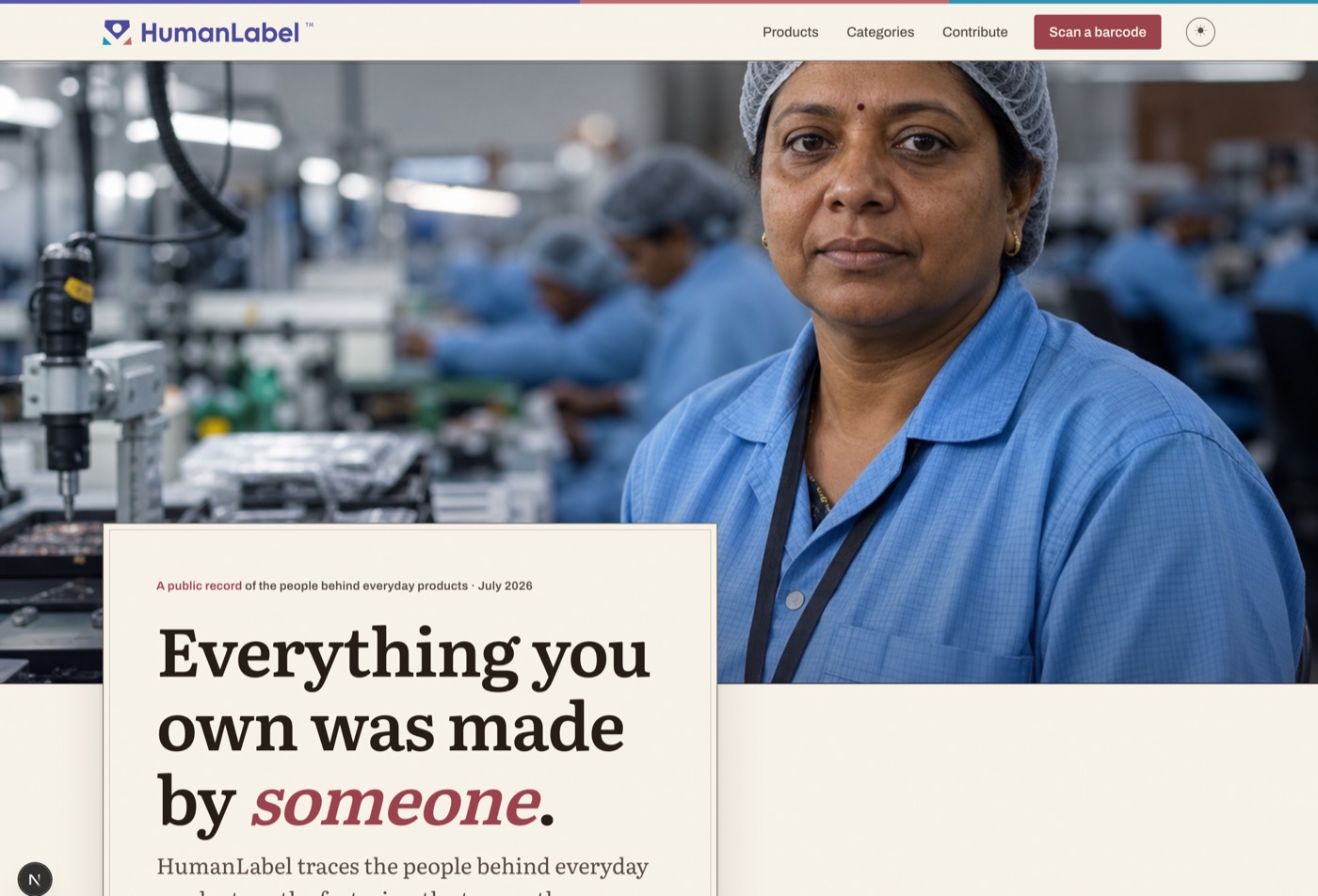
The front door. One honest footnote about this screen: the hero photo is a generated stand-in, filed in the build against a written art-direction spec. HumanLabel’s own rule is that real, licensed photography replaces it before anything launches, and that generated imagery is always labeled. The rule applies to the project’s own marketing too, so I’m labeling it here.
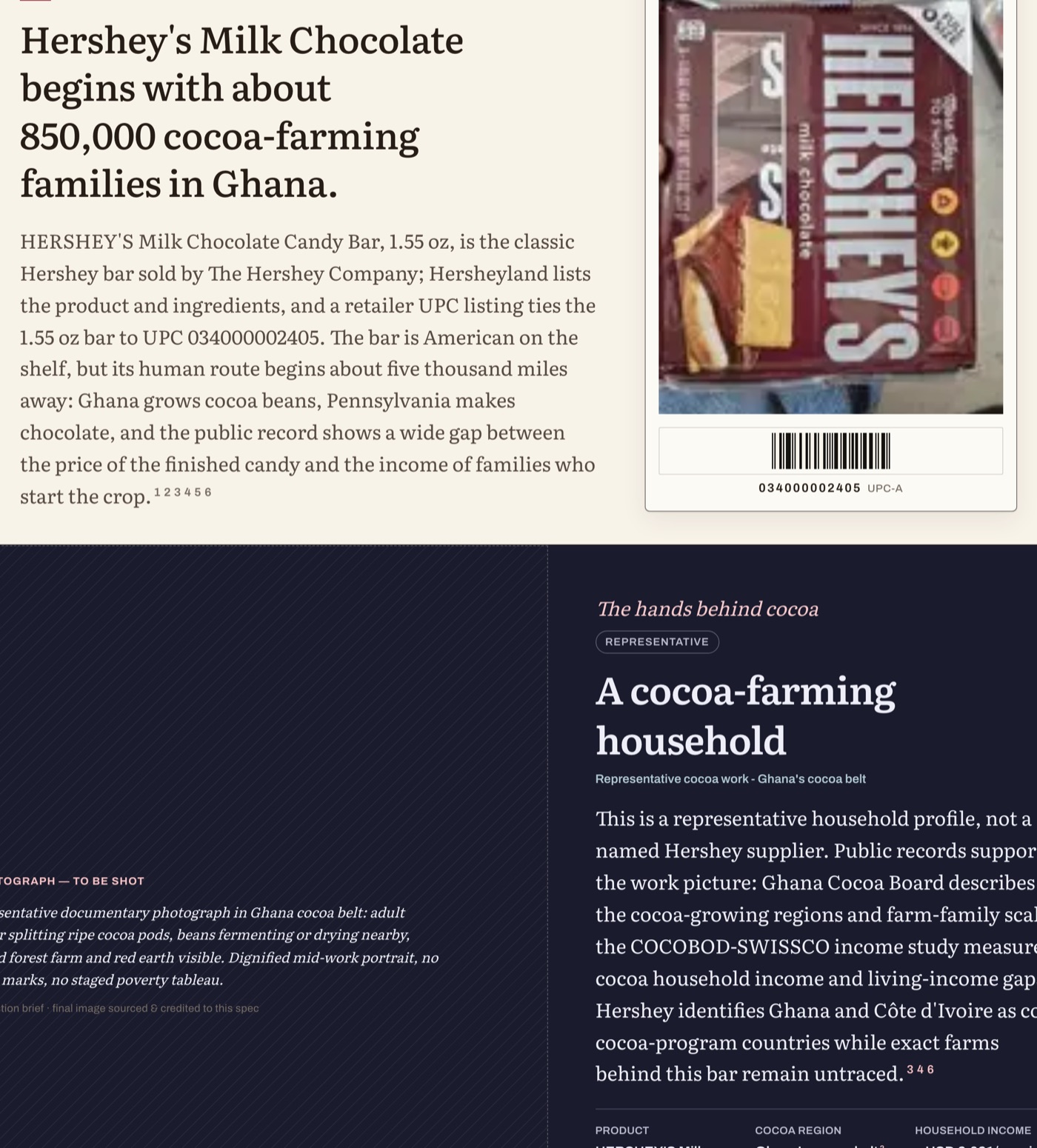
A product page opens like a story, not a spreadsheet. The flagship page traces the ordinary Hershey bar: it starts with the roughly 850,000 cocoa-farming families in Ghana, five thousand miles from the shelf where you meet it.

The journey: Ghana grows the beans, Pennsylvania makes the bar. Each stage carries the people and places the public record connects to it, with a confidence label, and unlabeled steps say plainly that they’re still being traced. The photograph is real and openly licensed, credit stored with the image.

The people who do this work: representative profiles, clearly labeled as such, assembled from public records. Household income studies, university research, union history. Where a licensed photograph hasn’t been sourced yet, the page shows the written brief for the photo instead of faking one. That’s the honesty rule working in public.

The pay, without a lecture: what a cocoa-farming household in Ghana actually earns against a living-income benchmark, and what comparable factory work pays in the United States. Each figure comes from a named study or the Bureau of Labor Statistics, and each is labeled a benchmark estimate where that’s what it is.
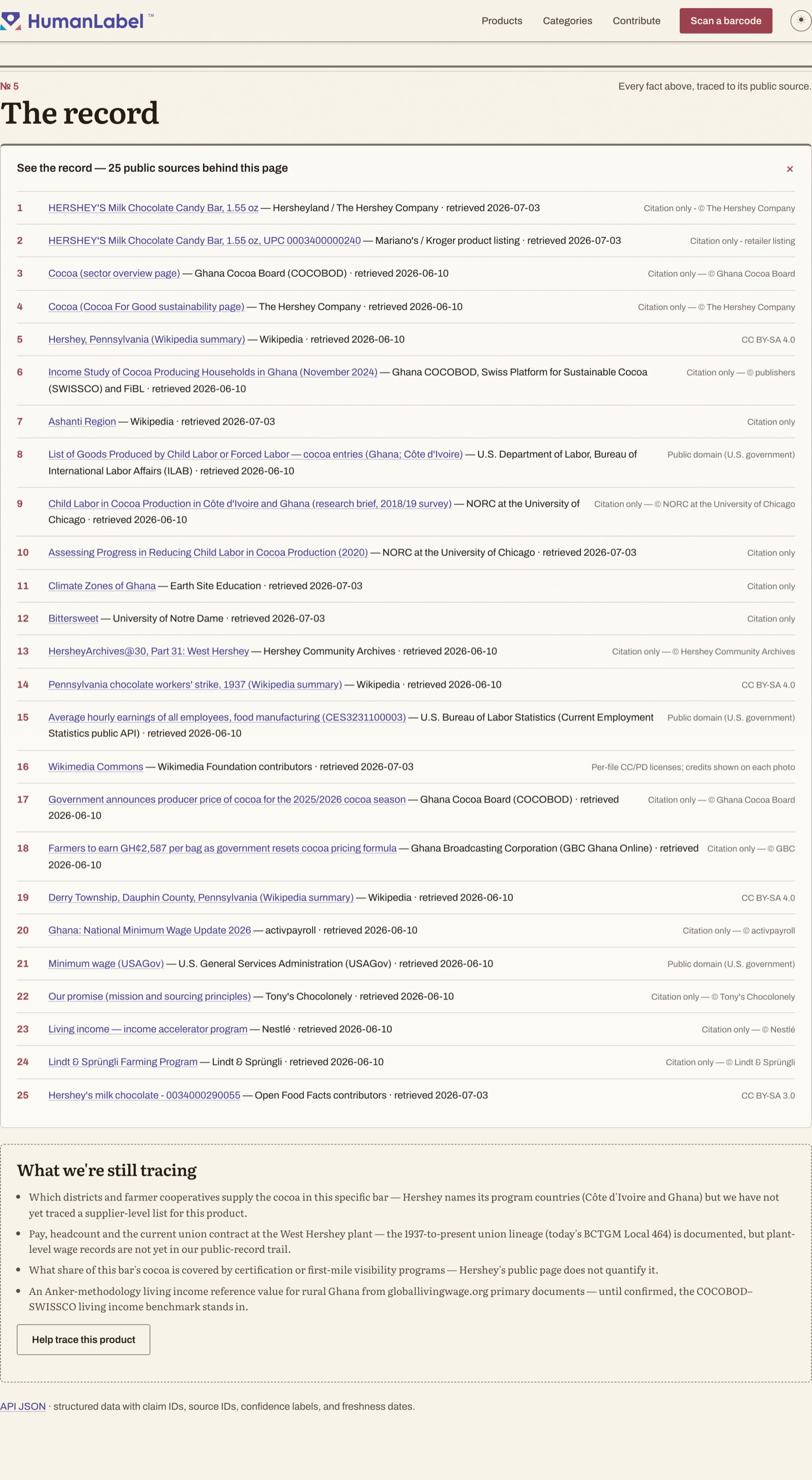
And underneath everything, the record: every source behind the page, with publisher, retrieval date, and license, followed by a plain list of what is still untraced. This is the part I care about most. The page earns trust by showing its work, including the gaps.
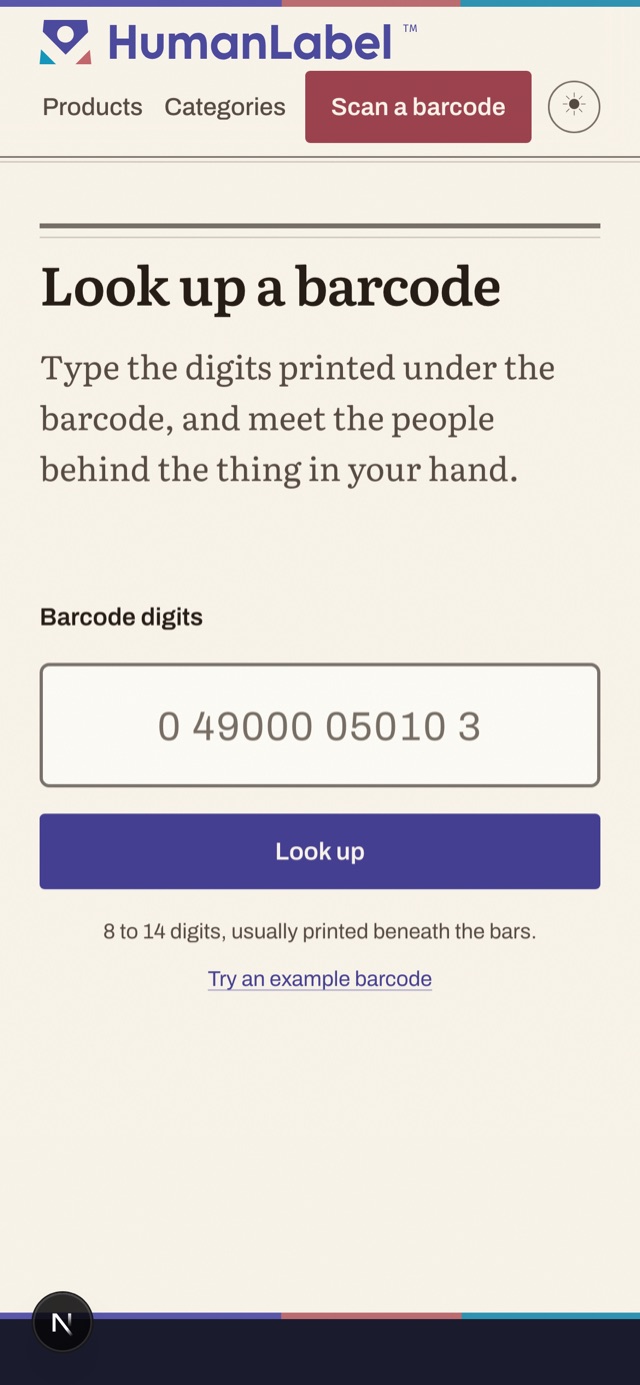
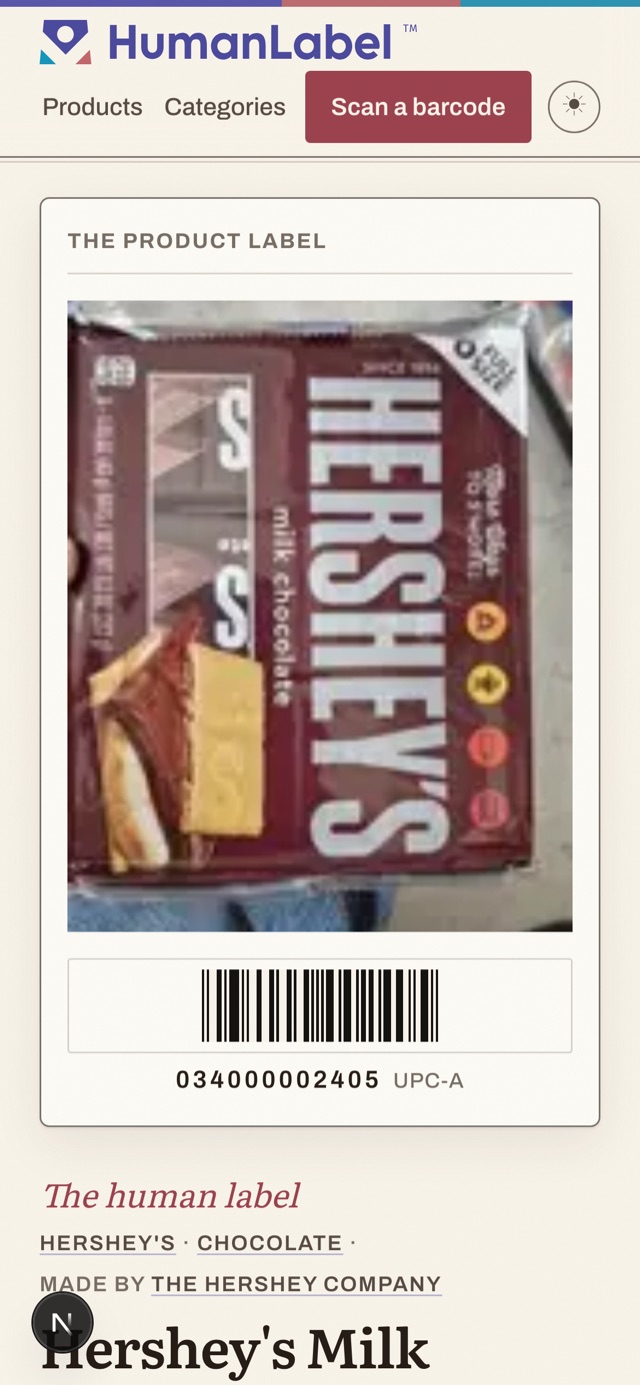
Built for the aisle: type the digits under any barcode and the product’s human story opens, one-handed, on a phone. An iOS scanner app exists as a dev build. Point the camera at the bars instead of typing.
What exists today
- A working tracer v0 that runs on my machine. A real web app, not a deck.
- 10,000 real products in the catalog snapshot, drawn from open sources: Open Food Facts and Open Beauty Facts, USDA FoodData Central, Wikidata, and CPSC records.
- 23,810 sourced public claims, each carrying a source, a confidence label (direct record, probable, or estimate), and a freshness date.
- Story-driven product pages (the people, the journey, the pay, the record) with flagship traces for a chocolate bar and a cola, and seven hand-picked stories on the home page.
- Category “aisle” pages that compare the humans behind competing products.
- Barcode lookup on the web, plus an iOS scanner shell: camera in, story out.
- A contribution intake, so packaging, receipts, and first-hand knowledge enter the same evidence pipeline as everything else.
- Nightly agentic research runs that grow the catalog from open data, behind quality gates and a review queue.
- Public data exports and a JSON API per product. A database about accountability should not trap its own work.
- Open data only, always: sources are ingested where license terms allow, never scraped against a site’s terms of service.
The current version is less about having a giant catalog and more about proving the shape of one good page. If one chocolate-bar page can show labor stages, countries, wages, sources, and uncertainty without becoming unreadable, the model has a chance.
What it isn’t yet
HumanLabel is not launched. It is not on the internet. There is no public search engine, no moderation team, no legal review process for disputed claims, no contributor community, no formal entity, and no way to give it money. Outside the flagship stories, most of those 10,000 product pages are honest partial pages (“what we’re still tracing”), not rich stories.
The research quality bar is the hard part. Supply chains are messy. Companies hide things. Open data is uneven. Some claims are true in one year and false in another. Some stages are known generally but not product-specifically. A pretty page can accidentally imply certainty where only probability exists.
That is why I am not rushing it online. A labor database that overclaims would be worse than no database. It would train people to distrust the whole category.
Where it came from
The question is older than the prototype. In 2021 this began as a nonprofit idea, worked out with mentors who kept landing on the same thing while shopping: what is the human cost? The problem statement we wrote then still holds:
“Consumers are unknowingly contributing to inhumane labor practices, and a significant number of them would make different decisions if properly armed with understandable information they could trust.”
The founding intent was non-judgmental transparency: empathy for buyers, for workers, and for the companies trying to make a profit in the world. Inform, support, allow choice. Never stigmatize. The 2026 build is that same idea with five more years of conviction and much better tools.
Where it’s going
The plan is to make HumanLabel good enough that a product search can surface a page people actually want to read. Helpful. Beautiful. Full of sourced information about the humans behind making the product and what it means for them.
The near-term work is catalog depth, source discipline, and contribution review. I want researchers, labor economists, librarians, and supply-chain people involved before this becomes public enough to matter.
The research method is not a trade secret, and it will not become one. How to trace the humans behind a product, how to label uncertainty honestly, how to keep a record from turning into a verdict: that recipe gets published free on the Pantry as I write it up, because a transparency project with a hidden method would be a joke at its own expense.
I am featuring it big anyway because saying the dream out loud is how the right people find it. Some projects need secrecy. This one needs standards, taste, and people who will argue with the claims before the world sees them.
Questions I actually get
Is HumanLabel live? When can I use it?
No, and I'm not promising a date. It runs on my machine; there is no public URL yet. There's an intended domain, but it isn't attached to anything today, and I don't want to imply there's a public product when there isn't. The launch list at the bottom of this page exists for exactly one announcement: the day that changes.
Where does the data come from?
Open sources, ingested only where license terms allow: Open Food Facts and Open Beauty Facts, USDA FoodData Central, Wikidata, and CPSC records for the catalog, plus public labor records for the stories: Department of Labor ILAB lists, the COCOBOD–SWISSCO household income study, NORC research, BLS wage series, union history archives. The chocolate-bar page alone stands on 25 public sources, each listed with its retrieval date and license.
How do you know a claim is true?
I don't ask you to take my word. That's the whole design. Every claim carries its source, a confidence label (direct record, probable, or estimate), and a freshness date. Not every claim is equally strong; the point is that the page tells you what kind of claim it is and where it came from, so you can inspect the evidence yourself.
Why no ethics scores or boycott lists?
Because HumanLabel is a record, not a verdict. The line in the build is: "We report records — we don't score morality." It shows wages, places, records, and sources, and trusts the reader. Sensitive labor facts are always attributed records ("the Department of Labor lists…"), never HumanLabel's own accusation. The moment it starts scoring, it becomes one more campaign to tune out.
Who are "Ama, 42" and the other people on the pages?
Representative profiles, clearly labeled as representative: a way to picture the work, assembled from public records like income studies and labor research. They are never fake named real individuals. When a page can stand on a real, named, consenting person's story, it will say so and cite it like everything else.
What about the photos?
Real, openly licensed photographs with stored credit and license. Where one hasn't been sourced yet, the page shows the written art-direction brief instead of faking it. You can see "PHOTOGRAPH — TO BE SHOT" briefs in the screenshots above. Generated imagery, where it appears at all, gets labeled as what it is.
What happens when I scan a barcode?
Today: you type the digits printed under the barcode and the product's human story opens. A dev-build iOS app does it with the camera. The aisle is the whole design target: one hand, weak store Wi-Fi, ninety seconds between you and the register.
What if a product's page is mostly empty?
Then it says so, plainly. Most of the 10,000 products are honest partial pages today. Unknowns are framed as "what we're still tracing": the edge of the map, not a broken page. I'd rather show the edge of the map than fake completeness, because the gaps are also part of the record.
Can companies pay to look better?
No. There are no partnerships, no sponsorships, and nothing for sale. A company will eventually be able to contribute evidence, through the same pipeline as everyone else, cited and labeled like everything else. Better treatment is not a product.
Is this a nonprofit?
Not yet, formally. It began in 2021 as a nonprofit idea and the spirit hasn't changed, but today it's a working prototype with no entity behind it. The structure gets decided when the thing is real enough to deserve one. If you've built or run a nonprofit and have opinions, I genuinely want to hear them.
How is this different from ethical-shopping guides?
It's a reference, not a campaign. Guides tend to score brands against a worldview; HumanLabel is non-ideological on purpose: product-level, source-backed, no moralizing. The bet is that granular, checkable, human information at the moment of choice does more than another verdict would.
Won't companies hate this?
Some might. But the founding intent includes empathy for companies trying to make a profit. The pages show programs and progress where the record supports them (the chocolate page cites the company's own $500M cocoa program alongside the child-labor records). A company doing right by its people has more to gain from this existing than anyone.
What's the moonshot?
That searching almost any product puts its human label page on the first page of results, "because we'll make them so helpful, and beautiful, and full of interesting information about the humans behind making the products and what it means for them." That's vision, not current fact. The current fact is a local prototype, a catalog snapshot, a claims pipeline, and a stubborn belief that ordinary product pages can tell the truth about the people behind them.
How can I help?
Three ways. Join the launch list below: one email, ever, when it goes live. Send expertise: I especially need people fluent in data licensing, labor economics, library science, and documentary photojournalism. And when it launches, contribute evidence (packaging, receipts, first-hand knowledge) into the same pipeline as everything else. There's no donate button because there's nothing to donate to yet; if you want to fund the tracing anyway, write me and we'll talk when there's an entity worth your money.
Get involved
The launch list is deliberately simple: email me and I add you by hand, the same way the newsletter works. You’ll hear from me exactly once, when there’s a URL to visit.
HumanLabel belongs on the projects map because it is a different kind of thing from Sherwood or Amber, but it comes from the same stubborn place: make the hidden structure visible, then let people choose with their eyes open.